
With a focus on actionable insights and strategic value, The Business Research Company’s 2026 market reports include market attractiveness scoring, total addressable market sizing, company benchmarking matrices, interactive Excel dashboards, deeper supply chain intelligence, emerging startup tracking, and granular product-level insights.
Satellite Attitude And Orbit Control System Market Size Forecast Points To $7.98 Billion In Revenue By 2030
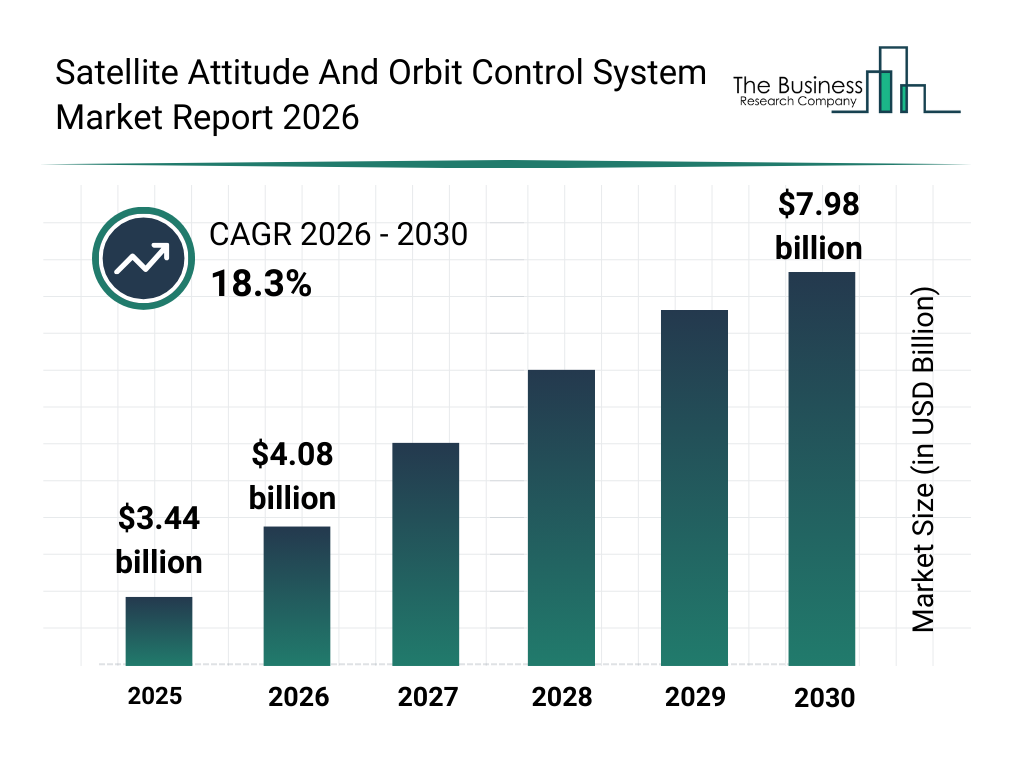
The satellite attitude and orbit control system market has seen significant expansion in recent years. It is forecast to grow from $3.44 billion in 2025 to $4.08 billion in 2026, reflecting a compound annual growth rate (CAGR) of 18.6%. The historical surge in this market can be attributed to several factors, including its deployment in early communication and observation satellites, the employment of gyroscopes for orientation, the reliance on thrusters for orbit correction, the implementation of star trackers for stabilization, and the increased integration of inertial measurement units (IMUs).
The satellite attitude and orbit control system market is anticipated to experience substantial growth over the next few years. It is forecast to expand to $7.98 billion in 2030, achieving a compound annual growth rate (CAGR) of 18.3%. This expansion during the forecast period is fueled by the creation of AI-driven orbit maintenance systems, their deployment in mega-constellation satellite networks, integration with autonomous satellite maneuvering, breakthroughs in precision pointing technologies, and the adoption of miniaturized sensors for small satellites. Key developments expected during this timeframe include a growing demand for precise satellite navigation and stabilization, increased integration of miniaturized control units for small satellites, a rising reliance on electric propulsion for orbit control, the advancement of sophisticated star trackers and high-accuracy sensors, and an increase in satellite launch volumes across commercial constellations.
Get A Free Satellite Attitude And Orbit Control System Market Sample Covering Drivers, Trends And Key Players:
Satellite Attitude And Orbit Control System Market Driver Analysis: Key Factor Supporting Revenue Growth
The increasing use of communication satellites is anticipated to fuel expansion within the satellite attitude and orbit control systems market in the coming years. These specialized satellites serve to transmit and boost radio telecommunication signals across different points on Earth. They play a vital role in worldwide communications, facilitating television broadcasts, phone conversations, internet access, and military communication networks. The widespread acceptance of communication satellites stems from their ability to provide global reach, facilitate long-range communication, offer broadcasting functions, and enable quick deployment. An attitude and orbit control system (AOCS) is indispensable for the effective operation of communication satellites. By ensuring the satellite’s correct orientation and stable orbit, the AOCS guarantees continuous and dependable signal transmission and reception, proper alignment of solar panels for energy, and its placement in the assigned orbital position, thereby delivering uninterrupted communication services over its entire operational lifespan. As an example, data from May 2023, shared by Kongsberg NanoAvionics, a small satellite manufacturer located in Lithuania, indicated that the global count of communication satellites orbiting Earth stood at 3,135. This figure accounted for 80% of all satellites, encompassing categories like earth observation, technology development, navigation, and space science. Consequently, the increased deployment of communication satellites directly contributes to the expansion of the satellite attitude and orbit control systems market.
Satellite Attitude And Orbit Control System Market Segmentation Framework: Major Segments At A Glance
The satellite attitude and orbit control system market covered in this report is segmented –
1) By Type: Attitude Control System, Orbit Control System
2) By Orbit Class: Geosynchronous Orbit (GEO), Low Earth Orbit (LEO), Medium Earth Orbit (MEO)
3) By Satellite Mass: 10-100 Kilogram (kg), 100-500 Kilogram (kg), 500-1000 Kilogram (kg), Below 10 Kilogram (kg), Above 1000 Kilogram (kg)
4) By Application: Aviation And Defense, Transportation, Other Applications
5) By End-User: Commercial, Military And Government, Other End-User
Subsegments:
1) By Attitude Control System: Reaction Wheel Systems, Magnetic Torque Systems, Thruster-Based Attitude Control, Inertial Measurement Units (IMUs), Gyroscopes And Star Trackers, Control Algorithms And Software
2) By Orbit Control System: Propulsion Systems (Chemical And Electric), Gravity Assist Maneuvers, Trajectory Correction Maneuvers, Orbit Maintenance Systems, Docking And Rendezvous Systems, Ground Control And Monitoring Systems
Latest Satellite Attitude And Orbit Control System Market Developments And Emerging Trends
Leading companies within the satellite attitude and orbit control systems market are prioritizing the creation of advanced solutions, such as the orbital insertion of demonstration satellites. These efforts aim to improve the accuracy of satellite positioning, enhance maneuverability, and prolong the functional life of satellites. A demonstration satellite is a spacecraft specifically engineered to evaluate and exhibit novel technologies, systems, or approaches in space, offering a testing ground to validate innovations prior to their integration into active missions. For instance, in March 2024, Axelspace Corporation, a Japanese space venture company, confirmed the successful launch and orbital placement of PYXIS, which is a demonstration satellite. PYXIS was positioned into a sun-synchronous orbit, circulating between 500 and 600 kilometers above the Earth’s surface. The satellite was deployed using SpaceX’s Falcon 9 rocket as part of the Transporter-10 rideshare mission, launched from Vandenberg Space Force Base in California.
Which Companies Are Shaping The Satellite Attitude And Orbit Control System Market?
Major companies operating in the satellite attitude and orbit control system market are Maxar Technologies Inc., The Lockheed Martin Corporation, Airbus SE, Honeywell International Inc., BAE Systems PLC, Thales Group, Safran SA, ViaSat Inc., Moog Inc., OHB System AG, Rocket Lab USA Inc., Millennium Space Systems Inc., GomSpace A/S, NanoAvionics LLC, Blue Canyon Technologies LLC, Jena-Optronik GmbH, AAC Clyde Space, Sener Aeronautica S.A., NewSpace Systems Pty Ltd., NGC Aerospace Ltd.
Dive Deeper Into The Satellite Attitude And Orbit Control System Market With The Full Report:
Satellite Attitude And Orbit Control System Market Regional Distribution: Where Is Revenue Concentrated?
North America was the largest region in the satellite attitude and orbit control system market in 2025. The regions covered in the satellite attitude and orbit control system market report are Asia-Pacific, South East Asia, Western Europe, Eastern Europe, North America, South America, Middle East, Africa.
Reach Out To Our Team:
The Business Research Company: https://www.thebusinessresearchcompany.com/
Americas: +1 310-496-7795
Asia: +44 7882 955267 & +91 8897263534
Europe: +44 7882 955267
Email us at: marketing@tbrc.info
Follow us on:
LinkedIn: https://in.linkedin.com/company/the-business-research-company
YouTube: https://www.youtube.com/channel/UC24_fI0rV8cR5DxlCpgmyFQ
Global Market Model: https://www.thebusinessresearchcompany.com/global-market-model

Wasay has over a decade of experience in market research, data modelling, and analytics, with prior experience at GlobalData and Decision Tree Consulting Services. At The Business Research Company , he leads research operations across syndicated studies, customized consulting engagements, and the Global Market Model platform. His professional experience includes supporting organizations such as Boston Consulting Group, KPMG, and Ernst & Young. Wasay holds a degree in Electronics and Communications Engineering, postgraduate management qualifications from International Management Institute Belgium and Indian School of Business and Entrepreneurship, and completed the Integrated Program in Business Analytics from Indian Institute of Management Indore.

