The Business Research Company’s 2026 market reports combine market attractiveness scoring, total addressable market sizing, company benchmarking matrices, interactive Excel dashboards, deeper supply chain intelligence, emerging startup tracking, and granular product-level insights to deliver research that is more actionable and strategically valuable.
SATCOM Transceivers Market Size Trajectory: Key Numbers Every Industry Stakeholder Should Know
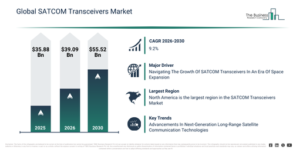
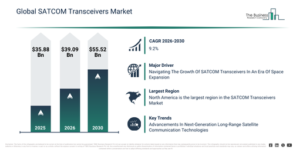
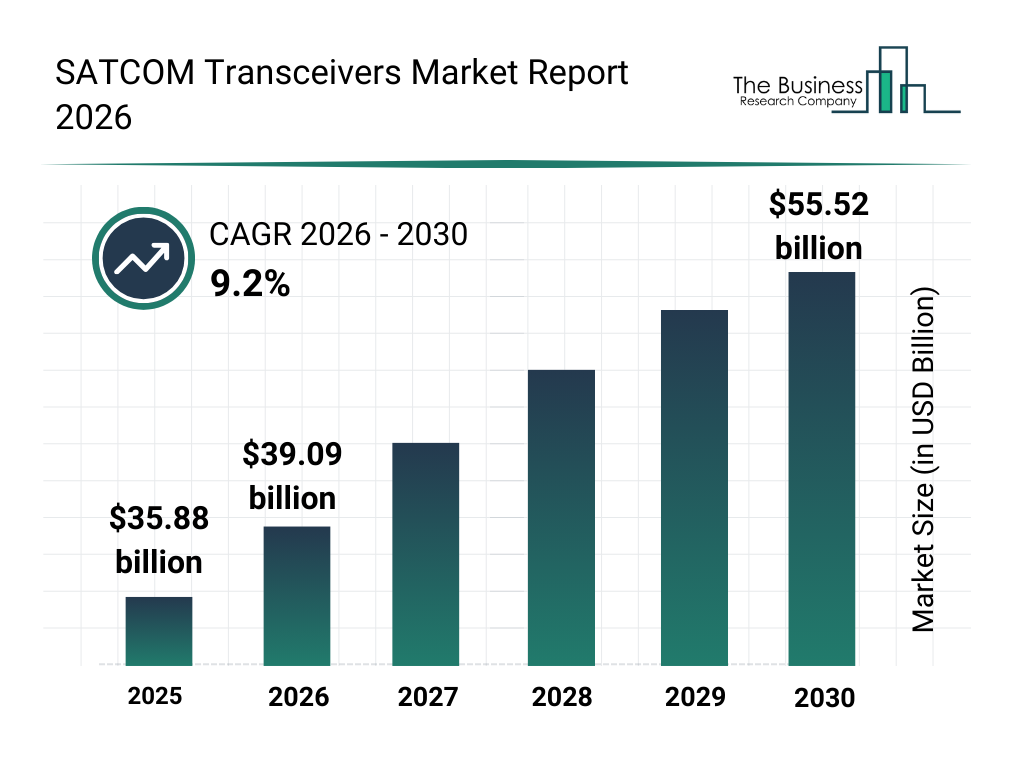
The satcom transceivers market has experienced substantial expansion recently. Projections indicate its size will increase from $35.88 billion in 2025 to $39.09 billion in 2026, demonstrating a compound annual growth rate (CAGR) of 8.9%. This historical growth is primarily due to several factors: a surging need for dependable long-haul communication in both maritime and aviation industries, continuous technological improvements in satellite transceiver hardware and signal processing, the increased integration of satcom transceivers in military and defense contexts, the development of disaster recovery and urgent communication systems, and the broadening of worldwide broadcasting and satellite-based data transmission services.
The satcom transceivers market size is projected to experience substantial growth over the next few years, reaching a value of $55.52 billion in 2030 at a compound annual growth rate (CAGR) of 9.2%. This expansion during the forecast period is attributed to several factors, including the integration of next-generation high-throughput satellites for accelerated data transmission, a rising demand for mobile and portable satcom transceivers, their increasing deployment in remote and underserved regions to provide internet connectivity, the development of advanced encryption and security features for secure communications, and the broadening application of satcom services across aerospace, maritime, and emergency response fields. Major trends expected in this timeframe encompass the miniaturization of transceivers for low size, weight, and power (SWAP), the growth of LEO/MEO constellation terminals, the adoption of flat-panel and phased-array antennas, the emergence of software-defined radios (SDR) and virtualized ground segments, and ongoing regulatory and spectrum harmonization efforts for satellite services.
Looking For Reliable SATCOM Transceivers Market Data? Request A Free Sample:
What Is Behind The Rising Demand In The SATCOM Transceivers Market?
An increasing volume of satellite launches is anticipated to boost the expansion of the SATCOM transceivers market in the future. Satellite launches involve deploying satellites into space via a launch vehicle or rocket, either for Earth orbit or for missions to other celestial bodies. This rise in satellite deployments is attributable to factors such as government investment, reduced expenses, swift development timelines, and broad applicability. A SATCOM transceiver facilitates immediate communication between satellites and ground control, enabling command execution, data relay, and continuous monitoring of the satellite’s condition. For example, data from June 2024, published by the US-based Satellite Industry Association, indicates that the commercial satellite sector experienced unprecedented growth in 2023, with 2,781 satellites launched, marking a 20% increase compared to 2022. Furthermore, the space industry reached a new benchmark with a record-breaking 190 total launches. By year-end, the count of operational satellites reached 9,691, demonstrating a 361% surge over the past five years. Consequently, the increasing frequency of satellite launches is a key factor propelling the expansion of the SATCOM transceivers market.
SATCOM Transceivers Market Segment Coverage And Subsegment Analysis
The satcom transceivers market covered in this report is segmented –
1) By Component: Navigation, Scientific Research, Communication, Remote Sensing, Other Components
2) By Frequency Band: K Band, C Band, X Band, Ku Band, Other Frequency Band
3) By Application: Air Traffic Control, Satellite Communication, Direct To Home, X-Ray, Electronic Countermeasure (ECM), Food Processing, Material Processing, Other Applications
Subsegments:
1) By Navigation: Global Positioning Systems (GPS), Satellite-Based Augmentation Systems (SBAS), Differential GPS (DGPS)
2) By Scientific Research: Earth Observation Satellites, Atmospheric Research, Space Science Missions
3) By Communication: Commercial Communication Satellites, Military Communication Satellites, Broadband Satellite Services
4) By Remote Sensing: Earth Imaging Satellites, Weather Satellites, Surveillance Satellites
5) By Other Components: Antennas, Modems, Signal Processors
SATCOM Transceivers Market Future Trends: Where Is The Industry Heading?
Leading companies operating in the SATCOM transceivers market are concentrating on developing sophisticated innovations, such as the unveiling of their fourth-generation LoRa technology, to boost long-range communication capabilities, optimize data transmission efficiency, and facilitate next-generation satellite connectivity solutions. The introduction of its fourth-generation LoRa technology denotes the release of an enhanced long-range, low-power wireless communication system. For instance, in March 2025, Semtech Corporation, a US-based semiconductor and Internet of Things (IoT) solutions company, introduced its LoRa Plus LR2021 transceiver with LoRa Gen 4 technology, which supports Sub-GHz, 2.4 GHz ISM, and licensed S-band networks. This transceiver allows for high data rate communication up to 2.6 Mbps for sensor data, audio, and image transfer, while concurrently maintaining low power consumption and backward compatibility, thereby representing a contemporary method to improve global SATCOM connectivity and enable intelligent IoT deployments across diverse industries.
SATCOM Transceivers Market Top Players List For 2026
Major companies operating in the satcom transceivers market are Hitachi Ltd., The Boeing Company, Airbus SE, Northrop Grumman Corporation, Mitsubishi Electric Corporation, Honeywell International Inc., Fujitsu Limited, NEC Corporation, Thales Group, L3Harris Technologies Inc., Viasat Inc., Cobham Limited, Rohde & Schwarz GmbH & Co. KG, SES S.A., Intelsat Ltd., Iridium Communications Inc., KVH Industries Inc., Comtech EF Data Corporation, AnaCom Inc., Intellian Technologies Inc., Advantech Wireless Technologies Inc., Skyware Technologies Limited, ACORDE TECHNOLOGIES S.A., Amplus Communication Pte. Ltd., ViaLite Communications LLC, Arralis Ltd.
Order Your Copy Of The SATCOM Transceivers Market Report 2026:
How Does The SATCOM Transceivers Market Vary By Region?
North America was the largest region in the SATCOM transceivers market in 2025. The regions covered in the satcom transceivers market report are Asia-Pacific, South East Asia, Western Europe, Eastern Europe, North America, South America, Middle East, Africa.
Reach Out To Our Team:
The Business Research Company: https://www.thebusinessresearchcompany.com/
Americas: +1 310-496-7795
Asia: +44 7882 955267 & +91 8897263534
Europe: +44 7882 955267
Email us at: marketing@tbrc.info
Follow us on:
LinkedIn: https://in.linkedin.com/company/the-business-research-company
YouTube: https://www.youtube.com/channel/UC24_fI0rV8cR5DxlCpgmyFQ
Global Market Model: https://www.thebusinessresearchcompany.com/global-market-model

Wasay has over a decade of experience in market research, data modelling, and analytics, with prior experience at GlobalData and Decision Tree Consulting Services. At The Business Research Company , he leads research operations across syndicated studies, customized consulting engagements, and the Global Market Model platform. His professional experience includes supporting organizations such as Boston Consulting Group, KPMG, and Ernst & Young. Wasay holds a degree in Electronics and Communications Engineering, postgraduate management qualifications from International Management Institute Belgium and Indian School of Business and Entrepreneurship, and completed the Integrated Program in Business Analytics from Indian Institute of Management Indore.