
Designed to make market research more actionable and strategically valuable, The Business Research Company’s 2026 market reports feature market attractiveness scoring, total addressable market sizing, company benchmarking matrices, interactive Excel dashboards, deeper supply chain intelligence, emerging startup tracking, and granular product-level insights.
How Fast Is The Ruminant Methane Reduction Market Growing? Market Size, CAGR And Forecast Insights
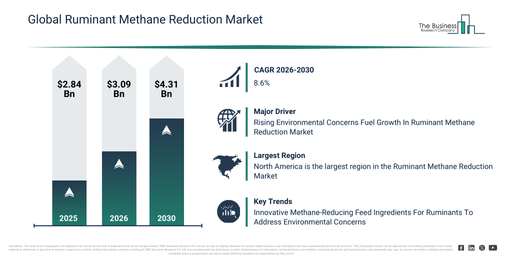
The ruminant methane reduction market has experienced robust growth in recent years. It is projected to increase from $2.84 billion in 2025 to $3.09 billion in 2026, at a compound annual growth rate (CAGR) of 8.9%. This past growth can be attributed to several factors including an expanding livestock population, traditional feed enhancement practices, early-stage research on methane inhibition, heightened awareness concerning greenhouse gas emissions, and the adoption of basic dietary supplements.
The ruminant methane reduction market is projected to experience robust expansion over the coming years, reaching $4.31 billion by 2030, driven by a compound annual growth rate (CAGR) of 8.6%. This anticipated growth is largely due to increasing global climate pledges, a heightened demand for livestock products with reduced emissions, wider implementation of seaweed-based additives, the proliferation of precision feeding technologies, and the creation of plant-derived methane inhibitors. Key trends expected during this period involve the uptake of natural feed ingredients designed to reduce methane, advancements in fermentation-targeted additive development, a greater incorporation of plant-based inhibitors into livestock diets, the growing inclusion of methane reduction strategies in standard farm management, and the broadening of specialized retail outlets for these solutions.
Unlock Ruminant Methane Reduction Market Insights With A Free Sample Report:
Ruminant Methane Reduction Market Momentum: Key Driver Expected To Boost Growth Through 2030
The escalating environmental concerns are anticipated to boost the growth of the ruminant methane reduction market moving forward. Environmental concerns pertain to issues linked to the detrimental effects of human activities and industrial processes on the natural surroundings. The heightened awareness of climate change and the financial consequences of environmental damage are intensifying these concerns, prompting both public advocacy and regulatory measures to tackle these problems. Ruminant methane reduction addresses environmental concerns by targeting a significant origin of greenhouse gas emissions, thereby alleviating climate change impacts and fostering more sustainable agricultural practices. For instance, in March 2024, according to the International Energy Agency (IEA), a France-based autonomous intergovernmental organization, in 2023, global energy-related carbon dioxide (CO2) emissions increased by 1.1%, equivalent to 410 million metric tons (Mt CO2) compared to 321 million metric tons in 2022, reaching a record high of over 37.4 metric tons in 2023, compared to 36.8 billion metric tons in 2022. Thus, the rising environmental concerns are driving the expansion of the ruminant methane reduction market.
Ruminant Methane Reduction Market Segments: A Category-By-Category Overview
The ruminant methane reduction market covered in this report is segmented –
1) By Product Type: Feed Additives Or Supplements, Dietary Supplements, Methane Inhibitors, Other Product Types
2) By Animal Type: Cattle, Sheep, Goats
3) By Distribution Channel: Direct Sales, Veterinary Clinics, Agricultural Cooperatives, Online Retailers, Specialty Stores
Subsegments:
1) By Feed Additives or Supplements: Probiotics, Yeast Culture, Tannins
2) By Dietary Supplements: Essential Oils, Seaweed Extracts, Fiber Supplements
3) By Methane Inhibitors: Chemical Methane Inhibitors, Plant-Based Methane Inhibitors, Enzyme-Based Methane Inhibitors
4) By Other Product Types: Fermentation Inhibitors, Nutritional Enhancers, Innovative Feed Formulations
Which Emerging Trends Are Gaining Traction In The Ruminant Methane Reduction Market?
Leading firms in the ruminant methane reduction market are concentrating on creating novel solutions, including methane-reducing feed ingredients, to improve product effectiveness and tackle environmental issues. These ingredients are defined as specific additives or supplements mixed into animal feed to decrease methane released during the digestion of ruminant animals like cattle, sheep, and goats. For instance, Elanco Animal Health Incorporated, a US-based pharmaceutical company specializing in pet and livestock medicines and vaccinations, obtained U.S. Food and Drug Administration (FDA) approval in May 2024 for Bovaer. Bovaer is a pioneering methane-reducing feed ingredient capable of reducing dairy cattle emissions by an average of 30% per cow per day. This significant approval signifies the FDA’s initial authorization of a product specifically engineered to lessen enteric methane emissions from dairy cows. With 3-NOP as its active ingredient, Bovaer functions by suppressing methane generation during digestion, potentially leading to a reduction of approximately 1.2 metric tons of CO2e annually per cow.
Ruminant Methane Reduction Market Key Participants: Prominent Companies At A Glance
Major companies operating in the ruminant methane reduction market are Cargill Incorporated, Yara International, Evonik Industries AG, Land O’Lakes Inc., Koninklijke DSM N.V., Nutreco N.V., Trouw Nutrition International B.V., Elanco Animal Health Incorporated, ForFarmers N.V., Lallemand Animal Nutrition, Phibro Animal Health Corporation, Volac International, Zinpro Corporation, Novus International Inc., AB Vista Limited, Calysta Inc., Agolin SA, Blue Ocean Barns Inc., CH4 Global Inc., FutureFeed Pty Ltd, Mootral SA, Rumin8 Ltd, Symbrosia Inc.
Get Detailed Ruminant Methane Reduction Market Forecasts In The Complete Report:
Top Region In The Ruminant Methane Reduction Market: A Global Perspective
North America was the largest region in the ruminant methane reduction market in 2025. The regions covered in the ruminant methane reduction market report are Asia-Pacific, South East Asia, Western Europe, Eastern Europe, North America, South America, Middle East, Africa.
Reach Out To Our Team:
The Business Research Company: https://www.thebusinessresearchcompany.com/
Americas: +1 310-496-7795
Asia: +44 7882 955267 & +91 8897263534
Europe: +44 7882 955267
Email us at: marketing@tbrc.info
Follow us on:
LinkedIn: https://in.linkedin.com/company/the-business-research-company
YouTube: https://www.youtube.com/channel/UC24_fI0rV8cR5DxlCpgmyFQ
Global Market Model: https://www.thebusinessresearchcompany.com/global-market-model

Wasay has over a decade of experience in market research, data modelling, and analytics, with prior experience at GlobalData and Decision Tree Consulting Services. At The Business Research Company , he leads research operations across syndicated studies, customized consulting engagements, and the Global Market Model platform. His professional experience includes supporting organizations such as Boston Consulting Group, KPMG, and Ernst & Young. Wasay holds a degree in Electronics and Communications Engineering, postgraduate management qualifications from International Management Institute Belgium and Indian School of Business and Entrepreneurship, and completed the Integrated Program in Business Analytics from Indian Institute of Management Indore.

