
Delivering more actionable and strategically valuable research, The Business Research Company’s 2026 market reports feature market attractiveness analysis, total addressable market evaluation, company benchmarking matrices, interactive Excel dashboards, expanded supply chain intelligence, emerging startup coverage, and detailed product insights.
Ruminant Methane Reduction Market Size Forecast: How Large Could The Market Become By 2030?
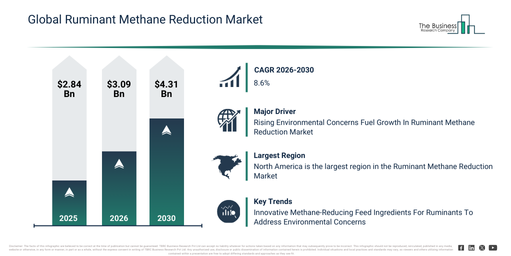
The ruminant methane reduction market has seen significant expansion in recent years. It is forecast to grow from $2.84 billion in 2025 to $3.09 billion in 2026, achieving a compound annual growth rate (CAGR) of 8.9. This past growth can be ascribed to a rise in livestock numbers, conventional feed enhancement techniques, early investigations into methane inhibition, increased recognition of greenhouse gas emissions, and the adoption of basic dietary supplements.
The ruminant methane reduction market is projected to experience robust expansion in the coming years, anticipated to reach a valuation of $4.31 billion by 2030, demonstrating a compound annual growth rate (CAGR) of 8.6. This projected increase is driven by factors such as increasing global pledges for climate action, a heightened consumer preference for low-emission livestock products, wider acceptance of seaweed-based feed supplements, advancements in precision feeding systems, and the introduction of methane inhibitors sourced from plants. Key developments expected during this period involve the incorporation of natural feed ingredients designed to reduce methane, an increase in the creation of fermentation-focused additives, greater utilization of plant-derived inhibitors in animal feed, a growing tendency to incorporate methane reduction strategies into standard farm operations, and the enlargement of specialized retail avenues for solutions aimed at methane reduction.
Download A Free Sample Report For Comprehensive Market Insights:
Ruminant Methane Reduction Market Growth Momentum: Which Factors Are Influencing Demand?
Growing environmental concerns are anticipated to drive the expansion of the ruminant methane reduction market in the coming years. These concerns pertain to issues arising from the detrimental impact of human activities and industrial processes on the natural environment. A heightened awareness of climate change and the financial consequences of environmental damage is intensifying these worries, prompting both public advocacy and regulatory actions to address them. Ruminant methane reduction offers a solution to environmental concerns by targeting a significant source of greenhouse gas emissions, thereby mitigating climate change impacts and fostering more sustainable agricultural practices. For instance, in March 2024, the International Energy Agency (IEA), a France-based autonomous intergovernmental organization, reported that global energy-related carbon dioxide (CO2) emissions in 2023 increased by 1.1, equating to 410 million metric tons (Mt CO2) compared to 321 million metric tons in 2022. This led to a record high of over 37.4 metric tons in 2023, compared to 36.8 billion metric tons in 2022. Consequently, the increasing environmental concerns are propelling the growth of the ruminant methane reduction market.
Ruminant Methane Reduction Market Segment Outlook: Which Categories Are Expanding The Fastest?
The ruminant methane reduction market covered in this report is segmented –
1) By Product Type: Feed Additives Or Supplements, Dietary Supplements, Methane Inhibitors, Other Product Types
2) By Animal Type: Cattle, Sheep, Goats
3) By Distribution Channel: Direct Sales, Veterinary Clinics, Agricultural Cooperatives, Online Retailers, Specialty Stores
Subsegments:
1) By Feed Additives or Supplements: Probiotics, Yeast Culture, Tannins
2) By Dietary Supplements: Essential Oils, Seaweed Extracts, Fiber Supplements
3) By Methane Inhibitors: Chemical Methane Inhibitors, Plant-Based Methane Inhibitors, Enzyme-Based Methane Inhibitors
4) By Other Product Types: Fermentation Inhibitors, Nutritional Enhancers, Innovative Feed Formulations
Ruminant Methane Reduction Market Trends Driving Strategic Industry Expansion
Companies active in the ruminant methane reduction market are concentrating on developing innovative solutions, such as feed ingredients that reduce methane, to enhance their products’ efficiency and address environmental concerns. Methane-reducing feed ingredients refer to specialized additives or supplements integrated into animal feed to lower methane emissions from the digestive processes of ruminant animals like cattle, sheep, and goats. For instance, in May 2024, Elanco Animal Health Incorporated, a US-based pharmaceutical company that manufactures medicines and vaccinations for pets and livestock, secured approval from the U.S. Food and Drug Administration (FDA) for Bovaer. This product is a first-in-class methane-reducing feed ingredient designed to decrease dairy cattle emissions by an average of 30 per cow per day. This significant approval marks the first occasion the FDA has authorized a product specifically engineered to mitigate enteric methane emissions from dairy cows. Bovaer, containing the active ingredient 3-NOP, operates by inhibiting methane production during digestion, potentially reducing emissions by about 1.2 metric tons of CO2e annually per cow.
Ruminant Methane Reduction Market Key Players And Strategic Industry Positioning
Major companies operating in the ruminant methane reduction market are Cargill Incorporated, Yara International, Evonik Industries AG, Land O’Lakes Inc., Koninklijke DSM N.V., Nutreco N.V., Trouw Nutrition International B.V., Elanco Animal Health Incorporated, ForFarmers N.V., Lallemand Animal Nutrition, Phibro Animal Health Corporation, Volac International, Zinpro Corporation, Novus International Inc., AB Vista Limited, Calysta Inc., Agolin SA, Blue Ocean Barns Inc., CH4 Global Inc., FutureFeed Pty Ltd, Mootral SA, Rumin8 Ltd, Symbrosia Inc.
Access The Complete Ruminant Methane Reduction Market Report:
Ruminant Methane Reduction Market Geographic Analysis: Where Is Demand Growing The Fastest?
North America was the largest region in the ruminant methane reduction market in 2025. The regions covered in the ruminant methane reduction market report are Asia-Pacific, South East Asia, Western Europe, Eastern Europe, North America, South America, Middle East, Africa.
Access a Customized Ruminant Methane Reduction Market Report for Deeper Competitive Insights
Get in touch with us:
The Business Research Company: https://www.thebusinessresearchcompany.com/?utm_source=BlogsPR&utm_medium=Paid&utm_campaign=home_page_test
Americas: +1 310-496-7795
Asia: +44 7882 955267 & +91 8897263534
Europe: +44 7882 955267
Email us at: marketing@tbrc.info
Follow us on:
LinkedIn: https://in.linkedin.com/company/the-business-research-company
YouTube: https://www.youtube.com/channel/UC24_fI0rV8cR5DxlCpgmyFQ
Global Market Model: https://www.thebusinessresearchcompany.com/global-market-model

Wasay has over a decade of experience in market research, data modelling, and analytics, with prior experience at GlobalData and Decision Tree Consulting Services. At The Business Research Company , he leads research operations across syndicated studies, customized consulting engagements, and the Global Market Model platform. His professional experience includes supporting organizations such as Boston Consulting Group, KPMG, and Ernst & Young. Wasay holds a degree in Electronics and Communications Engineering, postgraduate management qualifications from International Management Institute Belgium and Indian School of Business and Entrepreneurship, and completed the Integrated Program in Business Analytics from Indian Institute of Management Indore.
