
With a focus on actionable insights and strategic value, The Business Research Company’s 2026 market reports include market attractiveness scoring, total addressable market sizing, company benchmarking matrices, interactive Excel dashboards, deeper supply chain intelligence, emerging startup tracking, and granular product-level insights.
How Large Could The Polar Region Satellite Communications Market Become By 2030 At A 11.3% CAGR?
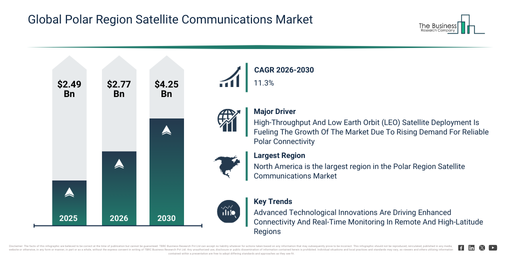
The polar region satellite communications market size has experienced rapid expansion in recent years. This market is anticipated to grow from $2.49 billion in 2025 to $2.77 billion in 2026, exhibiting a compound annual growth rate (CAGR) of 11.5%. The historical growth of the market can be attributed to several factors including the demand for connectivity in remote polar regions, the adoption of high-latitude satellite constellations, the increase in maritime and research expeditions, the use of portable communication units, and the requirement for secure polar communication links.
The polar region satellite communications market is projected to experience substantial expansion in the coming years. It will grow to $4.25 billion in 2030 at a compound annual growth rate (CAGR) of 11.3%. This anticipated growth during the forecast period is driven by factors such as the establishment of low-earth orbit constellations targeting polar regions, their incorporation into Arctic navigation and surveillance systems, the implementation of AI-powered communication optimization, increased support for polar resource exploration, and the broadening of emergency and disaster communication services. Key trends observed over the forecast period encompass the enlargement of low-earth orbit (LEO) constellations to cover polar areas, a heightened need for robust communication setups for Arctic maritime transport, an uptick in polar scientific investigations necessitating high-bandwidth data transfer, the increasing incorporation of portable satellite terminals for use in field operations, and the creation of high-frequency Ka- and Ku-band technologies designed for challenging weather conditions.
Get A Free Polar Region Satellite Communications Market Sample With 2030 Forecast Insights:
Polar Region Satellite Communications Market Outlook: Key Driver Supporting Long-Term Growth
The expansion in the deployment of high-throughput and low earth orbit (LEO) satellite constellations is projected to stimulate the growth of the polar region satellite communications market in the future. A low Earth orbit (LEO) satellite, defined as one orbiting the Earth at an altitude typically between 160 and 2,000 kilometers, offers capabilities for low-latency communication and high-resolution observation. The increasing prevalence of high-throughput and low earth orbit (LEO) satellite constellations stems from a rising need for swift, dependable, and low-latency connectivity, guaranteeing continuous communication and extensive coverage, particularly in isolated and underserved areas. These polar region satellite communications assist low earth orbit (LEO) satellite constellations by facilitating dependable and constant coverage in high-latitude and remote areas, thereby improving real-time communication and network performance. For example, data from February 2023, shared by the European Parliament, a France-based government body, indicates that as many as 170 low earth orbit (LEO) satellites could be constructed and launched between 2025 and 2027 for the infrastructure’s ground and space segments, with an additional approximately 20,000 satellites expected for deployment over the next ten years. Consequently, the expanding deployment of high-throughput and low earth orbit (LEO) satellite constellations is fueling the growth of the polar region satellite communications market.
Segmentation Of The Polar Region Satellite Communications Market: Key Categories Explained
The polar region satellite communications market covered in this report is segmented –
1) By Component: Hardware, Software, Services
2) By Platform: Ground Stations, Airborne, Maritime, Spaceborne
3) By Frequency Band: L-Band, S-Band, C-Band, X-Band, Ku-Band, Ka-Band, Other Frequency Bands
4) By Application: Defense And Military, Scientific Research, Oil And Gas, Maritime, Aviation, Other Applications
5) By End-User: Government, Commercial, Research Institutions, Other End-Users
Subsegments:
1) By Hardware: Satellite Antennas, Ground Terminals, Signal Amplifiers, Transceivers, Tracking Systems, Satellite Modems
2) By Software: Network Management Software, Data Analysis Software, Simulation And Modeling Software, Threat Detection Software
3) By Services: Installation Services, Maintenance Services, Monitoring Services, Consulting Services
Polar Region Satellite Communications Market Evolving Trends: What Businesses Should Know
Leading companies within the polar region satellite communications market are prioritizing advanced technological innovations, such as artificial intelligence (AI)-powered microsatellite surveillance, to equip governments, defense agencies, and research organizations with reliable, real-time connectivity and improved monitoring capabilities in distant, high-latitude areas. Artificial intelligence (AI)-powered microsatellite surveillance operates as a system where compact satellites employ AI algorithms to independently observe, analyze, and interpret data from remote or high-latitude regions instantaneously. For example, in June 2025, Space Inventor, a satellite engineering and manufacturing company based in Denmark, launched a Danish Arctic satellite. The BIFROST satellite, developed collaboratively with Terma, Gatehouse SatCom, DTU, and Unibap Space Solutions, provides space-based monitoring, target identification, and live event reporting across Greenland, the Arctic, and the North Atlantic. This initiative enhances situational awareness, supports military and emergency operations, and enables seamless data sharing between Danish and Swedish defense forces.
Who Competes In The Polar Region Satellite Communications Market? Major Companies Listed
Major companies operating in the polar region satellite communications market are Lockheed Martin Corporation, Raytheon Technologies Corporation, Northrop Grumman Corporation, Honeywell International Inc., L3Harris Technologies Inc., Viasat Inc., Thales Alenia Space, SES S.A., Eutelsat Communications S.A., Iridium Communications Inc., Cobham Limited, Telesat Canada, Hughes Network Systems LLC, Comtech Telecommunications Corp., Gilat Satellite Networks Ltd., KVH Industries Inc., Airbus Defence and Space, Springwise Ltd., China Great Wall Industry Corporation (CGWIC), Space Norway AS
Read The Complete Polar Region Satellite Communications Market Forecast Report Through 2030:
Polar Region Satellite Communications Market Regional Ranking: Which Geography Comes First?
North America was the largest region in the polar region satellite communications market in 2025. Asia-Pacific is expected to be the fastest-growing region in the forecast period. The regions covered in the polar region satellite communications market report are Asia-Pacific, South East Asia, Western Europe, Eastern Europe, North America, South America, Middle East, Africa.
Reach Out To Our Team:
The Business Research Company: https://www.thebusinessresearchcompany.com/
Americas: +1 310-496-7795
Asia: +44 7882 955267 & +91 8897263534
Europe: +44 7882 955267
Email us at: marketing@tbrc.info
Follow us on:
LinkedIn: https://in.linkedin.com/company/the-business-research-company
YouTube: https://www.youtube.com/channel/UC24_fI0rV8cR5DxlCpgmyFQ
Global Market Model: https://www.thebusinessresearchcompany.com/global-market-model

Wasay has over a decade of experience in market research, data modelling, and analytics, with prior experience at GlobalData and Decision Tree Consulting Services. At The Business Research Company , he leads research operations across syndicated studies, customized consulting engagements, and the Global Market Model platform. His professional experience includes supporting organizations such as Boston Consulting Group, KPMG, and Ernst & Young. Wasay holds a degree in Electronics and Communications Engineering, postgraduate management qualifications from International Management Institute Belgium and Indian School of Business and Entrepreneurship, and completed the Integrated Program in Business Analytics from Indian Institute of Management Indore.

