The Business Research Company’s 2026 market reports combine market attractiveness scoring, total addressable market sizing, company benchmarking matrices, interactive Excel dashboards, deeper supply chain intelligence, emerging startup tracking, and granular product-level insights to deliver research that is more actionable and strategically valuable.
Plasma Rocket Propulsion Market Size Review: What Shaped Past Growth And What Will Drive Future Expansion?
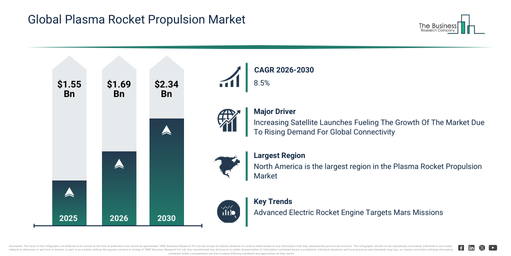
The plasma rocket propulsion market has experienced substantial growth in recent years. It is forecast to increase from $1.55 billion in 2025 to $1.69 billion in 2026, achieving a compound annual growth rate (CAGR) of 9.0%. The expansion observed in the past can be attributed to factors such as the increasing deployment of electric and Hall-effect thrusters for maintaining satellite positions, heightened government funding for plasma propulsion research and testing initiatives, the initial incorporation of ion thrusters into deep-space missions to enhance fuel efficiency, a growing need for satellite propulsion module enhancements to support extended mission durations, and the broadened availability of maintenance and technical support services for electric propulsion systems.
The plasma rocket propulsion market is anticipated to experience robust expansion over the coming years. It is projected to reach $2.34 billion in 2030, exhibiting a compound annual growth rate (CAGR) of 8.5%. This growth during the forecast period is driven by several factors, including the increasing implementation of plasma propulsion solutions for extended interplanetary voyages, a rising need for bespoke propulsion units tailored for compact satellites and large constellations, progress in high-power plasma generator technology enhancing thrust efficiency and dependability, the increasing commercial uptake of plasma propulsion advisory and integration offerings, and the broader application of advanced electric propulsion systems that facilitate quicker transit times for deep-space exploration. Key developments expected within this period include a greater uptake of plasma propulsion for missions exploring deep space, an escalating need for highly efficient electric propulsion systems for raising satellite orbits, continuous improvements in plasma generators leading to superior thrust-to-power ratios, the increasing incorporation of plasma thrusters into small satellites and cubesats, and the growth of specialized propulsion development services for commercial space operators.
Access Free Sample Pages From The Plasma Rocket Propulsion Market Report 2026:
Understanding The Main Driver Of The Plasma Rocket Propulsion Market
A surge in satellite deployments is projected to fuel the expansion of the plasma rocket propulsion market in the future. Satellite launches define the act of deploying artificial satellites into space via launch vehicles or rockets. This heightened demand for satellite launches stems from a growing global requirement for connectivity, as more regions pursue dependable internet access through satellite-based broadband services. Plasma rocket propulsion enhances satellite deployments by providing highly efficient thrust systems, which permit extended mission durations and accurate orbital modifications. This technology lowers fuel consumption while boosting operational performance, thereby fostering more sustainable and sophisticated space endeavors. For example, a report published by Space Foundation, a US-based non-profit organization, indicated in January 2025 that orbital launch attempts increased 16% in 2024, with 259 launches occurring at an average of one every 34 hours, a pace five hours more frequent than in 2023. Consequently, the rise in satellite launches is a key factor driving the growth of the plasma rocket propulsion market.
Plasma Rocket Propulsion Market Segment Mapping For 2026 And Beyond
The plasma rocket propulsion market covered in this report is segmented –
1) By Type: Electrothermal, Electromagnetic, Electrostatic
2) By Application: Spacecraft, Satellites, Space Probes, Other Applications
3) By End-User: Commercial, Military, Scientific Research
Subsegments:
1) By Electrothermal: Resistojet, Arcjet
2) By Electromagnetic: Magnetoplasmadynamic (MPD) Thrusters, Pulsed Inductive Thrusters (PIT), Helicon Double Layer Thrusters
3) By Electrostatic: Hall Effect Thrusters, Ion Thrusters, Gridded Ion Engines
What Key Trend Is Expected To Shape The Plasma Rocket Propulsion Market Over The Forecast Period?
Leading companies within the plasma rocket propulsion market are concentrating on creating novel solutions, including magnetic plasma accelerator-based electric thrusters, with the aim of boosting propulsion efficiency and facilitating extended space missions. These magnetic plasma accelerator-based electric thrusters leverage magnetic fields to propel plasma, generating thrust, and contribute to plasma rocket propulsion through their high efficiency and sustained performance capabilities. As an illustration, in February 2025, State Atomic Energy Corporation Rosatom, a Russian nuclear energy firm, unveiled a laboratory prototype of a plasma electric rocket engine intended for deep-space explorations, encompassing potential journeys to Mars. This particular engine incorporates a magnetic plasma accelerator that can produce a minimum of 6 Newtons of thrust with a specific impulse greater than 100 kilometers per second, functioning at an average power of 300 kilowatts in a pulsed-periodic operational mode. Such an advanced propulsion system enables spacecraft to attain considerably greater velocities than conventional engines while decreasing fuel usage by up to tenfold, potentially cutting the travel time to Mars to merely 30–60 days.
Plasma Rocket Propulsion Market Major Players And Industry Competition Overview
Major companies operating in the plasma rocket propulsion market are Lockheed Martin Corporation, Northrop Grumman Corporation, Blue Origin LLC, Moog Inc., Thales Alenia Space SAS, Airbus Defence and Space GmbH, OHB System AG, Sitael SpA, Phase Four Inc., ExoTerra Resource LLC, Exotrail SAS, Morpheus Space GmbH, Busek Co. Inc., Magdrive Ltd, Ad Astra Rocket Company, CU Aerospace LLC, ENPULSION GmbH, Howe Industries LLC, Neutron Star Systems UG, Orbion Space Technology Inc.
Full Plasma Rocket Propulsion Market Report: Market Size, Trends, Segments And Key Players:
Plasma Rocket Propulsion Market Geographic Segmentation: Regions Covered In The Report
North America was the largest region in the plasma rocket propulsion market in 2025. The regions covered in the plasma rocket propulsion market report are Asia-Pacific, South East Asia, Western Europe, Eastern Europe, North America, South America, Middle East, Africa.
Reach Out To Our Team:
The Business Research Company: https://www.thebusinessresearchcompany.com/
Americas: +1 310-496-7795
Asia: +44 7882 955267 & +91 8897263534
Europe: +44 7882 955267
Email us at: marketing@tbrc.info
Follow us on:
LinkedIn: https://in.linkedin.com/company/the-business-research-company
YouTube: https://www.youtube.com/channel/UC24_fI0rV8cR5DxlCpgmyFQ
Global Market Model: https://www.thebusinessresearchcompany.com/global-market-model

Wasay has over a decade of experience in market research, data modelling, and analytics, with prior experience at GlobalData and Decision Tree Consulting Services. At The Business Research Company , he leads research operations across syndicated studies, customized consulting engagements, and the Global Market Model platform. His professional experience includes supporting organizations such as Boston Consulting Group, KPMG, and Ernst & Young. Wasay holds a degree in Electronics and Communications Engineering, postgraduate management qualifications from International Management Institute Belgium and Indian School of Business and Entrepreneurship, and completed the Integrated Program in Business Analytics from Indian Institute of Management Indore.