With a focus on actionable insights and strategic value, The Business Research Company’s 2026 market reports include market attractiveness scoring, total addressable market sizing, company benchmarking matrices, interactive Excel dashboards, deeper supply chain intelligence, emerging startup tracking, and granular product-level insights.
Remote Sensing Observation Radars Market Size Outlook: A $3.28 Billion Market By 2030, Growing At 12.5% Annually
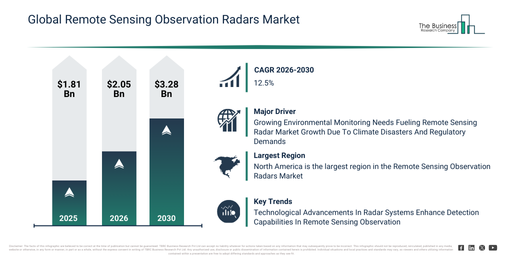
The remote sensing observation radars market has seen rapid growth in recent years. It is forecast to increase from $1.81 billion in 2025 to $2.05 billion in 2026, exhibiting a compound annual growth rate (CAGR) of 12.8%. This historical growth can be attributed to the growing adoption of radar imaging satellites for all-weather, day-night earth observation, the increasing use of remote sensing radars in environmental monitoring and climate research, the rising demand for disaster management support driven by frequent natural hazards, the early integration of radar data processing software to enhance image interpretation, and the expansion of defense and surveillance applications requiring long-range detection capabilities.
The remote sensing observation radars market is projected to experience swift expansion over the coming years. This market is forecast to reach $3.28 billion by 2030, exhibiting a compound annual growth rate (CAGR) of 12.5%. This anticipated expansion throughout the forecast period stems from several factors, including a heightened need for high-resolution radar imagery to aid precision agriculture and effective resource management, the increasing launch of advanced radar imaging satellites offering enhanced sensitivity and broader coverage, the wider integration of AI-powered radar data analytics for quicker and more precise findings, the enlargement of commercial remote sensing offerings for supervising infrastructure and urban planning, and technological progress that boosts multi-frequency and multi-polarization radar capabilities, thereby widening their potential applications. Key trends anticipated during this period encompass the growing application of all-weather remote sensing radar for disaster relief, a rise in the deployment of high-frequency radars for observing maritime activities, the broadening of aerial radar platforms for mapping agriculture, an increasing embrace of multi-band radar for overseeing urban infrastructure, and the creation of compact ground-based radar units for operational use in the field.
Make Data-Driven Decisions With A Free Remote Sensing Observation Radars Market Sample Report:
Key Demand Driver Expected To Lift Remote Sensing Observation Radars Market Revenue
The remote sensing observation radars market is expected to expand driven by the growing requirement for accurate environmental monitoring and effective disaster management. Environmental monitoring encompasses the systematic measurement and analysis of ecological characteristics, including climate trends, natural catastrophes, and changes in land use. The significant rise in environmental monitoring demands is attributed to an increase in climate-related disasters, as more frequent and intense wildfires, floods, and storms necessitate improved data for early warnings, disaster response, and long-term climate adaptation strategies. Remote sensing radars are beneficial for environmental monitoring because they offer centimeter-level measurement precision, day-night operation, and cloud-penetrating capabilities, which surpass optical systems for catastrophe prediction and ecological tracking. For instance, in January 2023, according to NOAA’s National Centers for Environmental Information, a U.S.-based federal scientific agency, in their Beyond the Data blog report, the United States experienced 28 separate billion-dollar weather and climate disasters, with cumulative damages exceeding $92.9 billion for the year. Thus, the increasing demand for precise environmental monitoring and disaster management is propelling the remote sensing observation radars market.
Exploring The Remote Sensing Observation Radars Market Through Its Key Segments
The remote sensing observation radars market covered in this report is segmented –
1) By Type Of Radar: Synthetic Aperture Radar (SAR), Reverse Synthetic Aperture Radar (RSAR), Pulsed Radar, Continuous Wave Radar (CWR), FMCW (Frequency Modulated Continuous Wave) Radar
2) By Platform Type: Satellite-Based Radars, Aerial-Based Radars, Ground-Based Radars, Marine Radars, Mobile Radars
3) By Frequency Band: Low Frequency (LF), Medium Frequency (MF), High Frequency (HF), Super High Frequency (SHF), Extremely High Frequency (EHF)
4) By Application: Agriculture, Forestry, Urban Planning, Disaster Management, Environmental Monitoring
5) By End-User Industry: Government And Defense, Aerospace, Telecommunications, Oil And Gas, Transportation And Logistics
Subsegments:
1) By Synthetic Aperture Radar (SAR): Spaceborne SAR, Airborne SAR, Ground-Based SAR
2) By Reverse Synthetic Aperture Radar (RSAR): Ground Surveillance RSAR, Maritime RSAR, Airborne Target Tracking RSAR
3) By Pulsed Radar: Doppler Pulsed Radar, Monopulse Pulsed Radar, Pulse-Doppler Radar
4) By Continuous Wave Radar (CWR): Basic Continuous Wave Radar, Frequency Shift Keying (FSK) Radar, Dual-Tone Continuous Wave Radar
5) By FMCW (Frequency Modulated Continuous Wave) Radar: Short-Range FMCW Radar, Medium-Range FMCW Radar, Long-Range FMCW Radar
New Trends Redefining Competition In The Remote Sensing Observation Radars Market
Leading companies within the remote sensing observation radar market are actively developing earth observation technology to improve climate resilience, enhance disaster management, optimize agricultural productivity, monitor deforestation, and bolster national security through advanced, all-weather, high-resolution surveillance capabilities. Earth observation technology refers to remote sensing systems, such as satellites, drones, and radars, that gather, analyze, and track data about the Earth’s surface, atmosphere, and oceans, supporting environmental, agricultural, disaster, and security applications. For example, in May 2025, Sisir Radar, an India-based aerospace company, alongside XDLINX Space Labs, another India-based aerospace company, launched India’s first Private L-Band SAR Satellite, representing a significant advancement in earth observation technology. This collaboration aims to increase the accessibility of high-resolution radar imagery to a wide spectrum of users, from government bodies to private enterprises, thereby fostering more informed decision-making across various sectors. The satellite is projected to deliver a 1-meter resolution in Stripmap mode, significantly exceeding the current industry benchmark of 5–10 meters for L-band SAR. This superior resolution, combined with its outstanding foliage penetration, facilitates applications that were previously unattainable or required considerably more expensive solutions.
Remote Sensing Observation Radars Market Competition: Key Players And Industry Participants
Major companies operating in the remote sensing observation radars market are Raytheon Technologies (RTX), Lockheed Martin Corporation, Airbus Defence and Space, Mitsubishi Electric Corporation, Northrop Grumman Corporation, BAE Systems plc, Thales Group, L3Harris Technologies Inc., Leonardo S.p.A., Elbit Systems Ltd., Saab AB, Indra Sistemas S.A., General Atomics Aeronautical Systems Inc., Hensoldt AG, OHB System AG, Japan Radio Co. Ltd. (JRC), Terma A/S, RADA Electronic Industries Ltd., Capella Space, Synspective Inc.
Get The Detailed Remote Sensing Observation Radars Market Research Report Here:
Remote Sensing Observation Radars Market Regional Overview: Largest Market And Global Coverage
North America was the largest region in the remote sensing observation radars market in 2025. Asia-Pacific is expected to be the fastest-growing region in the forecast period. The regions covered in the remote sensing observation radars market report are Asia-Pacific, South East Asia, Western Europe, Eastern Europe, North America, South America, Middle East, Africa.
Reach Out To Our Team:
The Business Research Company: https://www.thebusinessresearchcompany.com/
Americas: +1 310-496-7795
Asia: +44 7882 955267 & +91 8897263534
Europe: +44 7882 955267
Email us at: marketing@tbrc.info
Follow us on:
LinkedIn: https://in.linkedin.com/company/the-business-research-company
YouTube: https://www.youtube.com/channel/UC24_fI0rV8cR5DxlCpgmyFQ
Global Market Model: https://www.thebusinessresearchcompany.com/global-market-model

Wasay has over a decade of experience in market research, data modelling, and analytics, with prior experience at GlobalData and Decision Tree Consulting Services. At The Business Research Company , he leads research operations across syndicated studies, customized consulting engagements, and the Global Market Model platform. His professional experience includes supporting organizations such as Boston Consulting Group, KPMG, and Ernst & Young. Wasay holds a degree in Electronics and Communications Engineering, postgraduate management qualifications from International Management Institute Belgium and Indian School of Business and Entrepreneurship, and completed the Integrated Program in Business Analytics from Indian Institute of Management Indore.