Delivering more actionable and strategically valuable research, The Business Research Company’s 2026 market reports feature market attractiveness analysis, total addressable market evaluation, company benchmarking matrices, interactive Excel dashboards, expanded supply chain intelligence, emerging startup coverage, and detailed product insights.
Remote Sensing Observation Radars Market Forecast: What Market Value Is Expected By 2030?
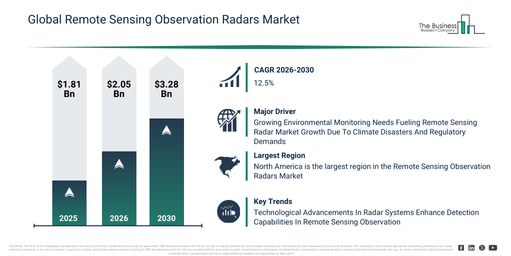
The remote sensing observation radars market has experienced rapid expansion in recent years. Its value is projected to climb from $1.81 billion in 2025 to $2.05 billion by 2026, demonstrating a compound annual growth rate (CAGR) of 12.8%. This historical growth can be attributed to the increasing adoption of radar imaging satellites for all-weather, day-night earth observation, the expanded use of remote sensing radars in environmental monitoring and climate research, a rising demand for disaster management support driven by frequent natural hazards, the early integration of radar data processing software to enhance image interpretation, and the broadening of defense and surveillance applications that require long-range detection capabilities.
The remote sensing observation radars market size is projected to experience substantial growth in the upcoming years. It is anticipated to expand to $3.28 billion by 2030, exhibiting a compound annual growth rate (CAGR) of 12.5%. This growth during the forecast period can be attributed to several factors, including the increasing demand for high-resolution radar imagery to support precision agriculture and resource management, the rising deployment of next-generation radar imaging satellites offering improved sensitivity and coverage, the growing adoption of AI-enabled radar data analytics for faster and more accurate insights, the expansion of commercial remote sensing services for infrastructure monitoring and urban planning, and technological advancements enhancing multi-frequency and multi-polarization radar capabilities to broaden their application potential. Key trends for the forecast period include the rising use of all-weather remote sensing radar for disaster response, increased deployment of high-frequency radars for maritime observation, expansion of aerial radar platforms for agricultural mapping, growing adoption of multi-band radar for urban infrastructure monitoring, and the development of compact ground-based radar units for field operations.
Download A Free Sample Report For Comprehensive Market Insights:
Remote Sensing Observation Radars Market Demand Drivers: What Is Fueling Industry Growth?
The remote sensing observation radars market is projected to grow as the demand for precise environmental oversight and effective disaster management intensifies moving forward. Environmental monitoring involves the methodical measurement and study of ecological characteristics, such as shifts in climate, natural catastrophes, and changes in land usage. The significant increase in environmental monitoring requirements stems from a rise in climate-related disasters, where more frequent and intense wildfires, floods, and storms necessitate improved data for early warnings, disaster response, and comprehensive climate adaptation strategies. Remote sensing radars are beneficial for environmental monitoring because they offer centimeter-level measurement precision, round-the-clock operation, and cloud-penetrating abilities, outperforming optical systems for anticipating catastrophes and tracking ecological developments. For instance, in January 2023, according to a report from the Beyond the Data blog by NOAA’s National Centers for Environmental Information, a U.S.-based federal scientific agency, the United States recorded 28 distinct billion-dollar weather and climate disasters, with cumulative damages surpassing $92.9 billion for the year. Thus, the escalating need for accurate environmental monitoring and disaster management is a key driver for the remote sensing observation radars market.
Remote Sensing Observation Radars Market Segment Breakdown: Which Categories Generate The Most Revenue?
The remote sensing observation radars market covered in this report is segmented –
1) By Type Of Radar: Synthetic Aperture Radar (SAR), Reverse Synthetic Aperture Radar (RSAR), Pulsed Radar, Continuous Wave Radar (CWR), FMCW (Frequency Modulated Continuous Wave) Radar
2) By Platform Type: Satellite-Based Radars, Aerial-Based Radars, Ground-Based Radars, Marine Radars, Mobile Radars
3) By Frequency Band: Low Frequency (LF), Medium Frequency (MF), High Frequency (HF), Super High Frequency (SHF), Extremely High Frequency (EHF)
4) By Application: Agriculture, Forestry, Urban Planning, Disaster Management, Environmental Monitoring
5) By End-User Industry: Government And Defense, Aerospace, Telecommunications, Oil And Gas, Transportation And Logistics
Subsegments:
1) By Synthetic Aperture Radar (SAR): Spaceborne SAR, Airborne SAR, Ground-Based SAR
2) By Reverse Synthetic Aperture Radar (RSAR): Ground Surveillance RSAR, Maritime RSAR, Airborne Target Tracking RSAR
3) By Pulsed Radar: Doppler Pulsed Radar, Monopulse Pulsed Radar, Pulse-Doppler Radar
4) By Continuous Wave Radar (CWR): Basic Continuous Wave Radar, Frequency Shift Keying (FSK) Radar, Dual-Tone Continuous Wave Radar
5) By FMCW (Frequency Modulated Continuous Wave) Radar: Short-Range FMCW Radar, Medium-Range FMCW Radar, Long-Range FMCW Radar
Remote Sensing Observation Radars Market Strategic Trends: What Is Defining The Next Phase Of Growth?
Leading companies in the remote sensing observation radar market are increasingly focused on advancing earth observation technology. This development aims to bolster climate resilience, refine disaster management, optimize agricultural yields, monitor deforestation, and enhance national security through high-resolution, all-weather surveillance capabilities. Earth observation technology specifically refers to remote sensing systems, including satellites, drones, and radars, which collect, analyze, and monitor data about the Earth’s surface, atmosphere, and oceans to support environmental, agricultural, disaster, and security applications. For example, in May 2025, Sisir Radar, an India-based aerospace company, together with XDLINX Space Labs, also an India-based aerospace company, successfully launched India’s first Private L-Band SAR Satellite, representing a groundbreaking advancement in earth observation technology. The objective of this partnership is to make high-resolution radar imagery more readily available to a wide array of users, from government agencies to private enterprises, thereby enabling smarter decision-making across numerous sectors. This new satellite is projected to deliver a 1-meter resolution in Stripmap mode, significantly outperforming the current industry standard of 5–10 meters for L-band SAR. This elevated resolution, coupled with exceptional foliage penetration, facilitates applications that were previously unattainable or required considerably more expensive solutions.
Remote Sensing Observation Radars Market Key Players And Strategic Industry Positioning
Major companies operating in the remote sensing observation radars market are Raytheon Technologies (RTX), Lockheed Martin Corporation, Airbus Defence and Space, Mitsubishi Electric Corporation, Northrop Grumman Corporation, BAE Systems plc, Thales Group, L3Harris Technologies Inc., Leonardo S.p.A., Elbit Systems Ltd., Saab AB, Indra Sistemas S.A., General Atomics Aeronautical Systems Inc., Hensoldt AG, OHB System AG, Japan Radio Co. Ltd. (JRC), Terma A/S, RADA Electronic Industries Ltd., Capella Space, Synspective Inc.
Access The Complete Remote Sensing Observation Radars Market Report:
#Remote Sensing Observation Radars Market Largest Region: Which Geography Holds The Highest Market Share?
North America was the largest region in the remote sensing observation radars market in 2025. Asia-Pacific is expected to be the fastest-growing region in the forecast period. The regions covered in the remote sensing observation radars market report are Asia-Pacific, South East Asia, Western Europe, Eastern Europe, North America, South America, Middle East, Africa.
Access a Customized Remote Sensing Observation Radars Market Report for Deeper Competitive Insights
https://www.thebusinessresearchcompany.com/customise?id=25487&type=smp
The Business Research Company: https://www.thebusinessresearchcompany.com/
Americas: +1 310-496-7795
Asia: +44 7882 955267 & +91 8897263534
Europe: +44 7882 955267
Email us at: marketing@tbrc.info
Follow us on:
LinkedIn: https://in.linkedin.com/company/the-business-research-company
YouTube: https://www.youtube.com/channel/UC24_fI0rV8cR5DxlCpgmyFQ
Global Market Model: https://www.thebusinessresearchcompany.com/global-market-model

Wasay has over a decade of experience in market research, data modelling, and analytics, with prior experience at GlobalData and Decision Tree Consulting Services. At The Business Research Company , he leads research operations across syndicated studies, customized consulting engagements, and the Global Market Model platform. His professional experience includes supporting organizations such as Boston Consulting Group, KPMG, and Ernst & Young. Wasay holds a degree in Electronics and Communications Engineering, postgraduate management qualifications from International Management Institute Belgium and Indian School of Business and Entrepreneurship, and completed the Integrated Program in Business Analytics from Indian Institute of Management Indore.