The Business Research Company’s 2026 market reports are designed to deliver research that is more actionable and strategically valuable. Key offerings include market attractiveness scoring, total addressable market sizing, company benchmarking matrices, interactive Excel dashboards, deeper supply chain intelligence, emerging startup tracking, and granular product-level insights.
Which Factors Will Shape The Rocket Autonomous Navigation Market Size Through 2030?
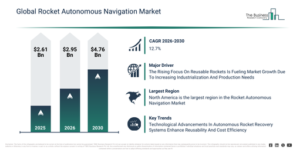
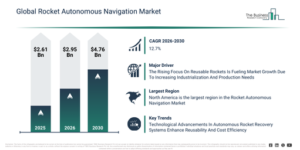
The rocket autonomous navigation market has experienced rapid expansion in recent years. Its valuation is set to rise from $2.61 billion in 2025 to $2.95 billion in 2026, registering a compound annual growth rate (CAGR) of 13.0%. This historical growth can be ascribed to the increasing implementation of onboard flight control computers to refine rocket guidance accuracy, the wider integration of star trackers for exact attitude and position determination in space missions, a greater reliance on software simulation for confirming autonomous navigation algorithms, the growth of testing and validation services as rockets evolved towards higher autonomy, and the early establishment of sensor and data processing systems that enable real-time trajectory adjustments.
The rocket autonomous navigation market is projected for significant expansion in the coming years, with its size anticipated to reach $4.76 billion in 2030, propelled by a compound annual growth rate (CAGR) of 12.7%. This expansion during the forecast period is driven by several factors, including an escalating need for fully autonomous mission planning for reusable and deep-space rockets, wider implementation of sophisticated navigation algorithms to improve precision and fuel economy, the expanding integration of multi-sensor fusion systems for enhanced reliability in challenging flight scenarios, the increasing involvement of commercial launch providers investing in advanced autonomous navigation solutions, and ongoing technological improvements leading to greater processing power and smaller flight control computers and star trackers. Key trends shaping the market over the same period encompass the broader embrace of sensor fusion and redundant navigation architectures, greater integration of onboard autonomy and real-time decision-making capabilities, the escalating deployment of miniaturized star trackers and lighter flight computers, an increase in simulation-driven validation and hardware-in-the-loop testing, and a sharp rise in the need for radiation-hardened navigation electronics.
Request A Free Rocket Autonomous Navigation Market Sample To Support Your Strategic Planning:
What Is Propelling The Rocket Autonomous Navigation Market Toward $4.76 Billion By 2030?
The increasing emphasis on reusable rockets is anticipated to drive expansion in the rocket autonomous navigation market moving forward. Reusable rockets are defined as launch vehicles engineered to return to Earth and be utilized multiple times, substantially lowering the expenses of space missions. This heightened focus on reusable rockets arises from a growing demand for economical and sustainable space missions that aim to minimize waste and optimize launch efficiency. Rocket autonomous navigation provides precise guidance, regulated landings, and real-time adjustments for reusable rockets, which aids in their safe recovery and improves the effectiveness of their reuse. For instance, in May 2025, as per PatentPC, a US-based artificial intelligence copilot technology development company, SpaceX, a US-based aerospace company, executed over 90 launches with reusable rockets in 2023, a considerable increase from fewer than 20 with disposable ones compared to 2022. Thus, the growing attention on reusable rockets is propelling the growth of the rocket autonomous navigation market.
What Are The Key Segments And Subsegments In The Rocket Autonomous Navigation Market?
The rocket autonomous navigation market covered in this report is segmented –
1) By Component: Hardware, Software, Services
2) By Technology: Global Positioning System (GPS), Inertial Navigation Systems, Sensor Fusion, Other Technologies
3) By End-User: Aerospace, Defense, Space Exploration, Other End-Users
Subsegments:
1) By Hardware: Inertial Measurement Units, Global Positioning System Receivers, Accelerometers And Gyroscopes, Flight Control Systems, Onboard Computers, Antennas And Transceivers, Actuators And Control Surfaces
2) By Software: Navigation And Guidance Algorithms, Trajectory Planning Software, Sensor Fusion Algorithms, Real-Time Operating Systems, Fault Detection And Correction Software, Simulation And Modeling Tools
3) By Services: System Integration Services, Maintenance And Repair Services, Calibration And Testing Services, Software Upgrades And Support, Training And Consulting Services, Mission Planning And Analysis Services
Rocket Autonomous Navigation Market Trends Behind The 12.7% CAGR Forecast
Leading companies in the Rocket Autonomous Navigation market are concentrating on developing technological advancements like autonomous rocket recovery vessels to improve launch efficiency, lower recovery expenses, and enable reusable launch missions. An autonomous rocket recovery ship is defined as an uncrewed vessel equipped with advanced navigation and control systems, designed to track, approach, and retrieve rocket boosters or stages following launch without human intervention. For example, in August 2025, iSpace, a Chinese exploration firm, unveiled the Xingji Guihang initiative to develop an autonomous rocket recovery ship, aiming to boost rocket retrieval efficiency and support reusable launch operations. It is engineered for sea-based recovery of reusable rocket boosters, backing China’s efforts towards cost-effective space launches. This ship boasts a spacious recovery deck and an advanced dynamic positioning system, allowing it to autonomously stabilize and accurately capture rockets even in turbulent waters. Such a vessel enhances China’s reusable rocket capabilities, decreases launch costs, and bolsters its competitive standing in commercial space technology.
Major Companies Profiled In The Rocket Autonomous Navigation Market Report
Major companies operating in the rocket autonomous navigation market are Raytheon Technologies Corporation, The Boeing Company, Lockheed Martin Corporation, Airbus Defence and Space, Northrop Grumman Corporation, Honeywell Aerospace, BAE Systems plc, Safran S.A., Thales Group, L3Harris Technologies Inc., Leonardo S.p.A., Space Exploration Technologies Corp., Blue Origin LLC, Moog Inc., Sierra Nevada Corporation, Beyond Gravity Inc., Rocket Lab USA Inc., True Anomaly Inc., KinetX Incorporated, Starfish Space Inc., Xona Space Systems Inc., WeSpace Technologies Inc.
Explore The Business Research Company’s Complete Rocket Autonomous Navigation Market Report:
Where Does The Rocket Autonomous Navigation Market Generate The Most Revenue?
North America was the largest region in the rocket autonomous navigation market in 2025. Asia-Pacific is expected to be the fastest-growing region in the forecast period. The regions covered in the rocket autonomous navigation market report are Asia-Pacific, South East Asia, Western Europe, Eastern Europe, North America, South America, Middle East, Africa.
Reach Out To Our Team:
The Business Research Company: https://www.thebusinessresearchcompany.com/
Americas: +1 310-496-7795
Asia: +44 7882 955267 & +91 8897263534
Europe: +44 7882 955267
Email us at: marketing@tbrc.info
Follow us on:
LinkedIn: https://in.linkedin.com/company/the-business-research-company
YouTube: https://www.youtube.com/channel/UC24_fI0rV8cR5DxlCpgmyFQ
Global Market Model: https://www.thebusinessresearchcompany.com/global-market-model

Wasay has over a decade of experience in market research, data modelling, and analytics, with prior experience at GlobalData and Decision Tree Consulting Services. At The Business Research Company , he leads research operations across syndicated studies, customized consulting engagements, and the Global Market Model platform. His professional experience includes supporting organizations such as Boston Consulting Group, KPMG, and Ernst & Young. Wasay holds a degree in Electronics and Communications Engineering, postgraduate management qualifications from International Management Institute Belgium and Indian School of Business and Entrepreneurship, and completed the Integrated Program in Business Analytics from Indian Institute of Management Indore.