Built to provide research that’s more actionable and strategically valuable, The Business Research Company’s 2026 market reports include market attractiveness analysis, total addressable market sizing, company benchmarking matrices, interactive Excel dashboards, broader supply chain intelligence, emerging startup tracking, and in-depth product insights.
Rocket Autonomous Navigation Market Forecast: What Value Will The Market Reach By 2030?
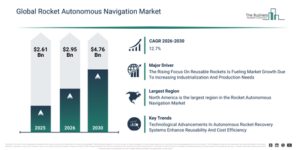
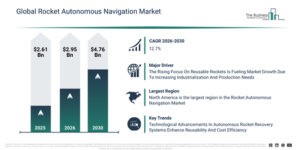
The market size for rocket autonomous navigation has experienced swift growth in recent years. It is anticipated to increase from $2.61 billion in 2025 to $2.95 billion in 2026, demonstrating a compound annual growth rate (CAGR) of 13.0%. This past growth can be attributed to the rising adoption of onboard flight control computers aimed at improving rocket guidance accuracy; the increasing integration of star trackers for precise attitude and position determination in space missions; a growing reliance on software simulation for validating autonomous navigation algorithms; the expansion of testing and validation services as rockets moved towards higher autonomy; and the early development of sensor and data processing systems enabling real-time trajectory adjustments.
The rocket autonomous navigation market is projected to experience substantial expansion in the coming years, with its valuation expected to reach $4.76 billion by 2030, demonstrating a compound annual growth rate (CAGR) of 12.7%. This growth during the forecast period is fueled by the escalating need for fully autonomous mission planning to support reusable and deep-space rockets, the wider adoption of sophisticated navigation algorithms for improved precision and fuel efficiency, the increasing integration of multi-sensor fusion systems to enhance reliability during intricate flight conditions, the growing number of commercial launch providers investing in advanced autonomous navigation solutions, and technological advancements leading to enhanced processing power and miniaturization of flight control computers and star trackers. Key trends anticipated in this period include a rise in the use of sensor fusion and redundant navigation architectures, the growing integration of onboard autonomy and real-time decision-making capabilities, the heightened utilization of miniaturized star trackers and lightweight flight computers, the broadening application of simulation-driven validation and hardware-in-the-loop testing methodologies, and a sharp increase in the requirement for radiation-hardened navigation electronics.
Get A Free Sample Report With In-Depth Market Insights:
Rocket Autonomous Navigation Market Development Factors: What’s Supporting Demand?
The growing emphasis on reusable rockets is projected to stimulate the expansion of the rocket autonomous navigation market in the future. Reusable rockets are defined as launch vehicles designed to return to Earth and be flown multiple times, substantially lowering the cost of space missions. This increased focus on reusable rockets arises from a rising demand for economical and sustainable space missions that minimize waste and maximize launch effectiveness. Rocket autonomous navigation facilitates precise guidance, controlled landings, and real-time adjustments for reusable rockets, thereby supporting secure recovery and enhancing the efficiency of rocket reuse. For instance, in May 2025, according to PatentPC, a US-based artificial intelligence copilot technology development company, SpaceX, a US-based aerospace company, conducted over 90 launches with reusable rockets in 2023, a significant increase from fewer than 20 with disposable ones compared to 2022. Consequently, the heightened focus on reusable rockets is propelling the growth of the rocket autonomous navigation market.
Rocket Autonomous Navigation Market Segment Analysis Spotlighting Growth Areas
The rocket autonomous navigation market covered in this report is segmented –
1) By Component: Hardware, Software, Services
2) By Technology: Global Positioning System (GPS), Inertial Navigation Systems, Sensor Fusion, Other Technologies
3) By End-User: Aerospace, Defense, Space Exploration, Other End-Users
Subsegments:
1) By Hardware: Inertial Measurement Units, Global Positioning System Receivers, Accelerometers And Gyroscopes, Flight Control Systems, Onboard Computers, Antennas And Transceivers, Actuators And Control Surfaces
2) By Software: Navigation And Guidance Algorithms, Trajectory Planning Software, Sensor Fusion Algorithms, Real-Time Operating Systems, Fault Detection And Correction Software, Simulation And Modeling Tools
3) By Services: System Integration Services, Maintenance And Repair Services, Calibration And Testing Services, Software Upgrades And Support, Training And Consulting Services, Mission Planning And Analysis Services
Rocket Autonomous Navigation Market Transformation Trends: What Innovations Are Driving Change?
Leading firms within the Rocket Autonomous Navigation market are prioritizing the creation of technological innovations like autonomous rocket recovery ships, aiming to boost launch efficiency, lower recovery expenses, and facilitate reusable launch activities. Such a ship is an uncrewed vehicle fitted with sophisticated navigation and control systems, built to locate, approach, and retrieve rocket boosters or stages post-launch, entirely free from human input. As an illustration, in August 2025, iSpace, a Chinese exploration firm, introduced the Xingji Guihang, a project intended to build an autonomous rocket recovery vessel, with the goal of enhancing rocket retrieval efficiency and aiding reusable launch endeavors. This vessel is engineered to recover reusable rocket boosters from the ocean, thereby contributing to the country’s drive for economical space launches. Key features include an expansive recovery deck and a sophisticated dynamic positioning system, enabling it to maintain stability and precisely secure rockets independently, even amidst turbulent waters. The ship will augment China’s capacity for reusable rockets, diminish launch expenditures, and solidify its competitive standing in the commercial space technology sector.
Rocket Autonomous Navigation Market Leading Companies: Who Holds The Strongest Market Presence?
Major companies operating in the rocket autonomous navigation market are Raytheon Technologies Corporation, The Boeing Company, Lockheed Martin Corporation, Airbus Defence and Space, Northrop Grumman Corporation, Honeywell Aerospace, BAE Systems plc, Safran S.A., Thales Group, L3Harris Technologies Inc., Leonardo S.p.A., Space Exploration Technologies Corp., Blue Origin LLC, Moog Inc., Sierra Nevada Corporation, Beyond Gravity Inc., Rocket Lab USA Inc., True Anomaly Inc., KinetX Incorporated, Starfish Space Inc., Xona Space Systems Inc., WeSpace Technologies Inc.
View The Full Rocket Autonomous Navigation Market Report:
Rocket Autonomous Navigation Market Global Footprint: Which Region Leads The Industry?
North America was the largest region in the rocket autonomous navigation market in 2025. Asia-Pacific is expected to be the fastest-growing region in the forecast period. The regions covered in the rocket autonomous navigation market report are Asia-Pacific, South East Asia, Western Europe, Eastern Europe, North America, South America, Middle East, Africa.
Reach Out To Our Team:
The Business Research Company: https://www.thebusinessresearchcompany.com/
Americas: +1 310-496-7795
Asia: +44 7882 955267 & +91 8897263534
Europe: +44 7882 955267
Email us at: marketing@tbrc.info
Follow us on:
LinkedIn: https://in.linkedin.com/company/the-business-research-company
YouTube: https://www.youtube.com/channel/UC24_fI0rV8cR5DxlCpgmyFQ
Global Market Model: https://www.thebusinessresearchcompany.com/global-market-model

Wasay has over a decade of experience in market research, data modelling, and analytics, with prior experience at GlobalData and Decision Tree Consulting Services. At The Business Research Company , he leads research operations across syndicated studies, customized consulting engagements, and the Global Market Model platform. His professional experience includes supporting organizations such as Boston Consulting Group, KPMG, and Ernst & Young. Wasay holds a degree in Electronics and Communications Engineering, postgraduate management qualifications from International Management Institute Belgium and Indian School of Business and Entrepreneurship, and completed the Integrated Program in Business Analytics from Indian Institute of Management Indore.