Market attractiveness scoring, total addressable market sizing, company benchmarking matrices, interactive Excel dashboards, deeper supply chain intelligence, emerging startup tracking, and granular product-level insights are among the key offerings featured in The Business Research Company’s 2026 market reports, designed to deliver more actionable and strategically valuable research.
Rocket Drag Reduction Systems Market Growth Outlook: How Much Bigger Will The Market Be By 2030?
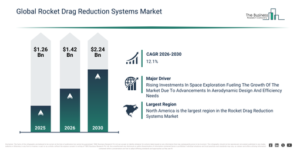
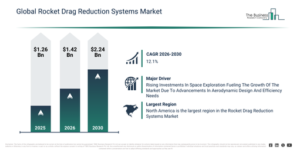
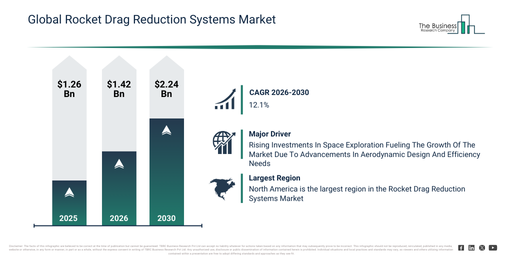
The rocket drag reduction systems market has experienced significant expansion recently. This market is projected to expand from $1.26 billion in 2025 to $1.42 billion in 2026, demonstrating a compound annual growth rate (CAGR) of 12.7%. Historically, this growth has stemmed from several factors, including initial aerospace research and development investments focused on enhancing aerodynamic efficiency, the growing complexity of launch vehicles necessitating advanced drag mitigation solutions, the creation of high-performance surface coatings for reducing boundary layer friction, the early deployment of shockwave control technologies within government and defense launch initiatives, and increasing demands for fuel efficiency compelling manufacturers to incorporate turbulence reduction devices.
The market for rocket drag reduction systems is projected to experience swift expansion over the coming years. This market is anticipated to reach a valuation of $2.24 billion by 2030, demonstrating a compound annual growth rate (CAGR) of 12.1%. This projected growth can be linked to several factors, including the rise in commercial launch operations demanding improved payload efficiency, breakthroughs in computational fluid dynamics leading to better drag reduction designs, the increasing reliance on reusable rockets which calls for robust drag-reduction materials, regulatory pressures on launch performance and fuel efficiency encouraging system implementation, and the expanding investments within the private space sector driving innovation in managing flow separation and shockwaves. Key trends anticipated during this period encompass the implementation of sophisticated aerodynamic flow-control mechanisms, a greater application of surface coatings designed to reduce drag, a growing need for lightweight composite constructions, the progression of shockwave management techniques, and the incorporation of hybrid passive and active drag reduction systems.
Request A Free Rocket Drag Reduction Systems Market Sample From The Business Research Company:
How Is The Key Growth Driver Influencing The Rocket Drag Reduction Systems Market?
Increased financial commitments to space exploration are anticipated to fuel the expansion of the rocket drag reduction systems market. Space exploration involves exploring and studying outer space using various technologies, including both manned and unmanned spacecraft and satellites. Heightened geopolitical rivalries, as nations strive for strategic advantage and technological leadership in space, are primarily driving these growing investments. Such investments boost rocket drag reduction systems through advancements in aerodynamic design and material science. These systems improve the efficiency of launches by reducing air resistance, which in turn lowers fuel consumption and enhances payload capacity. Ultimately, they contribute to the superior performance, reliability, and economic viability of contemporary space missions. For example, according to Novaspace in September 2023, government spending on space exploration reached $27 billion in 2024 and is projected to increase to nearly $31 billion by 2034. Consequently, rising investments in space exploration are propelling the rocket drag reduction systems market forward. The expanding volume of satellite launches is expected to boost the rocket drag reduction systems market. Satellite launches involve deploying artificial satellites into space using rockets or other launch vehicles. The rising need for global connectivity, as more regions seek reliable internet access via satellite broadband services, is fueling the demand for these launches. Rocket drag reduction systems enhance satellite launches by improving aerodynamic efficiency during the ascent phase, thereby minimizing air resistance, allowing for fuel conservation, and enabling heavier payloads to reach orbit. This, in turn, boosts the cost-effectiveness and dependability of satellite deployment missions. For instance, the Satellite Industry Association reported in June 2024 that the commercial satellite industry achieved record growth in 2023, with 2,781 satellites launched, marking a 20% increase from 2022. The space industry also reached an unprecedented 190 total launches. By the close of 2023, the number of operational satellites had surged to 9,691, representing a 361% rise over the preceding five years. Hence, the growing number of satellite launches is a key driver for the rocket drag reduction systems market.
Rocket Drag Reduction Systems Market Segmentation By Category: What Does The 2026 Report Cover?
The rocket drag reduction systems market covered in this report is segmented –
1) By Component: Aerodynamic Surfaces, Propulsion Systems, Control Systems, Other Components
2) By Type: Passive Drag Reduction Systems, Active Drag Reduction Systems
3) By Application: Commercial Spacecraft, Military And Defense, Research And Development
Subsegments:
1) By Aerodynamic Surfaces: Winglets, Fins, Nose Cones, Fairings, Flow Control Devices
2) By Propulsion Systems: Nozzles, Thrust Vectoring Systems, Afterburners, Multi-mode Propulsion Units, Exhaust Flow Modifiers
3) By Control Systems: Flight Control Software, Inertial Navigation Systems, Actuators, Sensors, Guidance Mechanisms
4) By Other Components: Thermal Protection Systems, Vibration Dampers, Structural Materials, Surface Coatings, Drag-Reducing Composites
Rocket Drag Reduction Systems Market Global Key Players And Competitive Overview
Major companies operating in the rocket drag reduction systems market are Northrop Grumman Corporation, Mitsubishi Heavy Industries Ltd., Safran SA, L3 Harris Technologies Inc., IHI Corporation, Space Exploration Technologies Corp., Blue Origin LLC, Ariane Group, United Launch Alliance LLC, Sierra Space Corp., Rocket Lab Ltd., Firefly Aerospace, Ursa Major Technologies Inc., Exo Terra Resource LLC, Land Space Technology Co. Ltd., Reaction Engines Ltd., Antrix Corporation Limited, Ad Astra Rocket Company, CU Aerospace LLC, Virgin Galactic Holdings Inc.
Explore Comprehensive Rocket Drag Reduction Systems Market Coverage In The Full Report:
Regional Analysis Of The Rocket Drag Reduction Systems Market: Where Is The Industry Concentrated?
North America was the largest region in the rocket drag reduction systems market in 2025. The regions covered in the rocket drag reduction systems market report are Asia-Pacific, South East Asia, Western Europe, Eastern Europe, North America, South America, Middle East, Africa.
Reach Out To Our Team:
The Business Research Company: https://www.thebusinessresearchcompany.com/
Americas: +1 310-496-7795
Asia: +44 7882 955267 & +91 8897263534
Europe: +44 7882 955267
Email us at: marketing@tbrc.info
Follow us on:
LinkedIn: https://in.linkedin.com/company/the-business-research-company
YouTube: https://www.youtube.com/channel/UC24_fI0rV8cR5DxlCpgmyFQ
Global Market Model: https://www.thebusinessresearchcompany.com/global-market-model

Wasay has over a decade of experience in market research, data modelling, and analytics, with prior experience at GlobalData and Decision Tree Consulting Services. At The Business Research Company , he leads research operations across syndicated studies, customized consulting engagements, and the Global Market Model platform. His professional experience includes supporting organizations such as Boston Consulting Group, KPMG, and Ernst & Young. Wasay holds a degree in Electronics and Communications Engineering, postgraduate management qualifications from International Management Institute Belgium and Indian School of Business and Entrepreneurship, and completed the Integrated Program in Business Analytics from Indian Institute of Management Indore.