Designed to make market research more actionable and strategically valuable, The Business Research Company’s 2026 market reports feature market attractiveness scoring, total addressable market sizing, company benchmarking matrices, interactive Excel dashboards, deeper supply chain intelligence, emerging startup tracking, and granular product-level insights.
Rocket Deorbiting Systems Market Forecast 2026–2030: Size, Value And Compound Annual Growth Rate
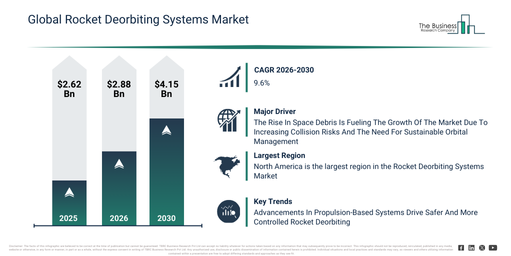
The market size for rocket deorbiting systems has experienced significant expansion recently. This market is projected to expand from $2.62 billion in 2025 to $2.88 billion in 2026, exhibiting a compound annual growth rate (CAGR) of 9.9%. Factors contributing to its past expansion include an increase in satellite launches, which generated early demand for post-mission disposal solutions, growing concerns about orbital debris following major fragmentation incidents, initial regulatory efforts promoting responsible end-of-life procedures, technological progress in small satellite propulsion that enabled fundamental deorbit capabilities, and the early implementation of deorbit kits by government-led space missions to reduce long-term debris risks.
The market size for rocket deorbiting systems is anticipated to experience substantial expansion over the next few years. It is projected to reach $4.15 billion in 2030, showing a compound annual growth rate (CAGR) of 9.6%. This growth during the forecast period can be attributed to the proliferation of commercial constellations needing adaptable deorbiting solutions, stricter global space sustainability regulations demanding end-of-life adherence, the increasing integration of autonomous deorbiting technologies to lower mission expenses, a growing demand for retrofitting hardware for older satellites nearing their operational end, and improved collaboration among space agencies and private companies to standardize deorbiting frameworks. Noteworthy trends for this period include the wider use of autonomous end-of-life deorbiting kits, a greater embrace of electrodynamic tethers for passive deorbiting, an expansion of partnerships for in-orbit servicing and active removal, the standardization of deorbiting protocols and regulatory compliance, and the development of lightweight retrofits for legacy satellites.
Try Before You Buy: Free Sample Of The Rocket Deorbiting Systems Market Report:
Rocket Deorbiting Systems Market Growth Engine: The Factor Boosting Demand Globally
The anticipated increase in space debris is projected to fuel the expansion of the rocket deorbiting systems market in the coming years. Space debris, also recognized as orbital debris or space junk, encompasses non-operational, man-made objects orbiting Earth that have lost their utility. This category includes discarded satellites, used rocket sections, and pieces formed from spacecraft impacts, blasts, or breakdown. The growing amount of space debris is attributed to a sharp rise in satellite constellations, as businesses are quickly deploying numerous small satellites to deliver worldwide coverage for services like broadband internet. Rocket deorbiting systems work to reduce space debris by making sure that obsolete rockets and spacecraft are either safely removed from orbit or transferred to disposal orbits. This strategy lowers the chances of collisions and fosters a tidier, more sustainable orbital environment. For example, data from May 2025, provided by the European Space Agency, a France-based entity focused on space exploration, indicates roughly 1.2 million pieces of space debris between 1 cm and 10 cm in size, alongside 140 million smaller fragments ranging from 1 mm to 1 cm. Consequently, the escalating volume of space debris is fueling the expansion of the rocket deorbiting systems market.
Which Categories And Subcategories Shape The Rocket Deorbiting Systems Market?
The rocket deorbiting systems market covered in this report is segmented –
1) By Type: Active Deorbiting Systems, Passive Deorbiting Systems
2) By Technology: Chemical Propulsion, Electric Propulsion, Hybrid Propulsion, Other Technologies
3) By Application: Commercial, Military, Government, Other Applications
5) By End-User: Satellite Operators, Space Agencies, Defense Organizations, Other End-Users
Subsegments:
1) By Active Deorbiting Systems: Propulsion-Based Systems, Electrodynamic Tethers, Laser Ablation Systems, Robotic Arm Capture Systems
2) By Passive Deorbiting Systems: Drag Augmentation Devices, Aerodynamic Stabilizers, Sublimating Materials, Shape-Memory Polymers
Rocket Deorbiting Systems Market Trend Insights: Strategic Focus Areas Of Leading Companies
Leading companies within the rocket deorbiting systems market are concentrating on developing advanced solutions, such as propulsion-based deorbiting systems, to guarantee accurate and regulated reentry and lessen orbital debris. Propulsion-based deorbiting systems utilize integrated engines to proactively guide rockets or spacecraft out of orbit by decreasing their velocity. This precise and dependable approach is well-suited for the secure deorbiting of large or high-altitude objects. For example, in June 2024, The Aerospace Corporation, a US-based nonprofit space research and development organization, unveiled a new prototype deorbit motor. This motor allows small spacecraft like CubeSats to deorbit safely and efficiently at the conclusion of their missions. This inventive motor employs a commercial off-the-shelf solid-propellant rocket featuring a unique deflector plate and nozzle design, producing spin-stabilized axial thrust for controlled reentry, even for satellites that have lost some attitude control. The technology addresses contemporary regulatory mandates, such as the FCC’s five-year deorbit rule. It aids in mitigating the escalating danger of space debris by enabling operators to decommission satellites on demand, thereby improving the sustainability of space operations.
Leading Organizations In The Rocket Deorbiting Systems Market
Major companies operating in the rocket deorbiting systems market are Kawasaki Heavy Industries Ltd., Space Exploration Technologies Corp. (SpaceX), Astroscale, Firefly Aerospace Inc., Surrey Satellite Technology Limited, ClearSpace SA, Space Flight Laboratory, MMA Design LLC, ThrustMe S.A.S., High Performance Space Structure Systems GmbH, D-Orbit S.p.A., Motiv Space Systems Inc., Orbotic Systems Inc., Kall Morris Inc. (KMI), Kurs Orbital Inc., CU Aerospace L.L.C., OrbitGuardians Inc., Skyrora Limited, Spaceo Inc., Vestigo Aerospace LLC
Continue Reading: The Full Rocket Deorbiting Systems Market Report:
Rocket Deorbiting Systems Market Regional Spotlight: Top Geography And Report Coverage
North America was the largest region in the rocket deorbiting systems market in 2025. Asia-Pacific is expected to be the fastest-growing region in the forecast period. The regions covered in the rocket deorbiting systems market report are Asia-Pacific, South East Asia, Western Europe, Eastern Europe, North America, South America, Middle East, Africa.
Reach Out To Our Team:
The Business Research Company: https://www.thebusinessresearchcompany.com/
Americas: +1 310-496-7795
Asia: +44 7882 955267 & +91 8897263534
Europe: +44 7882 955267
Email us at: marketing@tbrc.info
Follow us on:
LinkedIn: https://in.linkedin.com/company/the-business-research-company
YouTube: https://www.youtube.com/channel/UC24_fI0rV8cR5DxlCpgmyFQ
Global Market Model: https://www.thebusinessresearchcompany.com/global-market-model

Wasay has over a decade of experience in market research, data modelling, and analytics, with prior experience at GlobalData and Decision Tree Consulting Services. At The Business Research Company , he leads research operations across syndicated studies, customized consulting engagements, and the Global Market Model platform. His professional experience includes supporting organizations such as Boston Consulting Group, KPMG, and Ernst & Young. Wasay holds a degree in Electronics and Communications Engineering, postgraduate management qualifications from International Management Institute Belgium and Indian School of Business and Entrepreneurship, and completed the Integrated Program in Business Analytics from Indian Institute of Management Indore.