Market attractiveness scoring, total addressable market sizing, company benchmarking matrices, interactive Excel dashboards, deeper supply chain intelligence, emerging startup tracking, and granular product-level insights are among the key offerings featured in The Business Research Company’s 2026 market reports, designed to deliver more actionable and strategically valuable research.
Rocket Engines Market Valued At $4.03 Billion In 2026, Projected To Reach $4.64 Billion By 2030
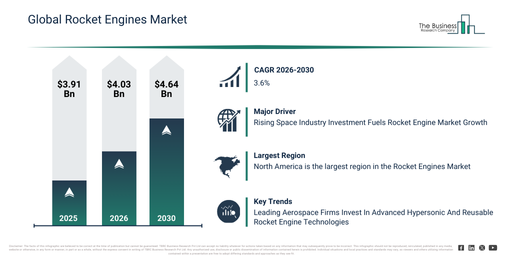
The rocket engines market size has shown steady expansion in recent years. It is forecast to increase from $3.91 billion in 2025 to $4.03 billion in 2026, reflecting a compound annual growth rate (CAGR) of 3.1%. This past growth can be attributed to several key drivers, including an increase in government-funded space exploration programs leading to higher rocket engine procurement, a rising demand for launch services to deploy commercial and defense satellites, ongoing advancements in liquid and solid propulsion technologies that enhance engine performance, the historical growth of private space companies contributing to engine development contracts, and an increased reliance on MRO and refurbishment services for reusable rocket engines.
The rocket engines market is projected to witness steady growth in the coming years, with its size expected to reach $4.64 billion by 2030, exhibiting a compound annual growth rate (CAGR) of 3.6%. This expansion during the forecast period is primarily driven by the increasing commercial spaceflight and tourism sectors, which in turn boosts new rocket engine production. Other contributing factors include the rising adoption of reusable propulsion systems aimed at reducing launch costs, growing investments in high-thrust and high-efficiency engines for deep space missions, and an increasing demand for small satellite launchers that support the development of compact rocket engines. An anticipated surge in hybrid and green propellant technologies is also expected to influence next-generation engine designs. Major trends anticipated in this period encompass continued advancements in reusable rocket engines, the miniaturization of propulsion systems for small satellites, the development of hybrid propulsion technologies, a strong focus on high-efficiency fuel and combustion systems, and the broadening of commercial space launch services.
Request A Complimentary Rocket Engines Market Research Sample:
Key Factor Propelling The Rocket Engines Market Forward
Rising financial commitments within the space industry are anticipated to drive the expansion of the rocket engine market in the future. This investment involves dedicating capital or assets to support endeavors such as space exploration, satellite advancements, commercial aerospace projects, or other related initiatives, with the dual objectives of achieving financial gains and furthering scientific and technological progress. Crucially, such investment in the space industry is essential for improving rocket engine technology, thereby enabling the development of more efficient, economical, and environmentally friendly propulsion solutions for space exploration and satellite placement. As an example, in 2023, data from The Space Report by Space Foundation, a US-based organization, revealed that the global space economy achieved a record valuation of $570 billion, marking a 7.4% rise from the updated 2022 total of $531 billion. Consequently, the growing financial commitment to the space industry is fueling the expansion of the rocket engine market.
Rocket Engines Market Segments And Subsegments Explained
The rocket engines market covered in this report is segmented –
1) By Propulsion Technology: Physically Powered, Chemically Powered, Electrically Powered, Thermal, Nuclear Rocket Engines
2) By Product Type: Liquid Rocket Engines, Solid Rocket Engines
3) By Application: Spacecraft, Ballistic Missiles, Others
Subsegments:
1) By Physically Powered: Mechanical Engines, Solid Propulsion Systems
2) By Chemically Powered: Liquid Rocket Engines, Solid Rocket Motors, Hybrid Rocket Engines
3) By Electrically Powered: Ion Thrusters, Hall Effect Thrusters, Electrospray Propulsion Systems
4) By Thermal: Nuclear Thermal Propulsion (NTP), Thermal Rocket Engines
5) By Nuclear Rocket Engines: Fission-Based Propulsion Systems, Fusion-Based Propulsion Systems (In Development)
Emerging Trends Transforming The Rocket Engines Market
Leading companies operating in the rocket engines market are concentrating on developing innovative solutions, including hypersonic propulsion demonstrations, to enhance high-speed flight capabilities, improve engine efficiency, and accelerate next-generation aerospace technologies. A hypersonic propulsion demonstration refers to a test or trial of engine technologies engineered to achieve and sustain speeds greater than Mach 5, showcasing the engine’s capacity for rapid flight, thermal regulation, and efficient thrust generation under extreme aerodynamic conditions. For instance, in October 2025, Lockheed Martin Ventures, a US-based aerospace company, made a strategic investment in Venus Aerospace, a Houston-based rocket propulsion startup specializing in next-generation rotating detonation rocket engine (RDRE) technology. This investment aims to assist Venus in scaling production and deploying its RDRE, which is reusable and throttleable, designed to reduce launch costs and provide mission flexibility for defense, space, and commercial high-speed aviation.
Rocket Engines Market Key Players: Major Companies In The 2026 Report
Major companies operating in the rocket engines market are Aerojet Rocketdyne Holdings, Inc., Space Exploration Technologies Corp., Northrop Grumman Corporation, Mitsubishi Heavy Industries, Ltd., Blue Origin, LLC, IHI Corporation, National Aeronautics and Space Administration (NASA), Lockheed Martin Corporation, China Aerospace Science and Technology Corporation (CASC), Roscosmos, Skyroot Aerospace, Gilmour Space Technologies, Deep Blue Aerospace, Reaction Engines, Roll- Royce Limited, Skyrora, Safran Aircraft Engines, Roxel, Pangea Aerospace, AVIO, ARCA space, ISAR Aerospace, EDePro, GKN Aerospace, Boeing Defence, Space & Security, Raytheon, Maxar Space, SpaceX, Orbital ATK, Virgin Galactic, Rocket Lab, Avibras Indústria Aeroespacial S/A, Israel Aerospace Industries, The Boeing Company
Explore The Full Rocket Engines Market Report With Forecasts To 2030:
Rocket Engines Market By Region: Where Is Demand Strongest?
North America was the largest region in the rocket engines market in 2025. North America is expected to be the fastest-growing region in the global rocket engines market share during the forecast period. The regions covered in the rocket engines market report are Asia-Pacific, South East Asia, Western Europe, Eastern Europe, North America, South America, Middle East, Africa.
Reach Out To Our Team:
The Business Research Company: https://www.thebusinessresearchcompany.com/
Americas: +1 310-496-7795
Asia: +44 7882 955267 & +91 8897263534
Europe: +44 7882 955267
Email us at: marketing@tbrc.info
Follow us on:
LinkedIn: https://in.linkedin.com/company/the-business-research-company
YouTube: https://www.youtube.com/channel/UC24_fI0rV8cR5DxlCpgmyFQ
Global Market Model: https://www.thebusinessresearchcompany.com/global-market-model

Wasay has over a decade of experience in market research, data modelling, and analytics, with prior experience at GlobalData and Decision Tree Consulting Services. At The Business Research Company , he leads research operations across syndicated studies, customized consulting engagements, and the Global Market Model platform. His professional experience includes supporting organizations such as Boston Consulting Group, KPMG, and Ernst & Young. Wasay holds a degree in Electronics and Communications Engineering, postgraduate management qualifications from International Management Institute Belgium and Indian School of Business and Entrepreneurship, and completed the Integrated Program in Business Analytics from Indian Institute of Management Indore.