Delivering more actionable and strategically valuable research, The Business Research Company’s 2026 market reports feature market attractiveness analysis, total addressable market evaluation, company benchmarking matrices, interactive Excel dashboards, expanded supply chain intelligence, emerging startup coverage, and detailed product insights.
Rocket Engines Market Size Outlook: How Fast Will Revenue Grow Through 2030?
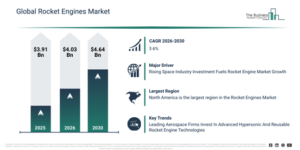
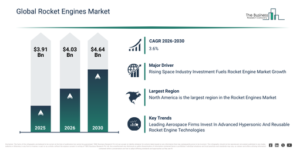
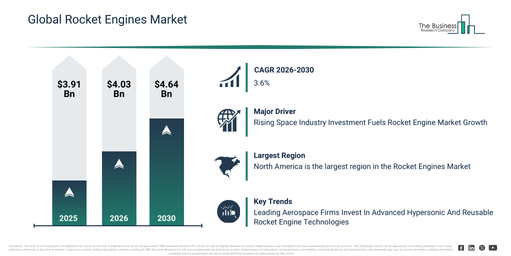
The rocket engines market has demonstrated consistent expansion in recent years. It is projected to grow from $3.91 billion in 2025 to $4.03 billion in 2026, achieving a compound annual growth rate (CAGR) of 3.1%. This historical growth can be ascribed to several factors: an increase in government-funded space exploration programs leading to higher rocket engine procurement; a heightened demand for launch services to deploy commercial and defense satellites; advancements in liquid and solid propulsion technologies, which improved engine performance; the past expansion of private space companies securing engine development contracts; and a greater reliance on MRO and refurbishment services for reusable rocket engines.
The rocket engines market size is projected to experience consistent expansion over the upcoming years. By 2030, this market is anticipated to reach $4.64 billion, achieving a compound annual growth rate (CAGR) of 3.6%. This expected growth is primarily driven by factors such as the increasing commercial spaceflight and tourism sectors, which stimulate new rocket engine manufacturing. Additionally, the wider adoption of reusable propulsion systems is contributing to lower launch expenses. Other contributing factors include greater investments in high-thrust and high-efficiency engines for deep space explorations, and the rising need for small satellite launchers, which encourages the creation of compact rocket engines. Furthermore, an anticipated rise in hybrid and green propellant technologies is influencing the design of future engine models. Significant trends predicted for this period encompass improvements in reusable rocket engines, the miniaturization of propulsion systems for smaller satellites, and the evolution of hybrid propulsion technologies. A strong emphasis on high-efficiency fuel and combustion systems, alongside the expansion of commercial space launch services, will also be prominent.
Download A Free Sample Report For Comprehensive Market Insights:
#Rocket Engines Market Demand Drivers Creating New Revenue Opportunities
Growing financial commitments within the space industry are expected to stimulate the expansion of the rocket engine market going forward. Investment in the space industry refers to the allocation of funds or resources to support activities related to space exploration, satellite technology, commercial space ventures, or other aerospace projects, with the aim of generating financial returns or advancing scientific and technological goals. Such investment is vital for advancing rocket engine technology, leading to more capable, cost-effective, and sustainable propulsion systems for space exploration and satellite deployment. For instance, in 2023, according to The Space Report by Space Foundation, a US-based organization, the global space economy reached a new high of $570 billion in 2023, an increase of 7.4% from a revised 2022 figure of $531 billion. Therefore, increasing investment in the space industry is driving the growth of the rocket engine market.
Rocket Engines Market Categorization By Product Type And Application
The rocket engines market covered in this report is segmented –
1) By Propulsion Technology: Physically Powered, Chemically Powered, Electrically Powered, Thermal, Nuclear Rocket Engines
2) By Product Type: Liquid Rocket Engines, Solid Rocket Engines
3) By Application: Spacecraft, Ballistic Missiles, Others
Subsegments:
1) By Physically Powered: Mechanical Engines, Solid Propulsion Systems
2) By Chemically Powered: Liquid Rocket Engines, Solid Rocket Motors, Hybrid Rocket Engines
3) By Electrically Powered: Ion Thrusters, Hall Effect Thrusters, Electrospray Propulsion Systems
4) By Thermal: Nuclear Thermal Propulsion (NTP), Thermal Rocket Engines
5) By Nuclear Rocket Engines: Fission-Based Propulsion Systems, Fusion-Based Propulsion Systems (In Development)
Rocket Engines Market Trends: What Is Shaping Future Industry Growth?
Leading companies in the rocket engines market are focusing on developing innovative solutions, such as hypersonic propulsion demonstrations, to advance high-speed flight capabilities, enhance engine efficiency, and accelerate next-generation aerospace technologies. A hypersonic propulsion demonstration refers to a test or trial of engine technologies crafted to achieve and sustain speeds greater than Mach 5, illustrating the engine’s capacity for high-speed flight, thermal management, and efficient thrust generation under extreme aerodynamic conditions. For instance, in October 2025, Lockheed Martin Ventures, a US-based aerospace company, executed a strategic investment in Venus Aerospace, a Houston-based rocket propulsion startup specializing in next-generation rotating detonation rocket engine (RDRE) technology. This investment aims to assist Venus in scaling production and deploying its RDRE, which is reusable and throttleable, intended to reduce launch costs and provide mission flexibility for defense, space, and commercial high-speed aviation.
Rocket Engines Market Company Landscape And Strategic Competition
Major companies operating in the rocket engines market are Aerojet Rocketdyne Holdings, Inc., Space Exploration Technologies Corp., Northrop Grumman Corporation, Mitsubishi Heavy Industries, Ltd., Blue Origin, LLC, IHI Corporation, National Aeronautics and Space Administration (NASA), Lockheed Martin Corporation, China Aerospace Science and Technology Corporation (CASC), Roscosmos, Skyroot Aerospace, Gilmour Space Technologies, Deep Blue Aerospace, Reaction Engines, Roll- Royce Limited, Skyrora, Safran Aircraft Engines, Roxel, Pangea Aerospace, AVIO, ARCA space, ISAR Aerospace, EDePro, GKN Aerospace, Boeing Defence, Space & Security, Raytheon, Maxar Space, SpaceX, Orbital ATK, Virgin Galactic, Rocket Lab, Avibras Indústria Aeroespacial S/A, Israel Aerospace Industries, The Boeing Company
Access The Complete Rocket Engines Market Report:
#Rocket Engines Market Largest Region: Which Geography Holds The Highest Market Share?
North America was the largest region in the rocket engines market in 2025. North America is expected to be the fastest-growing region in the global rocket engines market share during the forecast period. The regions covered in the rocket engines market report are Asia-Pacific, South East Asia, Western Europe, Eastern Europe, North America, South America, Middle East, Africa.
Access a Customized Rocket Engines Market Report for Deeper Competitive Insights
https://www.thebusinessresearchcompany.com/customise?id=3670&type=smp
The Business Research Company: https://www.thebusinessresearchcompany.com/
Americas: +1 310-496-7795
Asia: +44 7882 955267 & +91 8897263534
Europe: +44 7882 955267
Email us at: marketing@tbrc.info
Follow us on:
LinkedIn: https://in.linkedin.com/company/the-business-research-company
YouTube: https://www.youtube.com/channel/UC24_fI0rV8cR5DxlCpgmyFQ
Global Market Model: https://www.thebusinessresearchcompany.com/global-market-model

Wasay has over a decade of experience in market research, data modelling, and analytics, with prior experience at GlobalData and Decision Tree Consulting Services. At The Business Research Company , he leads research operations across syndicated studies, customized consulting engagements, and the Global Market Model platform. His professional experience includes supporting organizations such as Boston Consulting Group, KPMG, and Ernst & Young. Wasay holds a degree in Electronics and Communications Engineering, postgraduate management qualifications from International Management Institute Belgium and Indian School of Business and Entrepreneurship, and completed the Integrated Program in Business Analytics from Indian Institute of Management Indore.