
The Business Research Company’s 2026 market reports combine market attractiveness scoring, total addressable market sizing, company benchmarking matrices, interactive Excel dashboards, deeper supply chain intelligence, emerging startup tracking, and granular product-level insights to deliver research that is more actionable and strategically valuable.
Rocket Nozzle Expansion Systems Market Size Review: What Shaped Past Growth And What Will Drive Future Expansion?
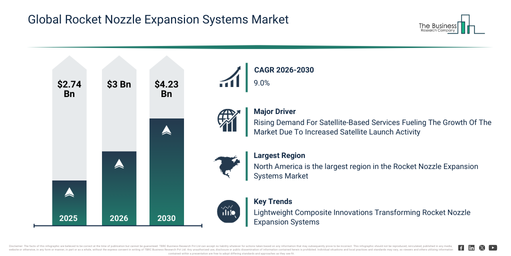
The rocket nozzle expansion systems market size has experienced strong growth over recent years. It is forecast to increase from $2.74 billion in 2025 to $3 billion in 2026, demonstrating a compound annual growth rate (CAGR) of 9.5%. This historical expansion can be attributed to advancements in high-temperature materials which enable reliable nozzle expansion performance, the early development of plug and annular nozzles to improve flow expansion control, an increasing requirement for higher specific impulse driving research into altitude-compensating nozzle designs, the adoption of linear aerospike concepts in experimental launch vehicles to enhance efficiency, and the growth of government propulsion programs that demand optimized nozzle geometries for variable-altitude missions.
The rocket nozzle expansion systems market is anticipated to experience substantial growth over the next few years. It is projected to reach $4.23 billion by 2030, exhibiting a compound annual growth rate (CAGR) of 9.0%. This growth during the forecast period is primarily driven by the expansion of commercial launch activities, which increases the demand for high-efficiency nozzle systems, and innovation in advanced manufacturing, enabling complex aerospike and toroidal nozzle structures. Other contributing factors include a rising emphasis on reusable rockets, necessitating durable and thermally resilient nozzle expansion systems, advancements in multi-altitude mission profiles that drive the adoption of altitude-compensating technologies, and growing investment in deep-space propulsion, which boosts demand for next-generation optimized nozzle designs. Major trends expected in this period involve advancements in high-altitude nozzle efficiency, an increase in thermal load management innovations, the adoption of multi-geometry nozzle designs, the growth of high-performance materials for nozzle manufacturing, and enhanced testing and validation of supersonic flow dynamics.
Access Free Sample Pages From The Rocket Nozzle Expansion Systems Market Report 2026:
Understanding The Main Driver Of The Rocket Nozzle Expansion Systems Market
The increasing need for satellite-based services is anticipated to drive the expansion of the rocket nozzle expansion systems market in the future. These services encompass applications utilizing satellites for various functions such as communication, navigation, Earth observation, and global data exchange, particularly benefiting remote or underserved regions. This expansion of satellite-based services stems from a significant rise in satellite constellations, which are designed to broaden broadband access as both governmental and private entities compete to provide high-speed internet to rural and previously unserved locations. Rocket nozzle expansion systems contribute to satellite-based services by boosting the thrust efficiency of launch vehicles, facilitating more accurate orbital placement, and enhancing overall mission reliability. For example, data released in June 2024 by the US-based Satellite Industry Association indicated that the commercial satellite industry achieved unprecedented growth in 2023, deploying 2,781 satellites, which represents a 20% increase compared to 2022. Furthermore, the space sector reached a new achievement with 190 total launches, marking the highest number ever documented. By year-end, the count of operational satellites reached 9,691, demonstrating a 361% surge over the preceding five years. Consequently, the escalating demand for satellite-based services is propelling the expansion of the rocket nozzle expansion systems market.
Rocket Nozzle Expansion Systems Market Segment Mapping For 2026 And Beyond
The rocket nozzle expansion systems market covered in this report is segmented –
1) By Type: Conical Nozzles, Bell Nozzles, Expansion Deflection Nozzles, Dual Bell Nozzles, Other Types
2) By Material: Metal Alloys, Composite Materials, Other Materials
3) By Application: Aerospace, Defense, Space Exploration, Other Applications
4) By End User: Commercial, Military, Government
Subsegments:
1) By Conical Nozzles: Fixed Conical Nozzles, Variable Conical Nozzles
2) By Bell Nozzles: Single Bell Nozzles, Extended Bell Nozzles, Stepped Bell Nozzles
3) By Expansion Deflection Nozzles: Fixed Expansion Deflection Nozzles, Variable Expansion Deflection Nozzles
4) By Dual Bell Nozzles: Fixed Dual Bell Nozzles, Variable Dual Bell Nozzles
5) By Other Types: Aerospike Nozzles, Plug Nozzles, Stepped Nozzles, Altitude Compensating Nozzles
What Key Trend Is Expected To Shape The Rocket Nozzle Expansion Systems Market Over The Forecast Period?
Major companies operating in the rocket nozzle expansion systems market are focusing on developing technologically advanced solutions, such as lightweight carbon composite nozzles, to decrease structural weight, enhance thrust efficiency, and improve thermal resistance. A lightweight carbon composite nozzle is a rocket nozzle fabricated from high-strength carbon-based materials that reduce overall weight while maintaining excellent thermal and structural performance during launches. For instance, in April 2024, the Indian Space Research Organisation (ISRO), an India-based space agency, launched a lightweight carbon-carbon (C-C) divergent nozzle, which is approximately 67% lighter than the previously utilized columbium alloy nozzle. It offers high thermal resistance, a low erosion rate, and superior dimensional stability under extreme conditions. This advancement enhances payload capacity by around 15 kg, improves specific impulse efficiency, and optimizes vehicle performance with reduced inert mass. It is designed for long-duration burns in a vacuum, making it ideal for upper-stage propulsion in space missions.
Rocket Nozzle Expansion Systems Market Major Players And Industry Competition Overview
Major companies operating in the rocket nozzle expansion systems market are The Boeing Company, Northrop Grumman Systems Corporation, Mitsubishi Heavy Industries Ltd., Safran S.A., Rolls-Royce Holdings plc, Space Exploration Technologies Corp., Blue Origin LLC, ArianeGroup SAS, The Lee Company, Karman Space & Defense Corp., Firefly Aerospace Inc., Indian Space Research Organisation, Ursa Major Technologies Inc., Weldaloy Products Co., PMF Industries Inc., Nacco Aerospace And Defense Inc., Astra Space Inc., Loki Research Inc., Skyrora Limited, Helander Metal Spinning Company Inc.
Full Rocket Nozzle Expansion Systems Market Report: Market Size, Trends, Segments And Key Players:
Rocket Nozzle Expansion Systems Market Geographic Segmentation: Regions Covered In The Report
North America was the largest region in the rocket nozzle expansion systems market in 2025. Asia-Pacific is expected to be the fastest-growing region in the forecast period. The regions covered in the rocket nozzle expansion systems market report are Asia-Pacific, South East Asia, Western Europe, Eastern Europe, North America, South America, Middle East, Africa.
Reach Out To Our Team:
The Business Research Company: https://www.thebusinessresearchcompany.com/
Americas: +1 310-496-7795
Asia: +44 7882 955267 & +91 8897263534
Europe: +44 7882 955267
Email us at: marketing@tbrc.info
Follow us on:
LinkedIn: https://in.linkedin.com/company/the-business-research-company
YouTube: https://www.youtube.com/channel/UC24_fI0rV8cR5DxlCpgmyFQ
Global Market Model: https://www.thebusinessresearchcompany.com/global-market-model

Wasay has over a decade of experience in market research, data modelling, and analytics, with prior experience at GlobalData and Decision Tree Consulting Services. At The Business Research Company , he leads research operations across syndicated studies, customized consulting engagements, and the Global Market Model platform. His professional experience includes supporting organizations such as Boston Consulting Group, KPMG, and Ernst & Young. Wasay holds a degree in Electronics and Communications Engineering, postgraduate management qualifications from International Management Institute Belgium and Indian School of Business and Entrepreneurship, and completed the Integrated Program in Business Analytics from Indian Institute of Management Indore.

