
Market attractiveness scoring, total addressable market sizing, company benchmarking matrices, interactive Excel dashboards, deeper supply chain intelligence, emerging startup tracking, and granular product-level insights are among the key offerings featured in The Business Research Company’s 2026 market reports, designed to deliver more actionable and strategically valuable research.
Rocket Multi-Stage Systems Market On Course To Reach $11.66 Billion By 2030: Size And Growth Overview
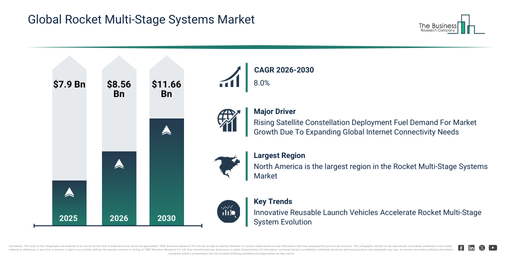
The rocket multi-stage systems market size has experienced significant growth in recent years. It is anticipated to expand from $7.9 billion in 2025 to $8.56 billion in 2026, registering a compound annual growth rate (CAGR) of 8.4%. This historical expansion can be attributed to an escalating demand for superior orbital insertion capability, which prompted the early adoption of multi-stage architectures; the development of advanced airframes facilitating efficient stage separation and structural stability; the proliferation of government deep-space missions necessitating multi-stage launch vehicles; breakthroughs in navigation systems enhancing stage-to-stage transition accuracy; and the initial integration of interplanetary probes, which required more powerful multi-stage configurations.
The market size for rocket multi-stage systems is anticipated to demonstrate significant expansion over the next few years. It is projected to reach $11.66 billion by 2030, exhibiting a compound annual growth rate (CAGR) of 8.0%. This growth during the forecast period is primarily driven by an uptick in commercial launch activity, which boosts the need for cost-efficient multi-stage systems; innovations in lightweight composite airframes that enhance payload capacity and stage performance; advancements in autonomous navigation allowing for more precise and reliable stage operations; increasing interest in lunar and Mars missions necessitating high-energy multi-stage vehicles; and the wider adoption of reusable and partially reusable stage technologies, which in turn stimulates new multi-stage system designs. Significant trends expected in this forecast period include developments in stage separation mechanism designs, the integration of highly durable structural materials, a rise in the use of modular stage configurations, improved precision in multi-stage payload deployment, and the increasing embrace of cost-optimized propulsion architectures.
Need Rocket Multi-Stage Systems Market Forecasts? Get Your Free Sample Report Here:
Rocket Multi-Stage Systems Market Growth Factors: What Is Strengthening Demand Worldwide?
The increasing need for satellite constellation deployment is projected to boost the growth of the rocket multi-stage systems market in the foreseeable future. This deployment method entails sending and arranging many satellites into coordinated orbits to operate together as a cohesive network, offering worldwide or local coverage. The rising requirement for global high-speed internet connectivity, especially in isolated areas lacking adequate traditional infrastructure, is driving this demand. Rocket multi-stage systems facilitate satellite constellation deployment by delivering numerous satellites into precise orbits, achieving this via progressive weight reduction, which enables larger payload capacities and broader spatial coverage. For example, as reported by the UK Space Agency, an executive agency of the department for business, innovation and skills based in the UK, in February 2025, over 2,900 satellites were launched in 2023, with mega-constellations forecast to comprise 75% of the anticipated 18,000 satellite launches by 2031. Consequently, the escalating demand for satellite constellation deployment is propelling the expansion of the rocket multi-stage systems market.
Rocket Multi-Stage Systems Market By Segment: Complete Category And Subcategory Breakdown
The rocket multi-stage systems market covered in this report is segmented –
1) By Component: Propulsion Systems, Avionics, Structural Systems, Payload Systems, Other Components
2) By Launch Vehicle Type: Small-Lift Launch Vehicles, Medium-Lift Launch Vehicles, Heavy-Lift Launch Vehicles, Super Heavy-Lift Launch Vehicles
3) By End-User: Government, Commercial, Defense
Subsegments:
1) By Propulsion Systems: Liquid Propulsion, Solid Propulsion, Hybrid Propulsion
2) By Avionics: Guidance Systems, Navigation Systems, Control Systems
3) By Structural Systems: Interstage Structures, Airframe, Fairings
4) By Payload Systems: Payload Adapters, Payload Fairings, Deployment Mechanisms
5) By Other Components: Separation Systems, Launch Support Systems, Fuel Tanks
Rocket Multi-Stage Systems Market Trend Outlook: Developments Defining The Forecast Period
Major companies operating in the rocket multi-stage systems market are focusing on developing innovative solutions, such as reusable heavy-lift orbital rockets, to address the growing demand for cost-effective satellite deployment and deep-space missions. These reusable heavy-lift orbital rockets utilize advanced propulsion and recovery systems to significantly lower launch costs and turnaround times compared to traditional expendable rockets. For instance, in January 2025, Blue Origin Enterprises LP, a US-based aerospace company, introduced the New Glenn, a next-generation, heavy-lift, two-stage orbital rocket engineered for reusability and efficiency. Standing over 320 ft tall with a 7-meter fairing, it is capable of delivering up to 45 tons to low Earth orbit (LEO). Its reusable first stage is powered by seven liquid oxygen/liquefied natural gas BE-4 engines, while the upper stage employs a hydrogen-powered BE-3U engine for high-performance orbital delivery. Built to support commercial, national security, and crewed missions, New Glenn offers deep-throttle control and minimal maintenance and is optimized for launching large constellations such as Project Kuiper, thereby helping reduce the cost of space access.
Who Is Competing For Share In The Rocket Multi-Stage Systems Market?
Major companies operating in the rocket multi-stage systems market are China Aerospace Science and Technology Corporation, Northrop Grumman Innovation Systems, Mitsubishi Heavy Industries Ltd., L3Harris Technologies Inc., IHI Corporation, Space Exploration Technologies Corp (SpaceX), Blue Origin LLC, ArianeGroup, United Launch Alliance, Relativity Space Inc., Rocket Lab USA Inc., Firefly Aerospace Inc., Avio S.p.A, Indian Space Research Organisation, Rocket Factory Augsburg AG, Isar Aerospace Technologies GmbH, Yuzhnoye Design Office, PLD Space, Skyrora Ltd., Skyroot Aerospace Private Limited, China Academy of Launch Vehicle Technology, LandSpace
Get The Full Picture With The Rocket Multi-Stage Systems Market Report:
Rocket Multi-Stage Systems Market Regional Snapshot: Leading Geography In 2025
North America was the largest region in the rocket multi-stage systems market in 2025. The regions covered in the rocket multi-stage systems market report are Asia-Pacific, South East Asia, Western Europe, Eastern Europe, North America, South America, Middle East, Africa.
Reach Out To Our Team:
The Business Research Company: https://www.thebusinessresearchcompany.com/
Americas: +1 310-496-7795
Asia: +44 7882 955267 & +91 8897263534
Europe: +44 7882 955267
Email us at: marketing@tbrc.info
Follow us on:
LinkedIn: https://in.linkedin.com/company/the-business-research-company
YouTube: https://www.youtube.com/channel/UC24_fI0rV8cR5DxlCpgmyFQ
Global Market Model: https://www.thebusinessresearchcompany.com/global-market-model

Wasay has over a decade of experience in market research, data modelling, and analytics, with prior experience at GlobalData and Decision Tree Consulting Services. At The Business Research Company , he leads research operations across syndicated studies, customized consulting engagements, and the Global Market Model platform. His professional experience includes supporting organizations such as Boston Consulting Group, KPMG, and Ernst & Young. Wasay holds a degree in Electronics and Communications Engineering, postgraduate management qualifications from International Management Institute Belgium and Indian School of Business and Entrepreneurship, and completed the Integrated Program in Business Analytics from Indian Institute of Management Indore.

