Designed to make market research more actionable and strategically valuable, The Business Research Company’s 2026 market reports feature market attractiveness scoring, total addressable market sizing, company benchmarking matrices, interactive Excel dashboards, deeper supply chain intelligence, emerging startup tracking, and granular product-level insights.
Space Militarization Market Revenue Expansion Outlook For The 2026–2030 Forecast Period
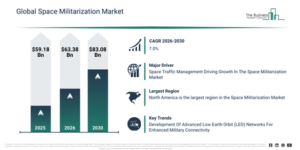
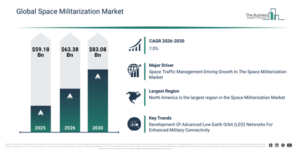
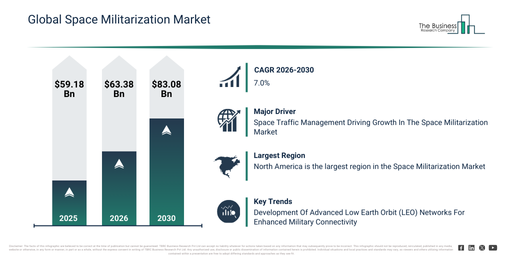
The space militarization market has experienced robust expansion in recent times. It is projected to expand from $59.18 billion in 2025 to $63.38 billion in 2026, demonstrating a compound annual growth rate (CAGR) of 7.1%. This historical increase can be ascribed to several factors, including larger government defense spending on military assets in space, innovations in space surveillance and reconnaissance technologies, the expanded use of military satellites for communication and navigation, escalating geopolitical tensions fostering space defense efforts, and the initial integration of space-based sensors and specialized spacecraft for strategic purposes.
The space militarization market is projected to experience substantial expansion in the coming years. By 2030, its value is anticipated to reach $83.08 billion, exhibiting a compound annual growth rate (CAGR) of 7.0%. This anticipated growth during the forecast period is primarily driven by several factors: the increase in space-based weaponry and offensive systems, the incorporation of AI and machine learning for self-governing space defense, increased funding for monitoring space domains and improving situational awareness, the creation of robust and adaptable military satellites and components, and a greater emphasis on integrating, maintaining, and supporting space militarization systems. Key trends identified for this period include the incorporation of AI and autonomous control into military space systems, the creation of robotic and uncrewed platforms for space, advancements in satellite communication and secure networking, the use of real-time data analytics and cybersecurity in space operations, sophisticated manufacturing of materials and parts suitable for space, the broadening of space domain awareness and surveillance, the deployment of specialized orbital weapon systems, heightened investment in space logistics and support frameworks, international cooperation for defense space missions, and an emphasis on making space assets more resilient and redundant.
Download A Free Sample For In-Depth Space Militarization Market Intelligence:
Space Militarization Market Demand Driver: How It Is Shaping Industry Growth
An increasing emphasis on space traffic management is projected to fuel the expansion of the space militarization market in the future. Space traffic management involves organizing and overseeing activities and objects in space to guarantee secure and effective operations within Earth’s orbit. The growing volume of satellites and space operations, which has resulted in greater worries regarding orbital crowding and safety, enhances the attention paid to space traffic management. Space militarization plays a role in the heightened focus on space traffic management by facilitating global operations, exercises, and logistics, as well as by creating technologies and strategies designed to safeguard space assets and maintain secure, organized orbital operations. For example, data from May 2024, reported by Gov.UK, a UK-based official website for the government of the United Kingdom, showed that in April 2024, over 9,000 active satellites were in orbit, with predictions suggesting this number might exceed 60,000 by 2030. Consequently, the increased attention on space traffic management is propelling the expansion of the space militarization market.
Space Militarization Market Segmentation Overview: Detailed Category Analysis
The space militarization market covered in this report is segmented –
1) By Type: Manned Spacecraft, Unmanned Spacecraft
2) By Capability: Defense, Support
3) By Solution: Space-Based Equipment, Space Stations, Satellites, Ground-Based Equipment, Logistics And Services
Subsegments:
1) By Manned Spacecraft: Space Shuttle Programs, Space Stations (e.g., military research stations), Manned Orbital Platforms, Military Spacecraft for Tactical Missions
2) By Unmanned Spacecraft: Satellites (Military Communication, Navigation, Reconnaissance), Unmanned Space Probes and Rovers, Space Drones and Autonomous Vehicles, Space-Based Missile Defense Systems
Top Space Militarization Market Trends And Recent Industry Developments
Leading companies operating in the space militarization market are developing advanced solutions, including extensive Low Earth Orbit (LEO) networks of military satellites, to maximize their market profitability. A Low Earth Orbit (LEO) network of military satellites describes a system of satellites positioned in a low-altitude Earth orbit, typically ranging from approximately 180 to 2,000 kilometers (112 to 1,242 miles) above the Earth’s surface. For example, in December 2023, Rocket Lab USA Inc., an aerospace technology company based in the US, was awarded a $515 million contract to build 18 satellites for a US government agency, which is thought to be the Space Development Agency (SDA). The contract involves the design, manufacturing, delivery, and operation of these satellites, slated to become part of the SDA’s low-earth orbit military satellite network, known as the Proliferated Warfighter Space Architecture. These satellites will specifically contribute to the Transport Layer Tranche 2 Beta, which consists of communication satellites designed to enable beyond-line-of-sight connectivity for military forces on the ground. These satellites are planned to carry radios that use the UHF and S-band frequencies, which are essential for voice and low-speed data transmissions used by military and intelligence units.
Space Militarization Market Company Landscape: Key Players To Watch
Major companies operating in the space militarization market are Raytheon Technologies Corporation, The Boeing Company, Lockheed Martin Corporation, Airbus SAS, General Dynamics Corporation, Northrop Grumman Corporation, Mitsubishi Heavy Industries Ltd., BAE Systems plc, L3Harris Technologies Inc., Leonardo S.p.A., Thales SA, Rheinmetall AG, Serco Group Plc, Teledyne Technologies Inc., Israel Aerospace Industries Ltd., Saab AB, Space Exploration Technologies Corp., Aerojet Rocketdyne Holdings Inc., SES SA, QinetiQ Group plc, Aselsan A.S., Orbital ATK, Maxar Technologies Inc., Kratos Defense & Security Solutions Inc., Ball Aerospace & Technologies Corp., Cobham plc
Explore The Space Militarization Global Market Report For Full Insights:
Space Militarization Market Region-Wise Analysis: Largest Regional Market Identified
North America was the largest region in the space militarization market in 2025. Asia-Pacific is expected to be the fastest-growing region in the forecast period. The regions covered in the space militarization market report are Asia-Pacific, South East Asia, Western Europe, Eastern Europe, North America, South America, Middle East, Africa.
Reach Out To Our Team:
The Business Research Company: https://www.thebusinessresearchcompany.com/
Americas: +1 310-496-7795
Asia: +44 7882 955267 & +91 8897263534
Europe: +44 7882 955267
Email us at: marketing@tbrc.info
Follow us on:
LinkedIn: https://in.linkedin.com/company/the-business-research-company
YouTube: https://www.youtube.com/channel/UC24_fI0rV8cR5DxlCpgmyFQ
Global Market Model: https://www.thebusinessresearchcompany.com/global-market-model

Wasay has over a decade of experience in market research, data modelling, and analytics, with prior experience at GlobalData and Decision Tree Consulting Services. At The Business Research Company , he leads research operations across syndicated studies, customized consulting engagements, and the Global Market Model platform. His professional experience includes supporting organizations such as Boston Consulting Group, KPMG, and Ernst & Young. Wasay holds a degree in Electronics and Communications Engineering, postgraduate management qualifications from International Management Institute Belgium and Indian School of Business and Entrepreneurship, and completed the Integrated Program in Business Analytics from Indian Institute of Management Indore.