The Business Research Company’s 2026 market reports are designed to deliver research that is more actionable and strategically valuable. Key offerings include market attractiveness scoring, total addressable market sizing, company benchmarking matrices, interactive Excel dashboards, deeper supply chain intelligence, emerging startup tracking, and granular product-level insights.
Which Factors Will Shape The Space Law Enforcement Market Size Through 2030?
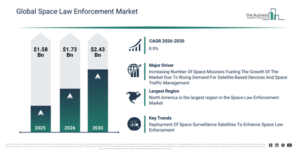
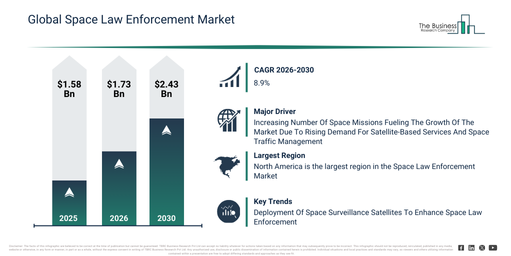
The market size for space law enforcement has shown significant growth over recent years. It is projected to increase from $1.58 billion in 2025 to $1.73 billion in 2026, demonstrating a compound annual growth rate (CAGR) of 9.5%. Historically, this expansion has stemmed from several factors, including the initial creation of licensing and authorization systems for commercial satellite operators, the nascent development of regulatory compliance structures consistent with international space agreements, a heightened demand for oversight in debris mitigation due to escalating orbital crowding, an increase in satellite traffic necessitating fundamental space traffic management enforcement initiatives, and the introduction of dispute resolution and arbitration services for commercial space disagreements.
The space law enforcement market size is anticipated to experience substantial growth in the coming years, with projections indicating an expansion to $2.43 billion by 2030, driven by a compound annual growth rate (CAGR) of 8.9%. This forecast growth is primarily attributable to the broader implementation of global space traffic management enforcement as mega-constellations become more prevalent, coupled with an increasing demand for ongoing monitoring services to ensure adherence to evolving space regulations. Further contributing factors include the creation of advanced oversight systems for both debris mitigation and active debris removal initiatives, a rising need for legal arbitration services as commercial space operations diversify, and strengthened collaboration among national regulators to reinforce unified space governance structures. Key trends influencing this period encompass a growing global emphasis on orbit compliance and regulatory enforcement, the ongoing expansion of commercial satellite constellations necessitating legal oversight, an increasing requirement for international dispute resolution mechanisms, a heightened focus on compliance with debris mitigation efforts, and advancements in cross-border space traffic coordination frameworks.
Request A Free Space Law Enforcement Market Sample To Support Your Strategic Planning:
What Is Propelling The Space Law Enforcement Market Toward $2.43 Billion By 2030?
A rising number of space missions is projected to drive expansion in the space law enforcement market moving ahead. These missions are predefined ventures or undertakings that deploy spacecraft into space for exploration, research, or the utilization of outer space. The proliferation of space missions stems from an escalating demand for communication services reliant on satellites, as both governmental bodies and private enterprises aim to broaden worldwide internet access and improve data transfer capabilities. To guarantee that space missions are executed securely and accountably, space law enforcement works to avert legal breaches, control space traffic, and minimize the danger of crashes or disruptions involving other space-based assets. For example, the Space Foundation, a US-based non-profit organization, reported in January 2025 that 2024 saw 259 space mission launches, occurring on average every 34 hours, which was five hours more frequently than in 2023. Consequently, the rising volume of space missions is fueling the expansion of the space law enforcement market.
What Are The Key Segments And Subsegments In The Space Law Enforcement Market?
The space law enforcement market covered in this report is segmented –
1) By Component: Software, Hardware, Services
2) By Application: Satellite Monitoring, Space Traffic Management, Space Debris Tracking, Compliance And Regulation, Other Applications
3) By End-User: Government Agencies, Private Space Companies, Defense Organizations, Other End-Users
Subsegments:
1) By Software: Satellite Mission Planning Software, Ground Control Software, Data Analysis And Visualization Tools, Simulation And Modeling Software, Navigation And Mapping Software, AI-Powered Threat Detection Systems, Space Traffic Management Software
2) By Hardware: Onboard Computers, Communication Systems, Sensors And Cameras, Antennas And Transceivers, Radar Systems, Power Supply Units, Launch Vehicle Components
3) By Services: Satellite Operation And Management, Data Processing And Analytics, Ground Station Services, Space Surveillance And Tracking, Integration And Testing Services, Maintenance And Support Services, Regulatory Compliance And Consulting
Space Law Enforcement Market Trends Behind The 8.9% CAGR Forecast
Leading companies in the space law enforcement market are prioritizing the development of technological advancements, particularly commercial space surveillance satellites, for the real-time observation of orbital objects. This effort aims to enhance situational awareness, ensure adherence to regulations, and reduce collision risks in increasingly crowded orbits. These space surveillance satellites employ advanced electro-optical sensors in sun-synchronous orbits to detect and track resident space objects (RSOs), including both satellites and debris, offering superior revisit rates and precision compared to traditional ground-based monitoring systems. As an illustration, in January 2025, Digantara Research & Technologies, a space technology company based in Bengaluru, India, launched the SCOT (Space Camera for Object Tracking) satellite. This satellite is notable as the world’s first commercial satellite capable of tracking objects as small as 5 centimeters in orbit. The SCOT satellite delivers real-time situational awareness, assists in complying with international space laws, and contributes to the sustainable management of Low Earth Orbit by mitigating collision hazards and refining orbital traffic regulation.
Major Companies Profiled In The Space Law Enforcement Market Report
Major companies operating in the space law enforcement market are Raytheon Technologies Corporation, The Boeing Company, Lockheed Martin Corporation, Northrop Grumman Corporation, Airbus Defence and Space GmbH, Thales Alenia Space SAS, Hogan Lovells US LLP, Greenberg Traurig LLP, Holland & Knight LLP, Anduril Industries Inc., Astroscale Pte. Ltd., Capella Space Corp., Turion Space Ltd., UnseenLabs S.A.S., LeoLabs Inc., HawkEye 360 Inc., Xage Security Inc., Kleos Space S.A., Schroeder Law PLLC, SpiderOak Mission Systems LLC
Explore The Business Research Company’s Complete Space Law Enforcement Market Report:
Where Does The Space Law Enforcement Market Generate The Most Revenue?
North America was the largest region in the space law enforcement market in 2025. The regions covered in the space law enforcement market report are Asia-Pacific, South East Asia, Western Europe, Eastern Europe, North America, South America, Middle East, Africa.
Reach Out To Our Team:
The Business Research Company: https://www.thebusinessresearchcompany.com/
Americas: +1 310-496-7795
Asia: +44 7882 955267 & +91 8897263534
Europe: +44 7882 955267
Email us at: marketing@tbrc.info
Follow us on:
LinkedIn: https://in.linkedin.com/company/the-business-research-company
YouTube: https://www.youtube.com/channel/UC24_fI0rV8cR5DxlCpgmyFQ
Global Market Model: https://www.thebusinessresearchcompany.com/global-market-model

Wasay has over a decade of experience in market research, data modelling, and analytics, with prior experience at GlobalData and Decision Tree Consulting Services. At The Business Research Company , he leads research operations across syndicated studies, customized consulting engagements, and the Global Market Model platform. His professional experience includes supporting organizations such as Boston Consulting Group, KPMG, and Ernst & Young. Wasay holds a degree in Electronics and Communications Engineering, postgraduate management qualifications from International Management Institute Belgium and Indian School of Business and Entrepreneurship, and completed the Integrated Program in Business Analytics from Indian Institute of Management Indore.