Market attractiveness scoring, total addressable market sizing, company benchmarking matrices, interactive Excel dashboards, deeper supply chain intelligence, emerging startup tracking, and granular product-level insights are among the key offerings featured in The Business Research Company’s 2026 market reports, designed to deliver more actionable and strategically valuable research.
Space Power Supply Market On Course To Reach $4.27 Billion By 2030: Size And Growth Overview
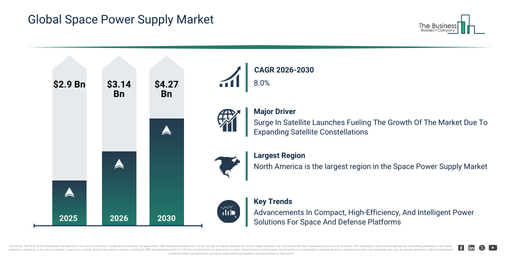
The space power supply market has seen strong growth in recent years. It is forecast to expand from $2.9 billion in 2025 to $3.14 billion in 2026, at a compound annual growth rate (CAGR) of 8.2%. The expansion during prior periods can be attributed to the integration of solar panels and lithium-ion batteries in spacecraft, the advancement of nickel-hydrogen batteries and thermoelectric generators, an increase in spacecraft and satellite missions, enhancements in power converters and voltage regulators, and financial commitments to long-duration space missions.
The space power supply market is projected to experience substantial expansion in the coming years. It is set to reach $4.27 billion by 2030, exhibiting a compound annual growth rate (CAGR) of 8.0%. This expansion during the forecast period is attributable to several factors, including the progress in high-efficiency solar and battery technologies, their implementation in reusable and modular spacecraft, the creation of supercapacitors and hybrid power systems, their integration into next-generation satellite and spacecraft platforms, and a rise in their use for deep-space missions. Key trends anticipated for the forecast period encompass a rising embrace of high-efficiency solar arrays, a greater need for radiation-hardened power components, breakthroughs in long-duration energy storage for deep-space operations, the miniaturization of power systems designed for small satellites, and the swift integration of hybrid power generation architectures.
Need Space Power Supply Market Forecasts? Get Your Free Sample Report Here:
Space Power Supply Market Growth Factors: What Is Strengthening Demand Worldwide?
The expansion of the space power supply market is anticipated to be driven by the rising volume of satellite launches. These launches encompass the deployment of artificial satellites into orbit around Earth or other celestial bodies via rockets or launch vehicles, serving objectives such as communication, navigation, Earth observation, or scientific investigations. The count of satellite launches has seen a consistent increase, primarily due to the widespread development of satellite constellations designed to improve global communication, navigation, and Earth observation capacities. For these launches, a dependable space power supply is crucial, delivering consistent energy for onboard systems, maintaining communication links, and ensuring payload operation throughout the mission. As an illustration, in November 2023, data from the United States International Trade Commission, a US-based federal agency, revealed that annual global space launches grew from 186 in 2022 to 197 in 2023. Consequently, the increasing frequency of satellite launches is fueling the growth of the space power supply market.
Space Power Supply Market By Segment: Complete Category And Subcategory Breakdown
The space power supply market covered in this report is segmented –
1) By Product Type: Power Management Systems, Power Distribution Units, Power Generation Units, Energy Storage Systems
2) By Technology Type: Solar Power Systems, Nuclear Power Systems, Chemical Batteries, Fuel Cells, Thermal Energy Systems
3) By Form Factor: Standalone Power Units, Modular Power Systems, Integrated Power Systems, Portable Power Supply Units
4) By Application: Satellite Systems, Space Exploration Missions, International Space Station (ISS), Space Rovers And Landers, Orbital Platforms
5) By End User: Government Agencies, Private Space Companies, Aerospace Manufacturers, Research Institutions
Subsegments:
1) By Power Management Systems: Battery Management Systems, Power Conditioning Units, Voltage Regulators, Load Controllers, Energy Management Controllers
2) By Power Distribution Units: Switchgear Units, Circuit Breakers, Busbars, Power Relays, Distribution Panels
3) By Power Generation Units: Solar Panels, Fuel Cells, Radioisotope Thermoelectric Generators, Thermal Generators, Dynamic Power Generators
4) By Energy Storage Systems: Lithium Ion Batteries, Nickel Hydrogen Batteries, Supercapacitors, Flywheel Energy Storage, Solid State Batteries
Space Power Supply Market Trend Outlook: Developments Defining The Forecast Period
Leading companies operating within the space power supply market are concentrating on developing innovative offerings, including specialized power supply modules for space environments. These developments aim to furnish compact, highly efficient, and reliable power provisions for satellites, unmanned aerial systems, and other platforms in space, thereby facilitating longer mission lifespans and reducing thermal management necessities. A space-optimized power supply module is defined as a compact, highly efficient power conversion apparatus engineered to deliver dependable electrical power while minimizing its physical footprint, weight, and thermal output. For instance, in July 2025, Frontgrade Technologies Inc., a US-based aerospace and defense entity, launched the PSM28 Power Supply Module, which is a space-optimized power supply module. This compact, rugged, and high-output power solution is specifically designed for SWaP-constrained platforms such as small satellites, unmanned aerial systems, and electronic warfare systems. It provides up to 150W of reliable, regulated voltages, complemented by flexible multi-output distribution, real-time telemetry, temperature sensing, and predictive maintenance capabilities, all fine-tuned for seamless incorporation into modular mission systems under the MAMBA initiative.
Who Is Competing For Share In The Space Power Supply Market?
Major companies operating in the space power supply market are Airbus Group SE, Raytheon Technologies Corporation Inc., Lockheed Martin Corporation, Northrop Grumman Corporation, Mitsubishi Electric Corporation, BAE Systems plc, L3Harris Technologies Inc., Jinko Solar Holding Co. Ltd., Teledyne Technologies Incorporated, GS Yuasa International Ltd., Thales Alenia Space S.p.A., Maxar Technologies Inc., Rocket Lab USA Inc., Spectrolab Inc., ISISPACE Group Ltd., GomSpace AB, NanoAvionics UAB, AAC Clyde Space Ltd., DHV Technology Ltd., EnduroSat Ltd., mPower Technology Inc.
Get The Full Picture With The Space Power Supply Market Report:
Space Power Supply Market Regional Snapshot: Leading Geography In 2025
North America was the largest region in the space power supply market in 2025. Asia-Pacific is expected to be the fastest-growing region in the forecast period. The regions covered in the space power supply market report are Asia-Pacific, South East Asia, Western Europe, Eastern Europe, North America, South America, Middle East, Africa.
Reach Out To Our Team:
The Business Research Company: https://www.thebusinessresearchcompany.com/
Americas: +1 310-496-7795
Asia: +44 7882 955267 & +91 8897263534
Europe: +44 7882 955267
Email us at: marketing@tbrc.info
Follow us on:
LinkedIn: https://in.linkedin.com/company/the-business-research-company
YouTube: https://www.youtube.com/channel/UC24_fI0rV8cR5DxlCpgmyFQ
Global Market Model: https://www.thebusinessresearchcompany.com/global-market-model

Wasay has over a decade of experience in market research, data modelling, and analytics, with prior experience at GlobalData and Decision Tree Consulting Services. At The Business Research Company , he leads research operations across syndicated studies, customized consulting engagements, and the Global Market Model platform. His professional experience includes supporting organizations such as Boston Consulting Group, KPMG, and Ernst & Young. Wasay holds a degree in Electronics and Communications Engineering, postgraduate management qualifications from International Management Institute Belgium and Indian School of Business and Entrepreneurship, and completed the Integrated Program in Business Analytics from Indian Institute of Management Indore.