The Business Research Company’s 2026 market reports combine market attractiveness scoring, total addressable market sizing, company benchmarking matrices, interactive Excel dashboards, deeper supply chain intelligence, emerging startup tracking, and granular product-level insights to deliver research that is more actionable and strategically valuable.
Space Power Systems Market Size Review: What Shaped Past Growth And What Will Drive Future Expansion?
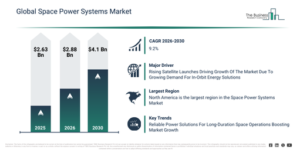
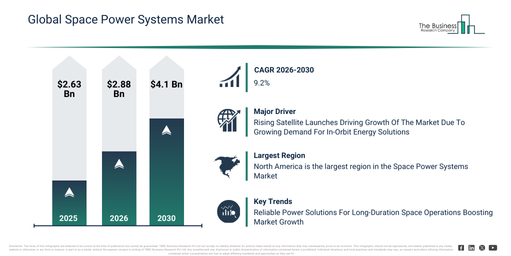
The space power systems market has experienced robust growth over recent years. Its size is projected to increase from $2.63 billion in 2025 to $2.88 billion in 2026, reflecting a compound annual growth rate (CAGR) of 9.5%. This historical expansion can be attributed to factors such as the development of radioisotope thermoelectric generators for powering deep space missions, the early implementation of radioisotope heater units for thermal regulation in extreme environments, initial research into wireless power transmission for space applications, advancements in fuel cell technology for long-duration spacecraft energy supply, and a heightened demand for backup power systems to support mission-critical satellite operations.
The market for space power systems is projected to experience robust expansion in the coming years. Its valuation is anticipated to reach $4.1 billion by 2030, exhibiting a compound annual growth rate (CAGR) of 9.2%. This expansion during the forecast timeframe is primarily driven by several factors: the increasing deployment of high-power satellites necessitating sophisticated energy generation setups, the broadening of wireless power transmission technologies for both lunar and orbital infrastructure, the creation of advanced radioisotope systems that offer enhanced efficiency and reduced mass, the growing adoption of modular energy storage and distribution units to facilitate adaptable spacecraft designs, and increased capital flow into sustainable space power solutions that underpin extended human and robotic missions. Key trends anticipated during this period encompass breakthroughs in high-efficiency photovoltaic and solar array technologies, a greater uptake of radioisotope thermoelectric generators for deep-space explorations, an escalating need for energy-dense storage solutions to support prolonged missions, the continued evolution of modular and scalable spacecraft power architectures, and the proliferation of commercial spacecraft and satellite deployments that demand dependable onboard power.
Access Free Sample Pages From The Space Power Systems Market Report 2026:
Understanding The Main Driver Of The Space Power Systems Market
The growing frequency of satellite deployments is projected to fuel the expansion of the space power systems market in the future. These launches involve placing satellites into orbit with launch vehicles for uses like communication, Earth observation, navigation, and scientific studies. This rise in satellite launches is mainly spurred by the global demand for broader high-speed internet coverage, facilitated by mega-constellations like Starlink and OneWeb. Space power systems play a crucial role by supplying dependable energy for satellite operations, propulsion, and communication once in orbit. For example, as reported by the Indian Space Research Organisation (ISRO), an India-based space agency, in April 2024, the year 2023 saw 3,143 space objects introduced into orbit from 212 launches and on-orbit break-up events, which is a considerable jump from the 2,533 objects from 179 launches in 2022. Consequently, the escalating volume of satellite launches is propelling the space power systems market’s growth.
Space Power Systems Market Segment Mapping For 2026 And Beyond
The space power systems market covered in this report is segmented –
1) By Type: Solar Power Systems, Nuclear Power Systems, Fuel Cells, Other Types
2) By Power Source: Photovoltaic, Radioisotope Thermoelectric Generators, Chemical, Other Power Sources
3) By Application: Satellites, Spacecraft, Rovers, Space Stations, Other Applications
4) By End-User: Commercial, Government, Defense
Subsegments:
1) By Solar Power Systems: Photovoltaic (PV) Panels, Solar Arrays, Power Conditioning Units (PCUs), Energy Storage, Solar Tracking Systems
2) By Nuclear Power Systems: Radioisotope Thermoelectric Generators (RTGs), Fission Surface Power Systems, Nuclear Thermal Propulsion Power Units, Dynamic Isotope Power Systems (DIPS)
3) By Fuel Cells: Hydrogen Fuel Cells, Solid Oxide Fuel Cells (SOFC), Proton Exchange Membrane Fuel Cells (PEMFC), Direct Methanol Fuel Cells (DMFC)
4) By Other Types: Chemical Batteries, Flywheel Energy Storage, Hybrid Power Systems, Capacitor-Based Systems
What Key Trend Is Expected To Shape The Space Power Systems Market Over The Forecast Period?
Leading companies in the space power systems market are focusing on technological advancements like polymer electrolyte membrane fuel cells to boost energy efficiency, lighten system weight, and provide reliable power for long-duration space missions. A polymer electrolyte membrane fuel cell (PEMFC) is an energy conversion device that generates electricity through an electrochemical reaction between hydrogen and oxygen, utilizing a solid polymer membrane as the electrolyte and functioning efficiently at low temperatures. For instance, in January 2024, the Indian Space Research Organisation (ISRO), an India-based space agency, launched a 100-watt class Polymer Electrolyte Membrane Fuel Cell (PEMFC) power system aboard the orbital platform POEM3, which was launched on PSLV-C58. This technology, adept at converting hydrogen and oxygen into electricity, water, and heat, offers substantial advantages over traditional power sources, including enhanced energy efficiency and clean operation, with water as the sole byproduct, suitable for onboard use or oxygen generation.
Space Power Systems Market Major Players And Industry Competition Overview
Major companies operating in the space power systems market are Raytheon Technologies Corporation, Boeing Defense, Space And Security, Lockheed Martin Corporation, Airbus Defence and Space, Northrop Grumman Corporation, Honeywell International Inc., Mitsubishi Electric Corporation, Thales Alenia Space, L3Harris Technologies, Inc., Leonardo S.p.A., SpaceX, Blue Origin, Moog Inc., Maxar Technologies Inc., Sierra Nevada Corporation, OHB SE, TERMA, Rocket Lab USA, Inc., Teledyne Energy Systems, AZUR SPACE Solar Power
Full Space Power Systems Market Report: Market Size, Trends, Segments And Key Players:
Space Power Systems Market Geographic Segmentation: Regions Covered In The Report
North America was the largest region in the space power systems market in 2025. Asia-Pacific is expected to be the fastest-growing region in the forecast period. The regions covered in the space power systems market report are Asia-Pacific, South East Asia, Western Europe, Eastern Europe, North America, South America, Middle East, Africa.
Reach Out To Our Team:
The Business Research Company: https://www.thebusinessresearchcompany.com/
Americas: +1 310-496-7795
Asia: +44 7882 955267 & +91 8897263534
Europe: +44 7882 955267
Email us at: marketing@tbrc.info
Follow us on:
LinkedIn: https://in.linkedin.com/company/the-business-research-company
YouTube: https://www.youtube.com/channel/UC24_fI0rV8cR5DxlCpgmyFQ
Global Market Model: https://www.thebusinessresearchcompany.com/global-market-model

Wasay has over a decade of experience in market research, data modelling, and analytics, with prior experience at GlobalData and Decision Tree Consulting Services. At The Business Research Company , he leads research operations across syndicated studies, customized consulting engagements, and the Global Market Model platform. His professional experience includes supporting organizations such as Boston Consulting Group, KPMG, and Ernst & Young. Wasay holds a degree in Electronics and Communications Engineering, postgraduate management qualifications from International Management Institute Belgium and Indian School of Business and Entrepreneurship, and completed the Integrated Program in Business Analytics from Indian Institute of Management Indore.