With a focus on actionable insights and strategic value, The Business Research Company’s 2026 market reports include market attractiveness scoring, total addressable market sizing, company benchmarking matrices, interactive Excel dashboards, deeper supply chain intelligence, emerging startup tracking, and granular product-level insights.
How Large Could The Space Propellant Tank Market Become By 2030 At A 6.4% CAGR?
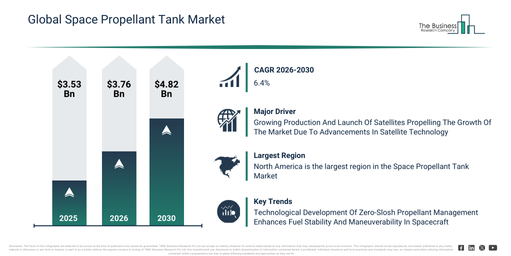
The space propellant tank market has shown substantial growth in recent years. It is anticipated to expand from $3.53 billion in 2025 to $3.76 billion in 2026, registering a compound annual growth rate (CAGR) of 6.5%. The historical development of this market can be linked to advancements in lightweight composite materials for tank construction, a heightened demand for cryogenic and high-pressure propellant storage, the expansion of satellite launch and space exploration initiatives, the creation of reusable and multi-use propellant tank systems, and increasing collaboration between aerospace manufacturers and space agencies.
The space propellant tank market is projected to experience substantial expansion in the coming years. By 2030, this market is forecast to reach $4.82 billion, demonstrating a compound annual growth rate (CAGR) of 6.4%. Several factors contribute to this growth during the forecast period, including the increasing use of advanced composite and metal alloys to reduce weight, the proliferation of commercial and government space missions, an emphasis on high-capacity and modular solutions for propellant storage, the incorporation of smart sensors for real-time propellant level tracking, and the creation of tanks designed for next-generation rocket propulsion systems. Key trends anticipated for this period involve a rising demand for lightweight composite propellant tanks, greater integration of reusable launch platforms leading to innovations in tank durability, breakthroughs in cryogenic storage technologies to support deep space exploration, an increase in commercial satellite deployment stimulating higher tank manufacturing, and strategic collaborations aimed at accelerating tank qualification and testing processes.
Get A Free Space Propellant Tank Market Sample With 2030 Forecast Insights:
Space Propellant Tank Market Outlook: Key Driver Supporting Long-Term Growth
The increasing manufacturing and deployment of satellites is anticipated to fuel the expansion of the space propellant tanks market. This process involves creating various spacecraft for diverse purposes and launching them into orbit with growing regularity, primarily due to advancements in small satellite technology that enable rapid deployment for communication, earth observation, and research. Space propellant tanks are vital in the production and launch of satellites, serving to store and manage the fuel essential for propulsion, maneuvering, and maintaining orbital positions throughout the satellite’s operational duration. For example, in July 2023, the United Nations Office for Outer Space Affairs (UNOOSA), an Austria-based entity dedicated to fostering international collaboration in the peaceful use and exploration of outer space, reported that as of June 2023, 11,330 individual satellites were orbiting Earth, marking a substantial 37.94% increase since January 2022. Consequently, the escalating production and launch of satellites are propelling the space propellant tanks market.
Segmentation Of The Space Propellant Tank Market: Key Categories Explained
The space propellant tank market covered in this report is segmented –
1) By Type: Liquid Propellants, Solid Propellants, Hybrid propellants
2) By Material: Aluminium And Titanium Alloys, Carbon Fiber, Nanomaterials, Thermoset And Thermoplastic
3) By Tank Design: Cylindrical Tanks, Spherical Tanks, Toroidal Tanks, Custom Designed Tanks
4) By Application: Launch Vehicles, Satellites And Spacecraft, Orbital Transfer Vehicles, Deep Space Missions
5) By End-User: Commercial, Defence
Subsegments:
1) By Liquid Propellants: Bipropellant, Monopropellant, Cryogenic, Hypergolic
2) By Solid Propellants: Homogeneous, Composite, Double-Base, Composite Modified Double-Base (CMDB)
3) By Hybrid Propellants: Paraffin-Based Fuels, Hydroxyl-Terminated Polybutadiene (HTPB), Acrylonitrile Butadiene Styrene (ABS), Polyethylene-Based Fuels
Space Propellant Tank Market Evolving Trends: What Businesses Should Know
Major companies in the space propellant tank market are prioritizing technological advancements, such as Zero-slosh propellant management, to improve spacecraft stability and performance by eliminating propellant movement and ensuring precise fuel control during maneuvers. Zero-slosh propellant management is a technology designed to prevent the motion or ‘sloshing’ of liquid propellants within tanks during space missions. It utilizes a rigid piston or a similar mechanism to separate liquid fuel from ullage gas, thereby ensuring stable fuel distribution and enhanced maneuverability in space. For instance, in August 2024, Agile Space Industries, a US-based provider of spacecraft propulsion solutions, introduced Zero-Slosh piston tanks for storable propellants. These tanks feature a rigid piston mechanism that isolates liquid propellant from ullage gas, preventing sloshing. This design enhances fuel stability, improves maneuverability, and ensures accurate fuel distribution during space missions, particularly for small spacecraft in microgravity environments. Zero-slosh piston tanks also simplify fuel management systems by removing the need for traditional anti-slosh mechanisms, leading to more efficient and cost-effective spacecraft designs.
Who Competes In The Space Propellant Tank Market? Major Companies Listed
Major companies operating in the space propellant tank market are Airbus S.A.S., Northrop Grumman Corporation, Eaton Corporation PLC, IHI Aerospace Co. Ltd., Rafael Advanced Defense Systems Ltd., Moog Inc., Blue Origin LLC, Ariane Group, MT Aerospace AG, Sierra Nevada Corporation, Nammo Space AS, European Space Agency (ESA), Dawn Aerospace, Agile Space Industries, Busek Co. Inc., Antrix Corporation Limited, Holscot Fluoropolymer Products Ltd., Infinite Composites Technologies, Firehawk Aerospace, Indian Space Research Organisation (ISRO)
Read The Complete Space Propellant Tank Market Forecast Report Through 2030:
Space Propellant Tank Market Regional Ranking: Which Geography Comes First?
North America was the largest region in the space propellant tank market in 2025. Asia-Pacific is expected to be the fastest-growing region in the forecast period. The regions covered in the space propellant tank market report are Asia-Pacific, South East Asia, Western Europe, Eastern Europe, North America, South America, Middle East, Africa.
Reach Out To Our Team:
The Business Research Company: https://www.thebusinessresearchcompany.com/
Americas: +1 310-496-7795
Asia: +44 7882 955267 & +91 8897263534
Europe: +44 7882 955267
Email us at: marketing@tbrc.info
Follow us on:
LinkedIn: https://in.linkedin.com/company/the-business-research-company
YouTube: https://www.youtube.com/channel/UC24_fI0rV8cR5DxlCpgmyFQ
Global Market Model: https://www.thebusinessresearchcompany.com/global-market-model

Wasay has over a decade of experience in market research, data modelling, and analytics, with prior experience at GlobalData and Decision Tree Consulting Services. At The Business Research Company , he leads research operations across syndicated studies, customized consulting engagements, and the Global Market Model platform. His professional experience includes supporting organizations such as Boston Consulting Group, KPMG, and Ernst & Young. Wasay holds a degree in Electronics and Communications Engineering, postgraduate management qualifications from International Management Institute Belgium and Indian School of Business and Entrepreneurship, and completed the Integrated Program in Business Analytics from Indian Institute of Management Indore.