With a focus on actionable insights and strategic value, The Business Research Company’s 2026 market reports include market attractiveness scoring, total addressable market sizing, company benchmarking matrices, interactive Excel dashboards, deeper supply chain intelligence, emerging startup tracking, and granular product-level insights.
Space Rocket Suborbital Launch Market Size Analysis: Historical Growth And Future Revenue Projections
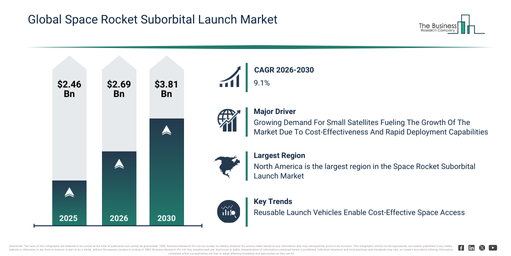
The space rocket suborbital launch market has experienced significant expansion recently. Its size is projected to increase from $2.46 billion in 2025 to $2.69 billion in 2026, demonstrating a compound annual growth rate (CAGR) of 9.3%. This past growth can be attributed to several factors, including the early development and deployment of sounding rockets for atmospheric and microgravity research, the initial use of suborbital test vehicles for technology demonstrations, the expansion of microgravity experimentation programs by academic and governmental bodies, the appearance of hypersonic research vehicles for brief spaceflights, and the early efforts in commercial space tourism utilizing suborbital rockets.
The space rocket suborbital launch market is projected to experience substantial expansion in the coming years, reaching $3.81 billion by 2030, demonstrating a compound annual growth rate (CAGR) of 9.1%. This projected increase is driven by several factors, including the proliferation of commercial suborbital space tourism, the greater use of suborbital launch vehicles for quick scientific experiments, ongoing advancements in propulsion and avionics systems to enhance reliability and safety, a growing need for microgravity research vehicles from the pharmaceutical and materials sectors, and an increase in comprehensive launch support equipment and end-to-end services for suborbital payload delivery. Key trends anticipated during this period encompass a heightened demand for economical suborbital research platforms, the expansion of space tourism and commercial suborbital ventures, continuous progress in propulsion and avionics technologies, a broadening of microgravity and atmospheric data studies, and increased collaboration between government bodies and academic institutions on suborbital experiments.
Preview The Space Rocket Suborbital Launch Market Report With A Free Sample:
Space Rocket Suborbital Launch Market Drivers: What Is Fueling Demand Through 2030?
The increasing need for small satellites is anticipated to boost the expansion of the space rocket suborbital launch market in the future. These compact, lightweight spacecraft, typically weighing less than 500 kilograms, are utilized for tasks like Earth observation, communication, or experimenting with new technologies. The surging demand for small satellites stems from their economical nature and adaptability, allowing for quicker deployment and simpler customization across various uses. Space rocket suborbital launch significantly benefits small satellites by offering economical and quick entry to space, making it perfect for testing and deploying lighter payloads. This capability supports short-duration missions that aid in technology advancement and scientific studies, thereby enhancing satellite innovation and operational efficiency. For example, in December 2024, Aerospace America, a US-based aerospace magazine, reported that 475 small satellites were launched across 55 missions, with some carrying up to 120 spacecraft in a single flight, representing the highest deployment rate seen in comparison to prior years. Consequently, the rising demand for small satellites is fueling the growth of the space rocket suborbital launch market.
Space Rocket Suborbital Launch Market Segmentation Analysis: Core Categories And Subcategories
The space rocket suborbital launch market covered in this report is segmented –
1) By Vehicle Type: Reusable, Expendable
2) By Payload Type: Satellite, Cargo, Human Spaceflight, Research And Development
3) By End-User: Commercial, Government, Defense, Academic
Subsegments:
1) By Reusable: Horizontal Takeoff And Landing Vehicles, Vertical Takeoff And Landing Vehicles, Winged Suborbital Spaceplanes, Capsule-Based Reentry Vehicles, Partially Reusable Rocket Systems
2) By Expendable: Sounding Rockets, Single-Stage Rockets, Two-Stage Launch Vehicles, Payload-Dedicated Launch Vehicles, Solid-Propellant Suborbital Rockets
Which Trends Will Define The Space Rocket Suborbital Launch Market Through 2030?
Major companies operating in the space rocket suborbital launch market are focusing on developing technologically advanced products, such as suborbital rockets, to offer more cost-effective solutions for space-related missions. A suborbital rocket is a rocket that reaches space but doesn’t complete an orbit around Earth before returning to the surface. For instance, in October 2023, PLD Space, a Spain-based aerospace company, launched the Miura 1 rocket. It is a suborbital, reusable launch vehicle designed to carry payloads of up to 100 kilograms to suborbital altitudes, offering short periods of microgravity for scientific research and technology testing. Its innovative propulsion system and lightweight composite structure enhance performance while minimizing environmental impact.
Space Rocket Suborbital Launch Market Major Companies And Industry Participants
Major companies operating in the space rocket suborbital launch market are The Boeing Company, Israel Aerospace Industries, Blue Origin Enterprises L.P., Rocket Lab USA Inc., Indian Space Research Organisation, AgniKul Cosmos Private Limited, Interstellar Technologies Inc., Vaya Space, Astrobotic Technology Inc., Virgin Galactic Holdings Inc., HyImpulse Technologies GmbH, PLD Space, Skyrora Ltd, Copenhagen Suborbitals, LinkSpace, PD Aerospace, Elara Aerospace, SR Space, UP Aerospace Inc., XCOR Aerospace.
Buy The Full Space Rocket Suborbital Launch Global Market Report 2026:
Space Rocket Suborbital Launch Market Geographic Analysis: Which Region Accounts For The Biggest Share?
North America was the largest region in the space rocket suborbital launch market in 2025. The regions covered in the space rocket suborbital launch market report are Asia-Pacific, South East Asia, Western Europe, Eastern Europe, North America, South America, Middle East, Africa.
Reach Out To Our Team:
The Business Research Company: https://www.thebusinessresearchcompany.com/
Americas: +1 310-496-7795
Asia: +44 7882 955267 & +91 8897263534
Europe: +44 7882 955267
Email us at: marketing@tbrc.info
Follow us on:
LinkedIn: https://in.linkedin.com/company/the-business-research-company
YouTube: https://www.youtube.com/channel/UC24_fI0rV8cR5DxlCpgmyFQ
Global Market Model: https://www.thebusinessresearchcompany.com/global-market-model

Wasay has over a decade of experience in market research, data modelling, and analytics, with prior experience at GlobalData and Decision Tree Consulting Services. At The Business Research Company , he leads research operations across syndicated studies, customized consulting engagements, and the Global Market Model platform. His professional experience includes supporting organizations such as Boston Consulting Group, KPMG, and Ernst & Young. Wasay holds a degree in Electronics and Communications Engineering, postgraduate management qualifications from International Management Institute Belgium and Indian School of Business and Entrepreneurship, and completed the Integrated Program in Business Analytics from Indian Institute of Management Indore.