The Business Research Company’s 2026 market reports combine market attractiveness scoring, total addressable market sizing, company benchmarking matrices, interactive Excel dashboards, deeper supply chain intelligence, emerging startup tracking, and granular product-level insights to deliver research that is more actionable and strategically valuable.
What Is The Space Rocket Steering Systems Market Growth Rate? A 8.7% CAGR Outlook Through 2030
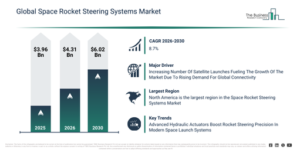
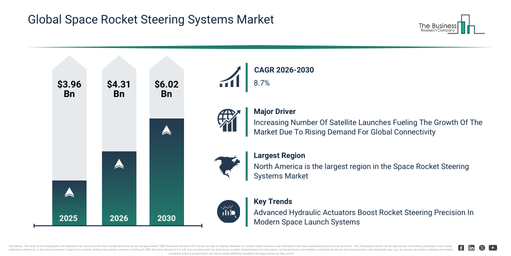
The market for space rocket steering systems has seen robust expansion in recent years. It is projected to increase from $3.96 billion in 2025 to $4.31 billion in 2026, achieving a compound annual growth rate (CAGR) of 9.0%. This historical growth can be attributed to several factors: the early creation of gimbaled engine mounts for thrust vector control, the initial design and evaluation of reaction control thrusters for rocket orientation, the expansion of guidance and navigation algorithm services for precise trajectory control, foundational research on gyroscopes and inertial navigation systems vital for flight stability, and the broader application of simulation and flight dynamics analysis for optimizing rocket steering.
The space rocket steering systems market is projected to experience robust expansion over the coming years. This market is anticipated to reach $6.02 billion by 2030, exhibiting a compound annual growth rate (CAGR) of 8.7%. This projected growth stems from several factors, including advancements in real-time telemetry and monitoring systems that enable adaptive steering control, the growing integration of AI-enhanced guidance and navigation algorithms, the creation of next-generation flight control computers and software, a heightened demand for high-precision thrust vector control systems crucial for reusable rockets, and the expansion of integrated steering actuator solutions for multi-stage and deep space launch vehicles. Key trends anticipated during this period encompass a rising need for high-precision thrust vector control systems, the incorporation of sophisticated simulation and flight dynamics analysis, an increase in real-time telemetry and monitoring services, the evolution of modular and scalable steering actuators, and a greater emphasis on reliability and fault detection software.
Access A Free Sample Of The Latest Space Rocket Steering Systems Market Analysis:
Why Is The Space Rocket Steering Systems Market Growing? The Key Demand Driver Explained
The expanding count of satellite launches is projected to fuel the growth of the space rocket steering systems market moving forward. Satellite launches involve deploying artificial satellites into space using launch vehicles or rockets. The escalating demand for satellite launches stems from the increasing requirement for global connectivity, as more regions seek reliable internet access through satellite-based broadband services. Space rocket steering systems facilitate satellite launches by enabling precise trajectory control, ensuring accurate placement of payloads into orbit. These systems boost launch reliability by stabilizing flight paths, contributing to the success of satellite deployment missions. For example, in January 2025, Space Foundation, a US-based nonprofit organization, noted that in 2024, 259 launches occurred at an average pace of one every 34 hours, which was five hours faster than in 2023. Consequently, the rising number of satellite launches is driving the expansion of the space rocket steering systems market.
What Are The Main Segments Of The Space Rocket Steering Systems Market?
The space rocket steering systems market covered in this report is segmented –
1) By Component: Actuators, Sensors, Controllers, Software, Other Components
2) By Technology: Hydraulic, Pneumatic, Electric, Hybrid
3) By Application: Commercial Launch Vehicles, Military Launch Vehicles, Space Exploration Vehicles
4) By End-User: Aerospace, Defense, Space Agencies
Subsegments:
1) By Actuators: Hydraulic Actuators, Electromechanical Actuators (EMA), Pneumatic Actuators, Thrust Vector Control (TVC) Actuators, Reaction Control System (RCS) Thruster Actuators
2) By Sensors: Position Sensors: Inertial Measurement Units (IMUs), Gyroscopes, Accelerometers, Pressure Sensors, Temperature Sensors
3) By Controllers: Flight Control Computers: Thrust Vector Control Units, Servo Drive Controllers, Redundant Control Units, Guidance Navigation Control (GNC) Systems
4) By Software: Thrust Vector Control Software, Flight Dynamics Software, Simulation And Modeling Tools, Autonomous Navigation Algorithms, Fault Detection And Mitigation Software
5) By Other Components: Valves And Pumps, Power Supply Units, Structural Mounts And Brackets, Wiring Harnesses, Cooling Systems
Space Rocket Steering Systems Market Trend Analysis: Where Leading Companies Are Focusing
Leading companies within the space rocket steering systems market are concentrating on developing advanced products, such as hydraulic actuators, to bolster precision control and reliability during rocket flights and maneuvers. Hydraulic actuators are mechanical devices that employ pressurized fluid to generate motion or force, thus enabling exact movement regulation in systems like rocket steering. For instance, in January 2024, Moog Inc., a US-based aerospace and defense company, launched next-generation hydraulic thrust vector control (TVC) actuators, which successfully guided the inaugural flight of United Launch Alliance’s Vulcan rocket. These actuators are crucial for ensuring stable and accurate trajectory control during missions, thereby demonstrating their reliability and performance in sophisticated space launch systems. The new actuators boast enhanced durability and responsiveness, which improves steering efficiency and contributes to mission success for modern rockets. This innovation highlights the increasing focus on precision engineering within aerospace, where high-performance actuation systems are indispensable for safe and efficient space exploration.
Which Companies Are Major Players In The Space Rocket Steering Systems Market?
Major companies operating in the space rocket steering systems market are The Boeing Company, Lockheed Martin Corporation, Northrop Grumman Corporation, Honeywell Aerospace, Safran S.A., L3Harris Technologies Inc., Space Exploration Technologies Corp., Hanwha Aerospace Co. Ltd., Blue Origin Enterprises L.P., Moog Inc., Thales Group, Relativity Space Inc., Rocket Lab USA Inc., Firefly Aerospace Inc., Avio S.p.A., Benchmark Space Systems Inc., Astra Space Inc., Gilmour Space Technologies Pty Ltd, HyImpulse Technologies GmbH, Skyrora Ltd., Masten Space Systems Inc.
Get The Complete Space Rocket Steering Systems Market Analysis Here:
Which Region Held The Largest Share Of The Space Rocket Steering Systems Market In 2025?
North America was the largest region in the space rocket steering systems market in 2025. Asia-Pacific is expected to be the fastest-growing region in the forecast period. The regions covered in the space rocket steering systems market report are Asia-Pacific, South East Asia, Western Europe, Eastern Europe, North America, South America, Middle East, Africa.
Reach Out To Our Team:
The Business Research Company: https://www.thebusinessresearchcompany.com/
Americas: +1 310-496-7795
Asia: +44 7882 955267 & +91 8897263534
Europe: +44 7882 955267
Email us at: marketing@tbrc.info
Follow us on:
LinkedIn: https://in.linkedin.com/company/the-business-research-company
YouTube: https://www.youtube.com/channel/UC24_fI0rV8cR5DxlCpgmyFQ
Global Market Model: https://www.thebusinessresearchcompany.com/global-market-model

Wasay has over a decade of experience in market research, data modelling, and analytics, with prior experience at GlobalData and Decision Tree Consulting Services. At The Business Research Company , he leads research operations across syndicated studies, customized consulting engagements, and the Global Market Model platform. His professional experience includes supporting organizations such as Boston Consulting Group, KPMG, and Ernst & Young. Wasay holds a degree in Electronics and Communications Engineering, postgraduate management qualifications from International Management Institute Belgium and Indian School of Business and Entrepreneurship, and completed the Integrated Program in Business Analytics from Indian Institute of Management Indore.