
Market attractiveness scoring, total addressable market sizing, company benchmarking matrices, interactive Excel dashboards, deeper supply chain intelligence, emerging startup tracking, and granular product-level insights are among the key offerings featured in The Business Research Company’s 2026 market reports, designed to deliver more actionable and strategically valuable research.
Space-Based Air Traffic Control Market Size Estimate For 2026 And Revenue Forecast Through 2030
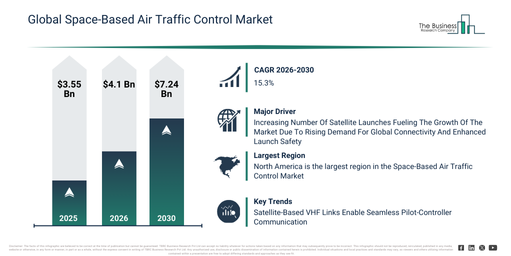
The space-based air traffic control market has experienced substantial growth recently, with its size projected to increase from $3.55 billion in 2025 to $4.1 billion in 2026, demonstrating a compound annual growth rate (CAGR) of 15.5%. Historically, this expansion can be linked to the creation of initial satellite-based navigation systems, the increasing global air traffic necessitating better surveillance, financial commitments to automatic dependent surveillance-broadcast (ADS-B) technology, improvements in satellite communication infrastructure, and the implementation of integrated air traffic management software by aviation authorities.
The space-based air traffic control market is anticipated to undergo significant expansion in the coming years, reaching a valuation of $7.24 billion by 2030, driven by a compound annual growth rate (CAGR) of 15.3%. This projected increase is largely due to factors such as the broader coverage of global space-based air traffic, a heightened demand for real-time flight tracking over vast oceans and isolated regions, the integration of artificial intelligence into flight management systems, the deployment of next-generation satellite constellations tailored for aviation, and strengthened partnerships between aerospace companies and air navigation service providers. Significant developments expected during this forecast period include the expansion of satellite-based ADS-B surveillance capabilities, increased adoption of multi-orbit satellite architectures, the proliferation of integrated air–ground data fusion platforms, a growing need for real-time flight analytics and monitoring services, and the development of communication and navigation modules for air traffic control that are enabled by space technology.
Free Space-Based Air Traffic Control Market Report Sample Available For Download:
Why Is Demand In The Space-Based Air Traffic Control Market Expected To Keep Rising?
The rising volume of satellite deployments is anticipated to fuel expansion in the space-based air traffic control market. These launches involve dispatching man-made satellites into orbit utilizing launch vehicles or rockets. The heightened demand for these launches stems from a growing requirement for worldwide connectivity, as a greater number of areas seek dependable internet access via satellite-powered broadband. Space-based air traffic control improves satellite deployments by facilitating exact tracking and seamless coordination throughout international airspace. This system boosts launch safety by mitigating collision hazards and supports streamlined mission execution with real-time information and communication. For example, in November 2023, The United States International Trade Commission, a US-based Government agency, announced that global space launches were projected to hit 197 in 2023, an increase from the 186 observed in 2022. Consequently, the growing frequency of satellite launches is stimulating the expansion of the space-based air traffic control market.
How Is The Space-Based Air Traffic Control Market Divided Across Segments And Subsegments?
The space-based air traffic control market covered in this report is segmented –
1) By Component: Hardware, Software, Services
2) By Technology: Automatic Dependent Surveillance-Broadcast, Satellite-Based Augmentation System, Other Technologies
3) By Application: Commercial Aviation, Military Aviation, General Aviation
4) By End-User: Airlines, Air Navigation Service Providers, Airports, Military
Subsegments:
1) By Hardware: Satellite Systems, Ground Receiving Stations, Automatic Dependent Surveillance–Broadcast Transponders, Antennas, Communication Modules, Signal Processors
2) By Software: Flight Data Processing Systems, Surveillance Data Processing Software, Air Traffic Flow Management (ATFM) Software, Communication And Navigation Software, Decision Support Tools, Integration Middleware
3) By Services: Installation And Integration Services, Maintenance And Support Services, Data Analytics And Monitoring Services, Satellite-Based Communication Services, Consulting And Training Services, Upgradation And Modernization Services
Space-Based Air Traffic Control Market Trends Reshaping Customer Demand And Business Strategies
Major companies operating in the space-based air traffic control market are concentrating on developing innovative solutions, such as space-based very high frequency (VHF) communications, to elevate global air traffic management, enhance safety, and decrease operational inefficiencies. These space-based very high frequency (VHF) communications represent sophisticated satellite systems that facilitate real-time voice and data exchanges between pilots and air traffic controllers, particularly in remote or oceanic areas where conventional ground-based VHF coverage is unavailable. For instance, in March 2025, Startical S.L., a Spain-based aerospace company, successfully launched its In-Orbit Demonstrator-1 (IOD-1), a SESAR Digital Sky Demonstrator illustrating how satellite-based communication can improve air traffic management (ATM). The IOD-1 is designed to validate space-based very high frequency (VHF) voice and data links, thereby enhancing surveillance and connectivity across European airspace. This specific demonstration aims to enable more efficient and sustainable air traffic management by utilizing satellite-based technologies to supplement existing ground infrastructure, guaranteeing continuous communication in distant and over-ocean regions.
Space-Based Air Traffic Control Market Major Players: Companies At The Forefront Of The Industry
Major companies operating in the space-based air traffic control market are RTX Corporation, Airbus SE, Boeing Company, Lockheed Martin Corporation, General Dynamics Corp, Northrop Grumman Corporation, Honeywell International Inc., Collins Aerospace, BAE Systems plc, Thales Group, L3Harris Technologies Inc., Leidos Holdings Inc., Indra Sistemas S.A., Saab AB, Moog Inc., Cobham Limited, Frequentis AG, Spire Global Inc., Adacel Technologies Limited, Aireon LLC, Saber Astronautics Pty Ltd, Searidge Technologies Inc.
Read More About The Space-Based Air Traffic Control Market In The Full Report:
Space-Based Air Traffic Control Market Regional Share Analysis For 2025
North America was the largest region in the space-based air traffic control market in 2025. The regions covered in the space-based air traffic control market report are Asia-Pacific, South East Asia, Western Europe, Eastern Europe, North America, South America, Middle East, Africa.
Reach Out To Our Team:
The Business Research Company: https://www.thebusinessresearchcompany.com/
Americas: +1 310-496-7795
Asia: +44 7882 955267 & +91 8897263534
Europe: +44 7882 955267
Email us at: marketing@tbrc.info
Follow us on:
LinkedIn: https://in.linkedin.com/company/the-business-research-company
YouTube: https://www.youtube.com/channel/UC24_fI0rV8cR5DxlCpgmyFQ
Global Market Model: https://www.thebusinessresearchcompany.com/global-market-model

Wasay has over a decade of experience in market research, data modelling, and analytics, with prior experience at GlobalData and Decision Tree Consulting Services. At The Business Research Company , he leads research operations across syndicated studies, customized consulting engagements, and the Global Market Model platform. His professional experience includes supporting organizations such as Boston Consulting Group, KPMG, and Ernst & Young. Wasay holds a degree in Electronics and Communications Engineering, postgraduate management qualifications from International Management Institute Belgium and Indian School of Business and Entrepreneurship, and completed the Integrated Program in Business Analytics from Indian Institute of Management Indore.

