The Business Research Company’s 2026 market reports combine market attractiveness scoring, total addressable market sizing, company benchmarking matrices, interactive Excel dashboards, deeper supply chain intelligence, emerging startup tracking, and granular product-level insights to deliver research that is more actionable and strategically valuable.
Space-Based Artificial Intelligence Assistants Market Value Projected To Grow At A 15.3% Compound Annual Growth Rate Through 2030
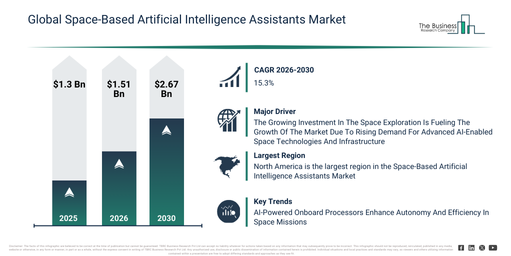
The space-based artificial intelligence assistants market size has seen rapid expansion in recent years. Its valuation is expected to rise from $1.3 billion in 2025 to $1.51 billion in 2026, achieving a compound annual growth rate (CAGR) of 16.2%. Key factors contributing to its historical growth include the establishment of early spaceborne computing systems, advancements in machine learning for autonomous spacecraft operations, the growing application of AI in satellite data analysis, government financing for AI-driven space missions, and the incorporation of AI for astronaut assistance in low-earth orbit missions.
The space-based artificial intelligence assistants market is anticipated to experience significant expansion over the coming years. This sector is projected to reach $2.67 billion in 2030, exhibiting a compound annual growth rate (CAGR) of 15.3%. This expansion during the forecast period is propelled by the increasing integration of AI assistants for deep-space exploration, the deployment of radiation-hardened AI processors and edge computing modules, a heightened need for autonomous mission planning and navigation, the rise of AI-powered environmental monitoring and system diagnostics, and collaborative efforts between aerospace and AI technology companies for advanced space operations. Key developments expected during this period involve the broadening of radiation-hardened AI hardware for enhanced orbital reliability, an increase in autonomous mission planning and spacecraft navigation systems, growing requirements for onboard real-time data analytics for scientific missions, greater incorporation of astronaut assistance systems utilizing natural language processing and diagnostics, and the implementation of edge-processing modules to lessen dependence on ground-station communication.
Evaluate The Space-Based Artificial Intelligence Assistants Market Report Before You Buy With A Free Sample:
Space-Based Artificial Intelligence Assistants Market Growth Driver Analysis For The 2026–2030 Forecast Period
Future growth in the space-based artificial intelligence assistants market is anticipated, driven by expanding investments in space exploration. These space exploration investments finance both public and private sector initiatives focused on developing technologies, missions, and infrastructure for discovering and developing space. The increasing demand for satellite services, which are crucial for global communication, navigation, and Earth monitoring in the current economy, fuels the rise in space exploration investments. Support for AI technologies and progress in onboard computing through space exploration investments hastens the expansion of space-based AI assistants. This, in turn, improves spacecraft autonomy, allows for real-time analysis, and facilitates efficient mission execution in space environments. For example, the Space Foundation, a US-based nonprofit supporting the global space community, reported in July 2024 that the global space economy reached $570 billion in 2023, representing a 7.4% rise from the revised 2022 total of $531 billion. Consequently, the expanding investments in space exploration are indeed boosting the space-based artificial intelligence assistants market.
Space-Based Artificial Intelligence Assistants Market Segmentation Breakdown: Primary And Secondary Categories
The space-based artificial intelligence assistants market covered in this report is segmented –
1) By Component: Hardware, Software, Services
2) By Application: Satellite Operations, Space Exploration, Spacecraft Navigation, Communications, Other Applications
3) By End-User: Government, Commercial, Defense, Research Organizations, Other End-Users
Subsegments:
1) By Hardware: Onboard Processors, Artificial Intelligence (AI) Accelerators, Edge Computing Devices, Sensor Suites, Communication Modules, Power Systems
2) By Software: Machine Learning Algorithms, Natural Language Processing (NLP) Engines, Predictive Analytics Software, Computer Vision Systems, Autonomous Navigation And Control Systems, Data Fusion And Decision-Making Platforms
3) By Services: Artificial Intelligence (AI) Training And Simulation Services, System Integration And Testing, Data Analysis And Interpretation, Predictive Maintenance Services, Mission Support And Operational Monitoring, Custom Software Development And Upgrades
Space-Based Artificial Intelligence Assistants Market Industry Trends: New Developments From Leading Companies
Leading firms in the space-based artificial intelligence assistants market are prioritizing the creation of sophisticated solutions, specifically AI-driven onboard processors, to lessen their dependence on ground control operations for space missions. These processors are intelligent computing systems integrated into spacecraft or satellites, leveraging AI for real-time data analysis. They enable autonomous operations and diminish reliance on ground-based oversight by processing information directly on board. For example, in March 2024, the Japanese electronics company Mitsubishi Heavy Industries introduced AIRIS, an AI-powered object detection system designed for onboard use. This system employs the advanced space-grade microprocessor “SOISOC4” to improve image processing and object identification capabilities in space. Its orbital demonstration is planned as part of JAXA’s Innovative Satellite Technology Demonstration-4 mission. The demonstration will feature AI identifying vessels in satellite imagery, sending only pertinent data to Earth, dynamically retraining the AI model with new information, and updating the onboard AI, thereby illustrating both cutting-edge AI functionalities and and the durable, energy-efficient SOISOC4 processor’s performance in a genuine space setting.
Who Are The Top Competitors In The Space-Based Artificial Intelligence Assistants Market?
Major companies operating in the space-based artificial intelligence assistants market are Airbus, International Business Machines Corporation, Mitsubishi Heavy Industries Ltd., National Aeronautics and Space Administration, Safran S.A., Thales Group, L3Harris Technologies Inc., SpaceX, Blue Origin LLC, German Aerospace Centre (DLR), Sierra Nevada Corporation, Axiom Space Inc., Sidus Space Inc., Klepsydra Technologies AG, KP Labs Inc., Cognitive Space, EdgeCortix Inc., Nebula AI, Planetary Systems AI, Aistrospace Limited
Access The Space-Based Artificial Intelligence Assistants Market Report For Complete Segment-Level Analysis:
Which Region Leads The Space-Based Artificial Intelligence Assistants Market, And Which Regions Are Covered?
North America was the largest region in the space-based artificial intelligence assistants market in 2025. Asia-Pacific is expected to be the fastest-growing region in the forecast period. The regions covered in the space-based artificial intelligence assistants market report are Asia-Pacific, South East Asia, Western Europe, Eastern Europe, North America, South America, Middle East, Africa.
Reach Out To Our Team:
The Business Research Company: https://www.thebusinessresearchcompany.com/
Americas: +1 310-496-7795
Asia: +44 7882 955267 & +91 8897263534
Europe: +44 7882 955267
Email us at: marketing@tbrc.info
Follow us on:
LinkedIn: https://in.linkedin.com/company/the-business-research-company
YouTube: https://www.youtube.com/channel/UC24_fI0rV8cR5DxlCpgmyFQ
Global Market Model: https://www.thebusinessresearchcompany.com/global-market-model

Wasay has over a decade of experience in market research, data modelling, and analytics, with prior experience at GlobalData and Decision Tree Consulting Services. At The Business Research Company , he leads research operations across syndicated studies, customized consulting engagements, and the Global Market Model platform. His professional experience includes supporting organizations such as Boston Consulting Group, KPMG, and Ernst & Young. Wasay holds a degree in Electronics and Communications Engineering, postgraduate management qualifications from International Management Institute Belgium and Indian School of Business and Entrepreneurship, and completed the Integrated Program in Business Analytics from Indian Institute of Management Indore.