The Business Research Company’s 2026 market reports combine market attractiveness scoring, total addressable market sizing, company benchmarking matrices, interactive Excel dashboards, deeper supply chain intelligence, emerging startup tracking, and granular product-level insights to deliver research that is more actionable and strategically valuable.
What Is The Low-Clinker Cement Market Growth Rate? A 8.2% CAGR Outlook Through 2030
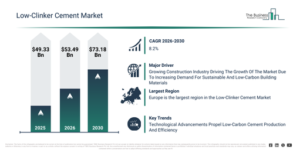
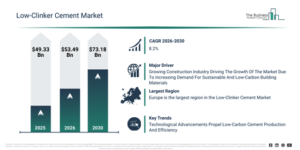
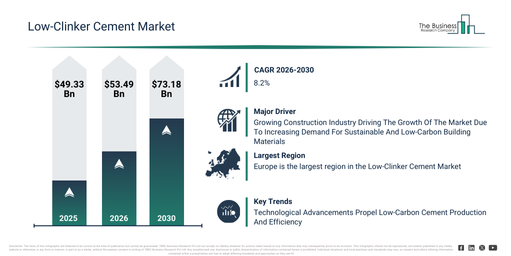
The low-clinker cement market size has seen significant expansion in recent years. It is anticipated to increase from $49.33 billion in 2025 to $53.49 billion in 2026, achieving a compound annual growth rate (CAGR) of 8.4%. This historical growth can be attributed to several factors including the rising adoption of low-clinker cements, the increasing use of fly ash and slag, the development of sustainable cement products, the expansion of residential and commercial projects, and a regulatory push for reduced carbon emissions.
The low-clinker cement market is projected to experience robust expansion over the coming years. Its size is forecasted to reach $73.18 billion in 2030, demonstrating a compound annual growth rate (CAGR) of 8.2%. This anticipated growth during the forecast period is attributable to several factors, including the rising production of geopolymer and carbon capture-enhanced cements, an increase in performance-based cement formulations, the uptake of ternary and multi-blended cement mixes, the broadening of industrial and infrastructure applications, and heightened innovation in low-emission cement technologies. Key trends observed within this period encompass the integration of low-clinker cement products, the embrace of supplementary cementitious materials, the utilization of fly ash and slag blends, the broadening scope of performance-based portland limestone cement, and the practical application of geopolymer and carbon capture-enhanced cements.
Access A Free Sample Of The Latest Low-Clinker Cement Market Analysis:
Why Is The Low-Clinker Cement Market Growing? The Key Demand Driver Explained
The expanding construction sector is anticipated to stimulate the growth of the low-clinker cement market. This industry encompasses all operations related to planning, designing, building, and maintaining structures and infrastructure. Its ascent is driven by increasing urbanization and infrastructural advancement, particularly in emerging economies. In this context, low-clinker cement finds application to decrease carbon emissions while ensuring the strength and durability of concrete structures. For instance, in July 2024, Atradius N.V., a Netherlands-based trade credit insurance company, reported that global construction output saw a 3.7% increase in 2024 compared to 2023, resulting in a 2.0% overall growth for the year. Thus, the burgeoning construction industry is propelling the low-clinker cement market.
What Are The Main Segments Of The Low-Clinker Cement Market?
The low-clinker cement market covered in this report is segmented –
1) By Product Type: Portland Limestone Cement, Portland Composite Cement, Slag Cement, Fly Ash Cement, Other Product Types
2) By Raw Material: Limestone, Slag, Fly Ash, Pozzolans, Other Raw Materials
3) By Distribution Channel: Direct Sales, Distributors Or Wholesalers, Online Retail, Other Distribution Channels
4) By Application: Residential, Commercial, Infrastructure, Industrial, Other Applications
5) By End-User: Construction, Oil And Gas, Mining, Other End-Users
Subsegments:
1) By Portland Limestone Cement: Moderate Limestone Content Cement, Ternary Blended Limestone Cement With Pozzolan Or Slag, High Limestone Replacement Cement, Performance-Based Portland Limestone Cement
2) By Portland Composite Cement: Limestone And Fly Ash Composite Cement, Limestone And Slag Composite Cement, Limestone And Silica Fume Composite Cement, Multi-Blended Composite Cement With Multiple Supplementary Materials
3) By Slag Cement: Ground Granulated Blast Furnace Slag Cement, Alkali-Activated Slag Cement, Portland And Slag Blended Cement, High Slag Content Cement
4) By Fly Ash Cement: Portland And Fly Ash Blended Cement, High-Volume Fly Ash Cement, Class F Fly Ash Blended Cement, Class C Fly Ash Blended Cement
5) By Other Product Types: Calcined Clay Cement, Pozzolanic Cement Based On Natural Pozzolans, Silica Fume Cement, Carbon Capture And Mineralization-Enhanced Cement, Geopolymer-Based Low-Clinker Cement
Low-Clinker Cement Market Trend Analysis: Where Leading Companies Are Focusing
Leading companies within the low-clinker cement market are concentrating on technological breakthroughs, such as low-clinker cement technologies integrated with digital process optimization, to achieve significant reductions in CO2 emissions and improve production efficiency while upholding high-performance material standards. These integrated low-clinker cement technologies represent advanced manufacturing systems that merge clinker-reduction methods with digital tools to streamline manufacturing effectiveness, optimize material usage, and manage carbon emissions. For instance, in March 2023, Ecocem, an Ireland-based company focused on sustainable cement technology, introduced its Advanced Cement Technology (ACT) platform, which can decrease CO2 emissions by up to 70%. Designed for deployment in existing cement production plants without demanding major investment or structural modifications, ACT is globally scalable and incorporates widely available low-carbon materials with sophisticated formulation and process technologies. By enabling the production of high-performance cement with dramatically lower embodied carbon, all while preserving strength and durability standards, ACT signifies a major technological advancement in the low-clinker cement sector and strengthens the industry’s wider initiative towards sustainable, low-carbon construction practices.
Which Companies Are Major Players In The Low-Clinker Cement Market?
Major companies operating in the low-clinker cement market are China National Building Material Co. Ltd., Holcim Ltd., Heidelberg Materials AG, CEMEX S.A.B. de C.V., UltraTech Cement Ltd., Taiheiyo Cement Corporation, Votorantim Cimentos S.A., Vicat S.A., CRH plc, Boral Limited, Shree Cement Limited, Dalmia Bharat Limited, Siam Cement Group Public Company Limited, Cementir Holding N.V., Dangote Cement Plc, JK Cement Limited, Buzzi Unicem S.p.A., CarbiCrete Inc., Partanna Inc., Hoffmann Green Cement Technologies S.A.S., Betolar Oy.
Get The Complete Low-Clinker Cement Market Analysis Here:
Which Region Held The Largest Share Of The Low-Clinker Cement Market In 2025?
Europe was the largest region in the low-clinker cement market in 2025. Asia-Pacific is expected to be the fastest-growing region in the forecast period. The regions covered in the low-clinker cement market report are Asia-Pacific, South East Asia, Western Europe, Eastern Europe, North America, South America, Middle East, Africa.
Reach Out To Our Team:
The Business Research Company: https://www.thebusinessresearchcompany.com/
Americas: +1 310-496-7795
Asia: +44 7882 955267 & +91 8897263534
Europe: +44 7882 955267
Email us at: marketing@tbrc.info
Follow us on:
LinkedIn: https://in.linkedin.com/company/the-business-research-company
YouTube: https://www.youtube.com/channel/UC24_fI0rV8cR5DxlCpgmyFQ
Global Market Model: https://www.thebusinessresearchcompany.com/global-market-model

Wasay has over a decade of experience in market research, data modelling, and analytics, with prior experience at GlobalData and Decision Tree Consulting Services. At The Business Research Company , he leads research operations across syndicated studies, customized consulting engagements, and the Global Market Model platform. His professional experience includes supporting organizations such as Boston Consulting Group, KPMG, and Ernst & Young. Wasay holds a degree in Electronics and Communications Engineering, postgraduate management qualifications from International Management Institute Belgium and Indian School of Business and Entrepreneurship, and completed the Integrated Program in Business Analytics from Indian Institute of Management Indore.