Enhanced with market attractiveness analysis, total addressable market evaluation, company benchmarking matrices, interactive Excel dashboards, expanded supply chain intelligence, emerging startup coverage, and detailed product insights, The Business Research Company’s 2026 market reports deliver more actionable and strategically valuable research.
Low-Clinker Cement Market Expected To Reach $73.18 Billion By 2030 At 8.2% CAGR
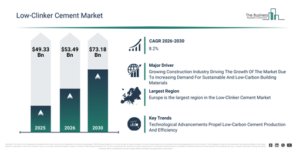
The low-clinker cement market has witnessed significant expansion in recent years. Its valuation is expected to rise from $49.33 billion in 2025 to $53.49 billion in 2026, demonstrating a compound annual growth rate (CAGR) of 8.4%. This past growth was primarily driven by the increasing adoption of low-clinker cements, greater utilization of fly ash and slag, the emergence of sustainable cement products, the broadening of residential and commercial projects, and a regulatory impetus for reduced carbon emissions.
The low-clinker cement market size is projected to experience robust expansion over the coming years. It is expected to reach $73.18 billion by 2030, growing at a compound annual growth rate (CAGR) of 8.2%. This anticipated growth during the forecast period is driven by factors such as increasing manufacturing of geopolymer and carbon capture-enhanced cements, the rise of performance-based cement formulations, the uptake of ternary and multi-blended cement mixes, broader use in industrial and infrastructure applications, and advancements in low-emission cement technologies. Significant trends for the forecast period encompass the integration of low-clinker cement products, the adoption of supplementary cementitious materials, the deployment of fly ash and slag blends, the broadening use of performance-based portland limestone cement, and the implementation of geopolymer and carbon capture-enhanced cements.
Download A Free Sample Report For Comprehensive Market Insights:
Low-Clinker Cement Market Expansion Supported By Key Demand Factors
The expansion of the construction sector is anticipated to drive the advancement of the low-clinker cement market in the future. This sector includes various operations involved in the planning, design, erection, and upkeep of both buildings and infrastructure. Its growth is fueled by escalating urbanization and ongoing infrastructure projects, particularly in developing nations. Within construction, low-clinker cement finds application in minimizing carbon footprints while preserving the integrity and longevity of concrete constructions. Illustratively, data from Atradius N.V., a trade credit insurance firm headquartered in the Netherlands, indicated in July 2024 that worldwide construction output saw a 3.7% rise in 2024 relative to 2023, contributing to an overall annual growth of 2.0%. Consequently, the expanding construction sector serves as a key impetus for the low-clinker cement market.
Low-Clinker Cement Market Categorization By Product Type And Application
The low-clinker cement market covered in this report is segmented –
1) By Product Type: Portland Limestone Cement, Portland Composite Cement, Slag Cement, Fly Ash Cement, Other Product Types
2) By Raw Material: Limestone, Slag, Fly Ash, Pozzolans, Other Raw Materials
3) By Distribution Channel: Direct Sales, Distributors Or Wholesalers, Online Retail, Other Distribution Channels
4) By Application: Residential, Commercial, Infrastructure, Industrial, Other Applications
5) By End-User: Construction, Oil And Gas, Mining, Other End-Users
Subsegments:
1) By Portland Limestone Cement: Moderate Limestone Content Cement, Ternary Blended Limestone Cement With Pozzolan Or Slag, High Limestone Replacement Cement, Performance-Based Portland Limestone Cement
2) By Portland Composite Cement: Limestone And Fly Ash Composite Cement, Limestone And Slag Composite Cement, Limestone And Silica Fume Composite Cement, Multi-Blended Composite Cement With Multiple Supplementary Materials
3) By Slag Cement: Ground Granulated Blast Furnace Slag Cement, Alkali-Activated Slag Cement, Portland And Slag Blended Cement, High Slag Content Cement
4) By Fly Ash Cement: Portland And Fly Ash Blended Cement, High-Volume Fly Ash Cement, Class F Fly Ash Blended Cement, Class C Fly Ash Blended Cement
5) By Other Product Types: Calcined Clay Cement, Pozzolanic Cement Based On Natural Pozzolans, Silica Fume Cement, Carbon Capture And Mineralization-Enhanced Cement, Geopolymer-Based Low-Clinker Cement
Low-Clinker Cement Market Growth Trends Influencing Competitive Dynamics
Leading companies in the low-clinker cement market are concentrating on technological innovations, such as low-clinker cement technologies combined with digital process optimization, to substantially decrease CO2 emissions and improve production efficiency while upholding high-performance material benchmarks. These low-clinker cement technologies, integrated with digital process optimization, describe sophisticated manufacturing systems that merge methods for reducing clinker with digital instruments to fine-tune production efficiency, material usage, and control carbon emissions. For example, in March 2023, Ecocem, an Ireland-based sustainable cement technology firm, introduced its Advanced Cement Technology (ACT) platform, which has the capacity to cut CO2 emissions by up to 70%. Engineered for deployment in existing cement production plants without significant investment or structural changes, ACT is globally scalable and integrates widely available low-carbon materials with advanced formulation and process techniques. By enabling the production of high-performance cement with considerably less embodied carbon, all while maintaining strength and durability standards, ACT signifies a major technological advancement in the low-clinker cement area and strengthens the industry’s broader movement towards sustainable, low-carbon construction practices.
Low-Clinker Cement Market Company Landscape And Strategic Competition
Major companies operating in the low-clinker cement market are China National Building Material Co. Ltd., Holcim Ltd., Heidelberg Materials AG, CEMEX S.A.B. de C.V., UltraTech Cement Ltd., Taiheiyo Cement Corporation, Votorantim Cimentos S.A., Vicat S.A., CRH plc, Boral Limited, Shree Cement Limited, Dalmia Bharat Limited, Siam Cement Group Public Company Limited, Cementir Holding N.V., Dangote Cement Plc, JK Cement Limited, Buzzi Unicem S.p.A., CarbiCrete Inc., Partanna Inc., Hoffmann Green Cement Technologies S.A.S., Betolar Oy.
Access The Complete Low-Clinker Cement Market Report:
Low-Clinker Cement Market Regional Outlook: Where Are The Largest Opportunities Located?
Europe was the largest region in the low-clinker cement market in 2025. Asia-Pacific is expected to be the fastest-growing region in the forecast period. The regions covered in the low-clinker cement market report are Asia-Pacific, South East Asia, Western Europe, Eastern Europe, North America, South America, Middle East, Africa.
Get in touch with us:
The Business Research Company: https://www.thebusinessresearchcompany.com/
Americas: +1 310-496-7795
Asia: +44 7882 955267 & +91 8897263534
Europe: +44 7882 955267
Email us at: marketing@tbrc.info
Follow us on:
LinkedIn: https://in.linkedin.com/company/the-business-research-company
YouTube: https://www.youtube.com/channel/UC24_fI0rV8cR5DxlCpgmyFQ
Global Market Model: https://www.thebusinessresearchcompany.com/global-market-model

Wasay has over a decade of experience in market research, data modelling, and analytics, with prior experience at GlobalData and Decision Tree Consulting Services. At The Business Research Company , he leads research operations across syndicated studies, customized consulting engagements, and the Global Market Model platform. His professional experience includes supporting organizations such as Boston Consulting Group, KPMG, and Ernst & Young. Wasay holds a degree in Electronics and Communications Engineering, postgraduate management qualifications from International Management Institute Belgium and Indian School of Business and Entrepreneurship, and completed the Integrated Program in Business Analytics from Indian Institute of Management Indore.