The Business Research Company’s 2026 market reports combine market attractiveness scoring, total addressable market sizing, company benchmarking matrices, interactive Excel dashboards, deeper supply chain intelligence, emerging startup tracking, and granular product-level insights to deliver research that is more actionable and strategically valuable.
What Is The Stationary Catalytic Systems Market Growth Rate? A 0% CAGR Outlook Through 2030
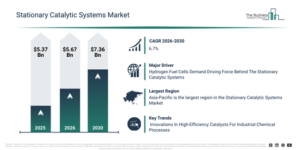
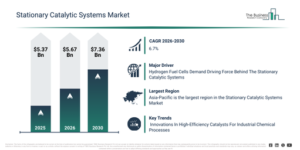
The stationary catalytic systems market has demonstrated strong growth in recent years. It is anticipated to increase from $5.37 billion in 2025 to $5.67 billion in 2026, achieving a compound annual growth rate (CAGR) of 5.5%. The expansion witnessed during the historic period can be attributed to several factors, including stricter industrial emission regulations, a rise in pollution levels originating from stationary industrial sources, the early adoption of SCR and oxidation catalyst technologies, increased utilization of platinum and palladium catalysts, and growing industrialization which drives demand for pollutant control.
The stationary catalytic systems market is projected for significant expansion over the coming years. This market is forecast to reach $7.36 billion by 2030, exhibiting a compound annual growth rate (CAGR) of 6.7%. This anticipated growth is driven by several factors, including the proliferation of clean energy policies, an increasing emphasis on decarbonization within heavy industries, innovations in catalyst regeneration technology, the rising need for economical multi-pollutant control systems, and heightened investments in modernizing emission controls. Key trends anticipated during this period involve the increasing uptake of high-efficiency catalyst formulations, a wider deployment of low-temperature catalytic systems, greater integration of catalyst monitoring and diagnostic tools, the development of modular catalytic units for industrial upgrades, and a growing move towards industrial operations with ultra-low emissions.
Access A Free Sample Of The Latest Stationary Catalytic Systems Market Analysis:
Why Is The Stationary Catalytic Systems Market Growing? The Key Demand Driver Explained
The increasing demand for hydrogen fuel cells is projected to boost the expansion of the stationary catalytic systems market in the coming years. A hydrogen fuel cell is an electrochemical device that converts hydrogen’s chemical energy into electricity through redox reactions. This sustainable energy source primarily produces electricity, heat, and water as its outputs. Hydrogen fuel cells can be deployed in stationary catalytic systems for purposes such as battery backup, ensuring an uninterrupted electricity supply (UPS), and generating power remotely. For instance, in September 2023, the Global Hydrogen Review 2023, published by the International Energy Agency (IEA), a France-based intergovernmental organization, reported that hydrogen utilization in road transport climbed by 45% in 2022. The inventory of fuel cell vehicles surpassed 58,000 by the year-end, experiencing an almost 40% increase to approximately 63,000 by mid-2023. Thus, the escalating requirement for hydrogen fuel cells is a primary factor propelling the stationary catalytic systems market.
What Are The Main Segments Of The Stationary Catalytic Systems Market?
The stationary catalytic systems market covered in this report is segmented –
1) By Technology: Selective Catalytic Reduction, Oxidation Catalyst
2) By Pollutant Type: Nox (Nitrogen Oxides), CO (Carbon Monoxide) Hydrocarbons, HAP (Hazardous Air Pollutants), DPM (Diesel Particulate Matter), NH3 (Ammonia)
3) By End-Use Industry: Chemical, Oil And Natural Gas, Power Plant, Metal And Mining, Cement, Other End-Use Industries
Subsegments:
1) By Selective Catalytic Reduction (SCR): Ammonia-Based SCR Systems, Urea-Based SCR Systems
2) By Oxidation Catalyst: Platinum-Based Catalysts, Palladium-Based Catalysts
Stationary Catalytic Systems Market Trend Analysis: Where Leading Companies Are Focusing
Leading firms in the stationary catalytic systems market are concentrating on creating novel solutions, including high-efficiency catalyst formulations. These aim to boost reaction speeds, cut down energy use, and extend the operational life of industrial chemical processes. High-efficiency catalyst formulations are advanced chemical compounds specifically engineered to speed up particular reactions, simultaneously reducing degradation and operational expenses. As an illustration, in September 2023, MIRATECH, a US-based industrial chemical company, introduced Apex, an innovative catalyst product line recognized as an industry leader. Apex is specifically designed to enhance reaction efficiency, prolong the lifespan of catalysts, and decrease operational downtime within large-scale chemical manufacturing, thereby allowing businesses to achieve greater productivity and reduced energy consumption.
Which Companies Are Major Players In The Stationary Catalytic Systems Market?
Major companies operating in the stationary catalytic systems market are Shell plc, BASF SE, Honeywell International inc., Bharat Heavy Electricals Limited, Yara International, Tenneco Inc., Johnson Matthey, Hitachi Zosen Corporation, Corning Incorporated, DuPont de Nemours Inc, Clariant AG, Durr Group, Umicore N.V., NIPPON SHOKUBAI CO. LTD, CECO Environmental, Babcock and Wilcox Enterprises Inc., Dinex Group, Ducon Infratechnologies Ltd., Kwangsung Corporation Ltd, Nett Technologies, Unifrax Holding Co., Air Clean Energy, DCL International, Catalytic Products International Inc., APC Technologies Inc., Advanced Catalyst Systems LLC
Get The Complete Stationary Catalytic Systems Market Analysis Here:
Which Region Held The Largest Share Of The Stationary Catalytic Systems Market In 2025?
Asia-Pacific was the largest region in the stationary catalytic systems market in 2025. The regions covered in the stationary catalytic systems market report are Asia-Pacific, South East Asia, Western Europe, Eastern Europe, North America, South America, Middle East, Africa.
Reach Out To Our Team:
The Business Research Company: https://www.thebusinessresearchcompany.com/
Americas: +1 310-496-7795
Asia: +44 7882 955267 & +91 8897263534
Europe: +44 7882 955267
Email us at: marketing@tbrc.info
Follow us on:
LinkedIn: https://in.linkedin.com/company/the-business-research-company
YouTube: https://www.youtube.com/channel/UC24_fI0rV8cR5DxlCpgmyFQ
Global Market Model: https://www.thebusinessresearchcompany.com/global-market-model

Wasay has over a decade of experience in market research, data modelling, and analytics, with prior experience at GlobalData and Decision Tree Consulting Services. At The Business Research Company , he leads research operations across syndicated studies, customized consulting engagements, and the Global Market Model platform. His professional experience includes supporting organizations such as Boston Consulting Group, KPMG, and Ernst & Young. Wasay holds a degree in Electronics and Communications Engineering, postgraduate management qualifications from International Management Institute Belgium and Indian School of Business and Entrepreneurship, and completed the Integrated Program in Business Analytics from Indian Institute of Management Indore.