Designed to make market research more actionable and strategically valuable, The Business Research Company’s 2026 market reports feature market attractiveness scoring, total addressable market sizing, company benchmarking matrices, interactive Excel dashboards, deeper supply chain intelligence, emerging startup tracking, and granular product-level insights.
How Fast Is The Sensors Market Growing? Market Size, CAGR And Forecast Insights
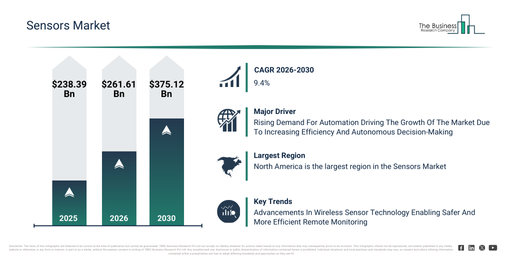
The size of the sensors market has experienced robust growth in recent years. This market is projected to expand from $238.39 billion in 2025 to $261.61 billion in 2026, demonstrating a compound annual growth rate (CAGR) of 9.7%. Historically, this expansion has been driven by factors such as advancements in semiconductor fabrication, the increasing implementation of automation in manufacturing processes, the strong demand for consumer electronics, stricter automotive safety regulations, and the broader deployment of industrial monitoring systems.
The sensors market is projected to experience robust expansion over the coming years. Its valuation is anticipated to reach $375.12 billion by 2030, exhibiting a compound annual growth rate (CAGR) of 9.4%. This anticipated growth is driven by factors such as the rise of smart cities, the expansion of electric and autonomous vehicle technologies, increased adoption of IoT in various sectors, growing demands for healthcare monitoring, and the integration of edge computing for real-time data analysis. Key developments expected during this period involve miniaturization and highly precise sensing capabilities, the proliferation of wireless and low-power sensor networks, the integration of multi-modal sensors, sophisticated signal processing and analytics, and the development of environment-adaptive and self-calibrating sensors.
Unlock Sensors Market Insights With A Free Sample Report:
Sensors Market Momentum: Key Driver Expected To Boost Growth Through 2030
The burgeoning need for automation is expected to fuel the expansion of the sensors market in the future. This involves utilizing machines or software to perform operations autonomously, thereby lessening human intervention. The uptake of automation is growing due to its considerable efficiency gains, facilitating quicker, precise completion of routine activities, which aids companies in cutting expenses and maintaining a competitive edge. This expansion directly boosts the need for sensors, given their crucial role in allowing machines to perceive, quantify, and react to environmental factors, thus supporting precise and independent choices. A case in point is the data from September 2024, where the International Federation of Robotics, a non-profit organization based in Germany, reported that 2023 saw the second-highest annual installation figure, totaling 541,302 robotic units. With 276,288 industrial robots deployed, constituting 51% of the global total, China continued its position as the leading market worldwide. Consequently, the rising requirement for automation will stimulate the growth of the sensors market.
Sensors Market Segments: A Category-By-Category Overview
The sensors market covered in this report is segmented –
1) By Type: Radar Sensors, Touch Sensors, Temperature And Humidity Sensors, Biosensors, Level Sensors, Pressure And Flow Sensors, Optical Sensors, Image Sensors, Other Types
2) By Technology: Micro-Electro-Mechanical Systems (MEMS), Complementary Metal-Oxide-Semiconductor (CMOS), Nano-Electro-Mechanical Systems (NEMS), Other Technologies
3) By End-Users: Consumer Electronics, Automotive, Biomedical And Healthcare, Industrial, Aerospace And Defense, Other End-Users
Subsegments:
1) By Radar Sensors: Short-Range Radar, Medium-Range Radar, Long-Range Radar, Imaging Radar, Doppler Radar
2) By Touch Sensors: Resistive Touch Sensors, Capacitive Touch Sensors, Surface Acoustic Wave (SAW) Sensors, Infrared Touch Sensors, Optical Imaging Touch Sensors
3) By Temperature And Humidity Sensors: Thermocouples, Resistance Temperature Detectors (RTDs), Thermistors, Infrared Temperature Sensors, Capacitive Humidity Sensors, Resistive Humidity Sensors, Thermal Conductivity Humidity Sensors
4) By Biosensors: Electrochemical Biosensors, Optical Biosensors, Piezoelectric Biosensors, Thermal Biosensors, Nanomechanical Biosensors
5) By Level Sensors: Contact Level Sensors, Non-contact Level Sensors, Ultrasonic Level Sensors, Capacitive Level Sensors, Radar Level Sensors, Optical Level Sensors, Conductive Level Sensors
6) By Pressure And Flow Sensors: Absolute Pressure Sensors, Gauge Pressure Sensors, Differential Pressure Sensors, Electromagnetic Flow Sensors, Ultrasonic Flow Sensors, Coriolis Flow Sensors, Thermal Mass Flow Sensors
7) By Optical Sensors: Photodiodes, Phototransistors, Photoelectric Sensors, Fiber Optic Sensors, Infrared Sensors, Ambient Light Sensors
8) By Image Sensors: CMOS Image Sensors, CCD Image Sensors, Infrared Image Sensors, 3D Image Sensors, X-ray Image Sensors
9) By Other Types: Proximity Sensors, Gas Sensors, Motion Sensors, Magnetic Sensors, Acoustic Sensors, Vibration Sensors
Which Emerging Trends Are Gaining Traction In The Sensors Market?
Leading firms within the sensors market are concentrating their efforts on creating sophisticated solutions, including wireless sensors, to facilitate real-time remote observation and data gathering in inaccessible or dangerous locations. Such a sensor is an instrument capable of detecting and quantifying physical or environmental states, then transmitting this information wirelessly to a primary system for oversight or examination. As an example, in November 2023, Worldsensing, an IoT enterprise from Spain, introduced its Vibration Meter, designed as a wireless sensor for monitoring vibrations. This device employs a tri-axial MEMS accelerometer, providing enhanced battery longevity, broader communication reach, and a more attractive cost point relative to current vibration technologies, all while adhering to crucial regulatory guidelines. An advanced algorithm is incorporated to track vibration thresholds and frequency, gathering data continuously at 1,000 MHz directly at the location. The collected data is then transmitted through a cellular gateway, utilizing Worldsensing’s Long Range (LoRa) antenna, which offers a range of up to 15 km and ensures compatibility with other Worldsensing equipment and networks. Operated by a user-changeable 3.6 V D-size battery, the instrument can function for up to 2 years with a 30-minute reporting interval and maintains dependable performance in severe temperatures from -40°C to 80°C.
Sensors Market Key Participants: Prominent Companies At A Glance
Major companies operating in the sensors market are Robert Bosch GmbH, Siemens AG, TDK Electronics AG, Infineon Technologies AG, KEYENCE Corporation, Ametek Inc., Banner Engineering Corp., WIKA Alexander Wiegand GmbH & Co. KG, Pepperl+Fuchs Inc., Christian Bürkert GmbH & Co. KG, Baumer Ltd., PCB Piezotronics Inc., Gefran S.p.A, First Sensor AG, KELLER AG, Micro Sensor Co. Ltd., Merit Sensor, di-soric, Sensitron, Spectra Symbol Corp., Proxitron GmbH, Holykell Sensor Inc., KWJ Engineering Inc., Novotechnik U.S. Inc., RIFTEK LLC
Get Detailed Sensors Market Forecasts In The Complete Report:
Top Region In The Sensors Market: A Global Perspective
North America was the largest region in the sensors market in 2025. Asia-Pacific is expected to be the fastest-growing region in the forecast period. The regions covered in the sensors market report are Asia-Pacific, South East Asia, Western Europe, Eastern Europe, North America, South America, Middle East, Africa.
Reach Out To Our Team:
The Business Research Company: https://www.thebusinessresearchcompany.com/
Americas: +1 310-496-7795
Asia: +44 7882 955267 & +91 8897263534
Europe: +44 7882 955267
Email us at: marketing@tbrc.info
Follow us on:
LinkedIn: https://in.linkedin.com/company/the-business-research-company
YouTube: https://www.youtube.com/channel/UC24_fI0rV8cR5DxlCpgmyFQ
Global Market Model: https://www.thebusinessresearchcompany.com/global-market-model

Wasay has over a decade of experience in market research, data modelling, and analytics, with prior experience at GlobalData and Decision Tree Consulting Services. At The Business Research Company , he leads research operations across syndicated studies, customized consulting engagements, and the Global Market Model platform. His professional experience includes supporting organizations such as Boston Consulting Group, KPMG, and Ernst & Young. Wasay holds a degree in Electronics and Communications Engineering, postgraduate management qualifications from International Management Institute Belgium and Indian School of Business and Entrepreneurship, and completed the Integrated Program in Business Analytics from Indian Institute of Management Indore.