Delivering more actionable and strategically valuable research, The Business Research Company’s 2026 market reports feature market attractiveness analysis, total addressable market evaluation, company benchmarking matrices, interactive Excel dashboards, expanded supply chain intelligence, emerging startup coverage, and detailed product insights.
Sensors Market Expected To Reach $375.12 Billion By 2030 At 9.4% CAGR
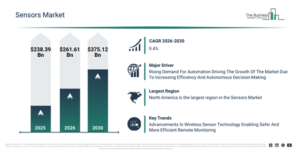
The sensors market has seen significant expansion in recent years. It is anticipated to increase from $238.39 billion in 2025 to $261.61 billion in 2026, exhibiting a compound annual growth rate (CAGR) of 9.7%. This historical growth can be attributed to various elements including advances in semiconductor fabrication, the growing adoption of automation in manufacturing, demand for consumer electronics, increasing automotive safety regulations, and the expansion of industrial monitoring systems.
The sensors market size is anticipated to experience substantial expansion in the coming years. This market is projected to reach $375.12 billion by 2030, exhibiting a compound annual growth rate (CAGR) of 9.4%. Driving this expansion during the forecast period are factors such as the rise of smart cities, the increasing presence of electric and autonomous vehicles, growing IoT implementation across industries, greater demands for healthcare monitoring, and the embrace of edge computing for instantaneous analytics. Key developments observed over the forecast period encompass miniaturization alongside high-precision sensing, the proliferation of wireless and low-power sensor networks, integrated multi-modal sensing solutions, sophisticated signal processing and data analysis, and sensors that adapt to their environment and self-calibrate.
Download A Free Sample Report For Comprehensive Market Insights:
Sensors Market Expansion Supported By Key Demand Factors
The rising demand for automation is projected to fuel the expansion of the sensors market in the upcoming years. Automation refers to the use of machines or software to execute tasks automatically, thereby lessening the necessity for human input. This demand for automation is increasing because it significantly improves efficiency by allowing for faster, error-free completion of repetitive tasks, which aids businesses in reducing costs and sustaining competitiveness. The broader adoption of automation consequently elevates the need for sensors, as sensors are vital for machines to detect, measure, and respond to real-world circumstances, enabling accurate and autonomous decisions. For instance, in September 2024, according to the International Federation of Robotics, a Germany-based non-profit organization, 2023 witnessed the second-highest annual installation, with 541,302 robotic units installed. Having deployed 276,288 industrial robots, or 51% of the total, China remained the world’s largest market. Therefore, the growing demand for automation will boost the development of the sensors market.
Sensors Market Segmentation: How Is The Market Structured Across Key Categories?
The sensors market covered in this report is segmented –
1) By Type: Radar Sensors, Touch Sensors, Temperature And Humidity Sensors, Biosensors, Level Sensors, Pressure And Flow Sensors, Optical Sensors, Image Sensors, Other Types
2) By Technology: Micro-Electro-Mechanical Systems (MEMS), Complementary Metal-Oxide-Semiconductor (CMOS), Nano-Electro-Mechanical Systems (NEMS), Other Technologies
3) By End-Users: Consumer Electronics, Automotive, Biomedical And Healthcare, Industrial, Aerospace And Defense, Other End-Users
Subsegments:
1) By Radar Sensors: Short-Range Radar, Medium-Range Radar, Long-Range Radar, Imaging Radar, Doppler Radar
2) By Touch Sensors: Resistive Touch Sensors, Capacitive Touch Sensors, Surface Acoustic Wave (SAW) Sensors, Infrared Touch Sensors, Optical Imaging Touch Sensors
3) By Temperature And Humidity Sensors: Thermocouples, Resistance Temperature Detectors (RTDs), Thermistors, Infrared Temperature Sensors, Capacitive Humidity Sensors, Resistive Humidity Sensors, Thermal Conductivity Humidity Sensors
4) By Biosensors: Electrochemical Biosensors, Optical Biosensors, Piezoelectric Biosensors, Thermal Biosensors, Nanomechanical Biosensors
5) By Level Sensors: Contact Level Sensors, Non-contact Level Sensors, Ultrasonic Level Sensors, Capacitive Level Sensors, Radar Level Sensors, Optical Level Sensors, Conductive Level Sensors
6) By Pressure And Flow Sensors: Absolute Pressure Sensors, Gauge Pressure Sensors, Differential Pressure Sensors, Electromagnetic Flow Sensors, Ultrasonic Flow Sensors, Coriolis Flow Sensors, Thermal Mass Flow Sensors
7) By Optical Sensors: Photodiodes, Phototransistors, Photoelectric Sensors, Fiber Optic Sensors, Infrared Sensors, Ambient Light Sensors
8) By Image Sensors: CMOS Image Sensors, CCD Image Sensors, Infrared Image Sensors, 3D Image Sensors, X-ray Image Sensors
9) By Other Types: Proximity Sensors, Gas Sensors, Motion Sensors, Magnetic Sensors, Acoustic Sensors, Vibration Sensors
Sensors Market Trends: What Is Shaping Future Industry Growth?
Leading companies in the sensors market are concentrating on developing sophisticated solutions, such as wireless sensors, to facilitate real-time remote observation and data acquisition in challenging or hazardous locations. A wireless sensor functions as a device that detects and quantifies physical or environmental conditions, then wirelessly transmits this data to a central system for analysis or monitoring. For instance, in November 2023, Worldsensing, an IoT company based in Spain, introduced the Vibration Meter, which is a wireless sensor designed for vibration monitoring. This product incorporates a tri-axial MEMS accelerometer, delivering improved battery lifespan, extended communication reach, and a more favorable price point compared to existing vibration technologies, all while complying with essential regulatory standards. It includes an advanced algorithm that monitors vibration thresholds and frequency, continuously gathering data at 1,000 MHz on-site. This data is transmitted through a cellular gateway using Worldsensing’s Long Range (LoRa) antenna, which provides up to 15 km of range and ensures compatibility with other Worldsensing devices and networks. Powered by a user-replaceable 3.6 V D-size battery, the device can operate for up to 2 years with a 30-minute reporting interval and performs dependably in extreme temperatures ranging from -40°C to 80°C.
Sensors Market Competitive Landscape And Leading Companies
Major companies operating in the sensors market are Robert Bosch GmbH, Siemens AG, TDK Electronics AG, Infineon Technologies AG, KEYENCE Corporation, Ametek Inc., Banner Engineering Corp., WIKA Alexander Wiegand GmbH & Co. KG, Pepperl+Fuchs Inc., Christian Bürkert GmbH & Co. KG, Baumer Ltd., PCB Piezotronics Inc., Gefran S.p.A, First Sensor AG, KELLER AG, Micro Sensor Co. Ltd., Merit Sensor, di-soric, Sensitron, Spectra Symbol Corp., Proxitron GmbH, Holykell Sensor Inc., KWJ Engineering Inc., Novotechnik U.S. Inc., RIFTEK LLC
Access The Complete Sensors Market Report:
Sensors Market Leading Geography: Which Region Generates The Most Revenue?
North America was the largest region in the sensors market in 2025. Asia-Pacific is expected to be the fastest-growing region in the forecast period. The regions covered in the sensors market report are Asia-Pacific, South East Asia, Western Europe, Eastern Europe, North America, South America, Middle East, Africa.
Get in touch with us:
The Business Research Company: https://www.thebusinessresearchcompany.com/
Americas: +1 310-496-7795
Asia: +44 7882 955267 & +91 8897263534
Europe: +44 7882 955267
Email us at: marketing@tbrc.info
Follow us on:
LinkedIn: https://in.linkedin.com/company/the-business-research-company
YouTube: https://www.youtube.com/channel/UC24_fI0rV8cR5DxlCpgmyFQ
Global Market Model: https://www.thebusinessresearchcompany.com/global-market-model

Wasay has over a decade of experience in market research, data modelling, and analytics, with prior experience at GlobalData and Decision Tree Consulting Services. At The Business Research Company , he leads research operations across syndicated studies, customized consulting engagements, and the Global Market Model platform. His professional experience includes supporting organizations such as Boston Consulting Group, KPMG, and Ernst & Young. Wasay holds a degree in Electronics and Communications Engineering, postgraduate management qualifications from International Management Institute Belgium and Indian School of Business and Entrepreneurship, and completed the Integrated Program in Business Analytics from Indian Institute of Management Indore.