The Business Research Company’s 2026 market reports combine market attractiveness scoring, total addressable market sizing, company benchmarking matrices, interactive Excel dashboards, deeper supply chain intelligence, emerging startup tracking, and granular product-level insights to deliver research that is more actionable and strategically valuable.
What Is The Silicon Carbide Power Semiconductor Market Growth Rate? A 22.9% CAGR Outlook Through 2030
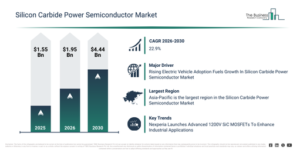
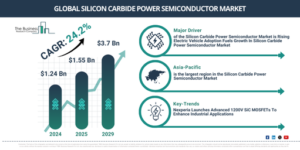
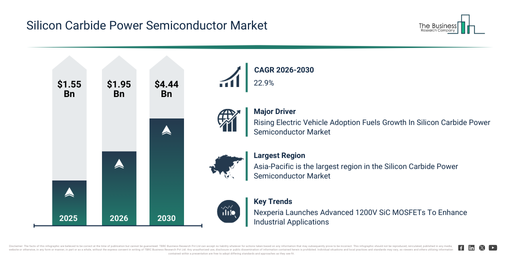
The silicon carbide power semiconductor market has experienced substantial expansion in recent years. It is projected to grow from $1.55 billion in 2025 to $1.95 billion in 2026, demonstrating a compound annual growth rate (CAGR) of 25.6%. The historical increase can be attributed to factors such as the limitations of silicon-based power devices, the growth of industrial automation systems, early adoption in renewable energy inverters, the rising demand for energy-efficient power electronics, and advancements in wide bandgap semiconductor research.
The silicon carbide power semiconductor market is poised for significant expansion in the coming years. Projections indicate it will reach a value of $4.44 billion by 2030, demonstrating a compound annual growth rate (CAGR) of 22.9%. This anticipated growth is driven by several factors, including the rapid development of electric vehicle charging infrastructure, increasing investments in renewable energy production, a rising need for high-efficiency data center power supplies, the adoption of high-voltage power modules within aerospace systems, and the scaling of SiC wafer manufacturing capacity. Key trends influencing this period involve the increasing integration of SiC devices in high-voltage power applications, greater utilization of SiC power semiconductors in electric vehicle powertrains, an escalating demand for high-temperature and high-frequency power devices, the expansion of SiC-based modules for industrial motor drives, and ongoing advancements in SiC wafer quality and yield improvements.
Access A Free Sample Of The Latest Silicon Carbide Power Semiconductor Market Analysis:
Why Is The Silicon Carbide Power Semiconductor Market Growing? The Key Demand Driver Explained
The growing adoption of electric vehicles is projected to propel the silicon carbide power semiconductor market forward. An electric vehicle (EV) is defined as a vehicle that utilizes one or more electric motors for propulsion. This increasing penetration of electric vehicles stems from technological advancements, supportive regulations, consumer demand, and industry investments. Silicon carbide (SiC) power semiconductors are crucial in electric vehicles, offering improved efficiency, reduced weight, and enhanced overall performance compared to conventional silicon-based semiconductors. Their integration continues to rise as EV manufacturers strive to optimize vehicle capabilities and improve the driving experience for consumers. For instance, according to the U.S. Energy Information Administration in January 2024, sales of hybrid vehicles, plug-in hybrid electric vehicles, and battery electric vehicles (BEVS) collectively accounted for 16.3% of total new light-duty vehicle (LDV) sales in the U.S. during 2023. Therefore, the expanding presence of electric vehicles is a key driver for growth in the silicon carbide power semiconductor market.
What Are The Main Segments Of The Silicon Carbide Power Semiconductor Market?
The silicon carbide power semiconductor market covered in this report is segmented –
1) By Type: Metal-Oxide Semiconductor Field-Effect Transistors (MOSFETs), Hybrid Modules, Schottky Barrier Diodes (SBDS), Insulated Gate Bipolar Transistors (IGBT), Bipolar Junction Transistor (BJT), Pin Diode, Junction FET (JFET), Other Types
2) By Voltage Range: 301-900 V, 901-1700 V, Above 1701 V
3) By Wafer Type: SiC Epitaxial Wafers, Blank SiC Wafers
4) By Application: Electric Vehicles (EV), Photovoltaics, Power Supplies, Industrial Motor Drives, Electric Vehicles Charging Infrastructure, RF Devices, Other Applications
5) By End-User: Industrial, Automotive, Energy And Power, Information Technology And Telecom, Transportation, Aerospace And Defense, Other End-Users
Subsegments:
1) By Metal-Oxide Semiconductor Field-Effect Transistors (MOSFETs): Normally-OFF MOSFETs, Normally-ON MOSFETs
2) By Hybrid Modules: Integrated Power Modules (IPMs), Power Conversion Modules, Other Hybrid Power Modules
3) By Schottky Barrier Diodes (SBDs): Standard Schottky Diodes, High-Voltage Schottky Diodes
4) By Insulated Gate Bipolar Transistors (IGBT): Standard IGBT, Trench IGBT
5) By Bipolar Junction Transistor (BJT): Standard BJT, High Power BJT
6) By Pin Diode: High-Voltage Pin Diodes, Low-Voltage Pin Diodes
7) By Junction FET (JFET): SiC-Based JFETs
8) By Other Types: Power Rectifiers, Thyristors, Silicon Carbide-Based Capacitors
Silicon Carbide Power Semiconductor Market Trend Analysis: Where Leading Companies Are Focusing
Major companies operating in the silicon carbide power semiconductor market are concentrating on developing innovative products, such as silicon carbide MOSFETs, to provide high performance and reliability in industrial applications. Silicon Carbide MOSFETs (Metal-Oxide-Semiconductor Field-Effect Transistors) are power semiconductor devices constructed using silicon carbide (SiC) as their semiconductor material. For instance, in November 2023, Nexperia B.V., a Netherlands-based semiconductor company, launched discrete 1200 V MOSFETs, a type of silicon carbide MOSFETs. These new devices are poised to revolutionize high-voltage applications with their unique set of features. Designed to optimize efficiency and reliability, Nexperia’s silicon carbide MOSFETs offer ultra-low switching losses and improved thermal performance, ensuring robust operation even in demanding conditions.
Which Companies Are Major Players In The Silicon Carbide Power Semiconductor Market?
Major companies operating in the silicon carbide power semiconductor market are Samsung Electronics Co. Ltd., Panasonic Corporation, Mitsubishi Electric Corporation, Toshiba Corporation, Eaton Corporation plc, Texas Instruments Inc., STMicroelectronics N.V., Infineon Technologies AG, BorgWarner Inc., NXP Semiconductors N.V., Renesas Electronics Corporation, Danfoss A/S, Microchip Technology Inc., ON Semiconductor Corporation, Fuji Electric Co. Ltd., ROHM Co. Ltd., Littelfuse Inc., Microsemi Corporation, Wolfspeed Inc., GeneSiC Semiconductor Inc.
Get The Complete Silicon Carbide Power Semiconductor Market Analysis Here:
Which Region Held The Largest Share Of The Silicon Carbide Power Semiconductor Market In 2025?
Asia-Pacific was the largest region in the silicon carbide power semiconductor market in 2025. Asia-Pacific is expected to be the fastest-growing region in the market. The regions covered in the silicon carbide power semiconductor market report are Asia-Pacific, South East Asia, Western Europe, Eastern Europe, North America, South America, Middle East, Africa.
Reach Out To Our Team:
The Business Research Company: https://www.thebusinessresearchcompany.com/
Americas: +1 310-496-7795
Asia: +44 7882 955267 & +91 8897263534
Europe: +44 7882 955267
Email us at: marketing@tbrc.info
Follow us on:
LinkedIn: https://in.linkedin.com/company/the-business-research-company
YouTube: https://www.youtube.com/channel/UC24_fI0rV8cR5DxlCpgmyFQ
Global Market Model: https://www.thebusinessresearchcompany.com/global-market-model

Wasay has over a decade of experience in market research, data modelling, and analytics, with prior experience at GlobalData and Decision Tree Consulting Services. At The Business Research Company , he leads research operations across syndicated studies, customized consulting engagements, and the Global Market Model platform. His professional experience includes supporting organizations such as Boston Consulting Group, KPMG, and Ernst & Young. Wasay holds a degree in Electronics and Communications Engineering, postgraduate management qualifications from International Management Institute Belgium and Indian School of Business and Entrepreneurship, and completed the Integrated Program in Business Analytics from Indian Institute of Management Indore.