With a focus on actionable insights and strategic value, The Business Research Company’s 2026 market reports include market attractiveness scoring, total addressable market sizing, company benchmarking matrices, interactive Excel dashboards, deeper supply chain intelligence, emerging startup tracking, and granular product-level insights.
How Large Could The Semiconductor Back-End Equipment Market Become By 2030 At A 8.6% CAGR?
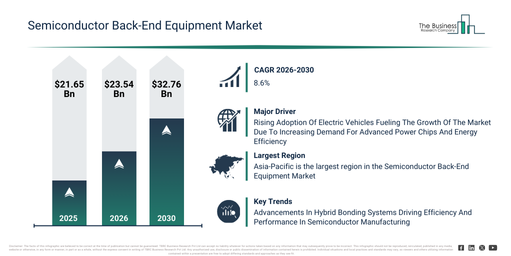
The semiconductor back-end equipment market has experienced substantial growth in recent years. It is projected to expand from $21.65 billion in 2025 to $23.54 billion in 2026, demonstrating a compound annual growth rate (CAGR) of 8.7%. This historic growth was primarily driven by increasing semiconductor demand, the expansion of consumer electronics, a rise in automotive electronics production, the development of telecommunication infrastructure, and the adoption of standard packaging techniques.
The semiconductor back-end equipment market is projected to experience substantial expansion in the coming years. Its valuation is set to reach $32.76 billion by 2030, exhibiting a compound annual growth rate (CAGR) of 8.6%. This forecasted growth stems from factors such as the greater uptake of AI-driven testing, a move towards heterogeneous integration, the expansion of automotive and 5G electronics sectors, the rising need for wafer-level packaging, and the proliferation of smart connected devices. Key developments anticipated during this timeframe involve advanced packaging automation, the implementation of high-precision testing systems, the miniaturization of semiconductor components, improvements in yield optimization and quality control, and the deployment of integrated assembly solutions.
Get A Free Semiconductor Back-End Equipment Market Sample With 2030 Forecast Insights:
Semiconductor Back-End Equipment Market Outlook: Key Driver Supporting Long-Term Growth
The increasing focus on electric vehicles is projected to stimulate the expansion of the semiconductor back-end equipment market. Electric vehicles operate using electricity stored in rechargeable batteries, employing electric motors for propulsion instead of conventional fuel-based engines. The heightened interest in electric vehicles stems from rising environmental concerns, as these vehicles contribute to lowering greenhouse gas emissions and decreasing reliance on fossil fuels, thereby supporting global sustainability initiatives. Semiconductor back-end equipment is crucial for electric vehicles, facilitating the production of advanced power chips that enhance energy efficiency, optimize battery performance, and boost overall vehicle reliability. For example, in November 2024, data from the US-based government agency, the Joint Office of Energy and Transportation, indicated that plug-in electric vehicle sales in the US climbed from 6.8% of total vehicle sales in 2022 to 9.4% in 2023. Consequently, the increasing emphasis on electric vehicles is propelling the growth of the semiconductor back-end equipment market.
Segmentation Of The Semiconductor Back-End Equipment Market: Key Categories Explained
The semiconductor back-end equipment market covered in this report is segmented –
1) By Equipment Type: Die Bonding Equipment, Wire Bonding Equipment, Packaging Equipment, Testing Equipment
2) By Process Stage: Wafer Level Processing, Chip Level Processing, Final Test And Packaging, Assembly, Other Process Stages
3) By Application: Consumer Electronics, Automotive Electronics, Telecommunications, Data Processing, Industrial Applications
4) By End-User Industry: Semiconductor Manufacturers, Original Equipment Manufacturers (OEMs), Fabrication Plants (Fabs), Research And Development Institutions, Other End-User Industries
Subsegments:
1) By Die Bonding Equipment: Thermo-Compression Die Bonding, Eutectic Die Bonding, Transient Liquid Phase (TLP) Bonding, Flip Chip Bonding, Adhesive Die Bonding
2) By Wire Bonding Equipment: Ball Bonding, Wedge Bonding, Looping Systems, Ribbon Bonding
3) By Packaging Equipment: Molding Equipment, Encapsulation Equipment, Lead Frame Processing Equipment, Trim And Form Equipment, Wafer-Level Packaging (WLP) Equipment
4) By Testing Equipment: Final Test Equipment, In-Line Test Equipment, Burn-In Test Equipment, Automated Test Equipment (ATE)
Semiconductor Back-End Equipment Market Evolving Trends: What Businesses Should Know
Companies prominent in the semiconductor back-end equipment market are actively pursuing the development of advanced solutions, such as hybrid bonding systems designed for greater interconnect density. Their aim is to enhance performance, improve power efficiency, and enable 3D integration. A hybrid bonding system directly connects dies or wafers using metal and dielectric interfaces instead of solder bumps, thereby achieving ultra-fine pitch and delivering superior electrical and thermal performance. As an illustration, in May 2024, BE Semiconductor Industries N.V., a semiconductor assembly equipment manufacturer based in the Netherlands, secured an order for 26 Hybrid Bonding Systems from a leading semiconductor logic producer. This product provides high precision with 100 nm placement accuracy, outperforming conventional bonding systems. It also facilitates advanced wafer-to-wafer and die-to-wafer bonding, ideal for high-volume manufacturing. This uptake signifies increasing interest in hybrid bonding as the semiconductor industry seeks methods to address the escalating performance, density, and efficiency needs of future devices.
Who Competes In The Semiconductor Back-End Equipment Market? Major Companies Listed
Major companies operating in the semiconductor back-end equipment market are ASE Group, Toray Engineering Co. Ltd., Yamaha Robotics Holdings Co. Ltd., Micron Technology Inc., Applied Materials Inc., Advantest Corp., ASM International, Teradyne Inc., Nordson Corporation, KLA Corp., Disco Corporation, Advanced Micro-Fabrication Equipment Inc., Onto Innovation Inc., FormFactor, Cohu Inc., SUSS MicroTec SE, TOWA Corp., EV Group Inc., Kulicke & Soffa Industries Inc., Screen Holdings Company Limited, Hanmi Semiconductor Company Limited, GL Tech Co. Ltd., Camtek Ltd., Synova LLC, Matsusada Precision Inc.
Read The Complete Semiconductor Back-End Equipment Market Forecast Report Through 2030:
Semiconductor Back-End Equipment Market Regional Ranking: Which Geography Comes First?
Asia-Pacific was the largest region in the semiconductor back-end equipment market in 2025. Asia-Pacific is expected to be the fastest-growing region in the forecast period. The regions covered in the semiconductor back-end equipment market report are Asia-Pacific, South East Asia, Western Europe, Eastern Europe, North America, South America, Middle East, Africa.
Reach Out To Our Team:
The Business Research Company: https://www.thebusinessresearchcompany.com/
Americas: +1 310-496-7795
Asia: +44 7882 955267 & +91 8897263534
Europe: +44 7882 955267
Email us at: marketing@tbrc.info
Follow us on:
LinkedIn: https://in.linkedin.com/company/the-business-research-company
YouTube: https://www.youtube.com/channel/UC24_fI0rV8cR5DxlCpgmyFQ
Global Market Model: https://www.thebusinessresearchcompany.com/global-market-model

Wasay has over a decade of experience in market research, data modelling, and analytics, with prior experience at GlobalData and Decision Tree Consulting Services. At The Business Research Company , he leads research operations across syndicated studies, customized consulting engagements, and the Global Market Model platform. His professional experience includes supporting organizations such as Boston Consulting Group, KPMG, and Ernst & Young. Wasay holds a degree in Electronics and Communications Engineering, postgraduate management qualifications from International Management Institute Belgium and Indian School of Business and Entrepreneurship, and completed the Integrated Program in Business Analytics from Indian Institute of Management Indore.