With a focus on actionable insights and strategic value, The Business Research Company’s 2026 market reports include market attractiveness scoring, total addressable market sizing, company benchmarking matrices, interactive Excel dashboards, deeper supply chain intelligence, emerging startup tracking, and granular product-level insights.
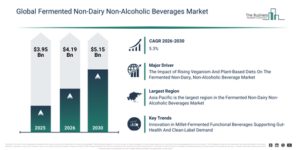
Fermented Non-Dairy Non-Alcoholic Beverages Market Size Outlook: A $5.15 Billion Market By 2030, Growing At 5.3% Annually
The market for fermented non-dairy non-alcoholic beverages has experienced substantial growth recently. This market is projected to expand from $3.95 billion in 2025 to $4.19 billion by 2026, demonstrating a compound annual growth rate (CAGR) of 5.9%. Historically, this growth can be attributed to several factors, including heightened consumer interest in fermented foods, the early embrace of kombucha products, the expansion of specialty beverage brands, increased public awareness of probiotics, and innovations in non-dairy formulations.
The fermented non-dairy non-alcoholic beverages market size is projected to experience robust expansion over the next few years. It is expected to reach $5.15 billion by 2030, demonstrating a compound annual growth rate (CAGR) of 5.3%. This anticipated growth is driven by factors such as the increasing demand for dairy-free functional beverages, a heightened focus on digestive health, the spread of clean-label beverage consumption, greater market penetration of online beverage retail, and elevated investments in fermentation technologies. Key trends during this forecast period include the surging popularity of plant-based fermented drinks, the expanding consumption of kombucha and water kefir, a rising inclination towards gut-health beverages, continuous product innovation employing diverse plant substrates, and enhanced retail availability across various channels.
Make Data-Driven Decisions With A Free Fermented Non-Dairy Non-Alcoholic Beverages Market Sample Report:
Key Demand Driver Expected To Lift Fermented Non-Dairy Non-Alcoholic Beverages Market Revenue
The increasing adoption of veganism and plant-based diets is projected to drive the growth of the fermented, non-dairy, non-alcoholic beverage market in the coming period. Veganism and plant-based diets represent a philosophy and way of life that actively seeks to eliminate all forms of animal exploitation, incorporating a rigorous diet that excludes any animal-derived products. The expansion of veganism and plant-based diets is attributed to growing awareness regarding animal welfare, the health advantages associated with vegan nutrition, and shifting consumer interests. Fermented, non-dairy, and non-alcoholic beverages are an important addition to the vegan diet, providing nutritional benefits, upholding ethical and environmental objectives, and contributing to overall health and wellness. They offer convenient, palatable, and versatile alternatives that align with vegan principles, simplifying the transition to and maintenance of a plant-based lifestyle for individuals. As an illustration, in April 2024, according to Finder, a US-based personal finance comparison site, approximately 2.5 million individuals in the UK identify as vegan, making up 4.7% of the population; this marks an increase from 1.4 million vegans (2.5%) in 2023, indicating a rise of 1.1 million vegans in the UK between 2023 and 2024. Therefore, the growth in veganism and plant-based diets is a primary driver for the fermented, non-dairy, non-alcoholic beverage market.
Exploring The Fermented Non-Dairy Non-Alcoholic Beverages Market Through Its Key Segments
The fermented non-dairy non-alcoholic beverages market covered in this report is segmented –
1) By Product Type: Dairy Free Drinkable Yogurts, Fermented Soft Drinks, Fermented Juices, Non-Dairy Kefir
2) By Source: Fruits, Vegetables, Cereals, Other Sources
3) By Distribution Channel: Retail Stores, Department Store, Super Market, Hypermarket, Specialty Store
4) By Application: Modern Trade, Specialty Stores, Convenience Stores, Online Retailers
Subsegments:
1) By Dairy-Free Drinkable Yogurts: Coconut Milk-Based Yogurts, Almond Milk-Based Yogurts, Soy Milk-Based Yogurts, Oat Milk-Based Yogurts
2) By Fermented Soft Drinks: Kombucha, Fermented Lemonades, Water Kefir
3) By Fermented Juices: Fermented Fruit Juices, Vegetable-Based Fermented Juices
4) By Non-Dairy Kefir: Coconut Milk Kefir, Almond Milk Kefir, Soy Milk Kefir, Oat Milk Kefir
New Trends Redefining Competition In The Fermented Non-Dairy Non-Alcoholic Beverages Market
Leading companies within the fermented non-dairy non-alcoholic beverages market are concentrating on creating novel solutions, specifically “millet-fermented functional beverages,” to satisfy the increasing consumer desire for natural, clean-label, and sugar-free drinks that support gut health. This trend is influenced by a greater focus on digestive well-being, reduced sugar intake, and plant-based living. These millet-fermented functional beverages utilize millets, which are ancient grains, as the medium for fermentation, merging traditional cereal nutrition with contemporary probiotic or fermentation techniques. This process results in a naturally fermented drink that may offer prebiotic or probiotic advantages and contains no added sugars or dairy. An example of this is the launch by Bliss Body, an India-based functional-beverage brand, in November 2024, of a new line of millet-fermented drinks available in Pineapple, Mango, and Orange flavors. This product collection is characterized by a sugar-free formulation and a naturally sweet taste achieved through fermentation, integrating the nutritional aspects of millet with the advantages of fermentation. It targets consumers who aim for gut health improvement, blood-sugar regulation, stress reduction, and overall wellness, all without dairy or refined sugar. These beverages are formulated to aid digestive well-being, lessen bloating, and present a natural, revitalizing drink choice for individuals mindful of their health.
Fermented Non-Dairy Non-Alcoholic Beverages Market Competition: Key Players And Industry Participants
Major companies operating in the fermented non-dairy non-alcoholic beverages market are PepsiCo Inc., Danone S.A, General Mills Inc., DuPont de Nemours Inc, Yakult Honsha Co. Ltd., Chr. Hansen A/S, Probi AB, Health-Ade LLC, KeVita Inc., Lifeway Foods Inc., Lifeway Foods inc., Konings NV, GT’s Living Foods LLC, Fentimans Ltd., Bionade GmbH, Millennium Products Inc., Bionade GmbH, Reed’s Inc., Good Karma Foods Inc., Thurella AG, AGM Foods PTY Ltd., China-Biotics Inc.
Get The Detailed Fermented Non-Dairy Non-Alcoholic Beverages Market Research Report Here:
Fermented Non-Dairy Non-Alcoholic Beverages Market Regional Overview: Largest Market And Global Coverage
Asia Pacific was the largest region in the fermented non-dairy non-alcoholic beverages market in 2025. The regions covered in the fermented non-dairy non-alcoholic beverages market report are Asia-Pacific, South East Asia, Western Europe, Eastern Europe, North America, South America, Middle East and Africa.
Reach Out To Our Team:
The Business Research Company: https://www.thebusinessresearchcompany.com/
Americas: +1 310-496-7795
Asia: +44 7882 955267 & +91 8897263534
Europe: +44 7882 955267
Email us at: marketing@tbrc.info
Follow us on:
LinkedIn: https://in.linkedin.com/company/the-business-research-company
YouTube: https://www.youtube.com/channel/UC24_fI0rV8cR5DxlCpgmyFQ
Global Market Model: https://www.thebusinessresearchcompany.com/global-market-model

Wasay has over a decade of experience in market research, data modelling, and analytics, with prior experience at GlobalData and Decision Tree Consulting Services. At The Business Research Company , he leads research operations across syndicated studies, customized consulting engagements, and the Global Market Model platform. His professional experience includes supporting organizations such as Boston Consulting Group, KPMG, and Ernst & Young. Wasay holds a degree in Electronics and Communications Engineering, postgraduate management qualifications from International Management Institute Belgium and Indian School of Business and Entrepreneurship, and completed the Integrated Program in Business Analytics from Indian Institute of Management Indore.