Built to provide research that’s more actionable and strategically valuable, The Business Research Company’s 2026 market reports include market attractiveness analysis, total addressable market sizing, company benchmarking matrices, interactive Excel dashboards, broader supply chain intelligence, emerging startup tracking, and in-depth product insights.
Fermented Non-Dairy Non-Alcoholic Beverages Market Poised To Hit $5.15 Billion By 2030 With A 5.3% CAGR
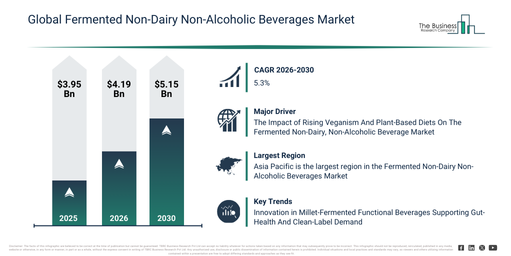
The market size for fermented non-dairy non-alcoholic beverages has experienced substantial growth in recent years. It is projected to increase from $3.95 billion in 2025 to $4.19 billion in 2026, reflecting a compound annual growth rate (CAGR) of 5.9%. The expansion observed historically can be ascribed to a rising consumer appetite for fermented foods, the initial widespread adoption of kombucha products, the diversification of specialty beverage brands, an elevated awareness of probiotics, and innovations within non-dairy formulations.
The market for fermented non-dairy non-alcoholic beverages is projected to experience substantial expansion over the upcoming years. This market is anticipated to reach a valuation of $5.15 billion by 2030, exhibiting a compound annual growth rate (CAGR) of 5.3%. Key factors driving this expansion during the projection period include the increasing consumer demand for dairy-free functional drinks, a heightened emphasis on digestive well-being, the broader adoption of clean-label beverage options, greater penetration of online platforms for beverage sales, and enhanced investments in fermentation technologies. Significant trends expected throughout the forecast timeframe encompass the increasing appeal of plant-based fermented beverages, the broadened consumption of kombucha and water kefir, a surging demand for gut-health drinks, advancements in product development utilizing various plant substrates, and improved retail accessibility across different distribution channels.
Get A Free Sample Report With In-Depth Market Insights:
Fermented Non-Dairy Non-Alcoholic Beverages Market Opportunity Drivers: What’s Unlocking New Revenue Potential?
An increasing adoption of veganism and plant-based eating habits is anticipated to fuel the expansion of the fermented, non-dairy, non-alcoholic beverage market moving ahead. Veganism and plant-based diets represent a philosophy and way of life focused on shunning animal exploitation in all its forms, encompassing a rigorous diet free from animal products. This surge in vegan and plant-based dietary choices stems from increasing awareness regarding animal welfare, the health advantages associated with vegan nutrition, and evolving consumer preferences. Fermented, non-dairy, non-alcoholic drinks serve as a beneficial complement to a vegan diet, providing nutritional value, aligning with ethical and environmental objectives, and promoting overall health. These beverages offer readily available, palatable, and adaptable choices that resonate with vegan principles, thereby simplifying the adoption and sustained practice of a plant-based lifestyle. For example, data from Finder, a US-based personal finance comparison site, in April 2024 revealed that roughly 2.5 million people in the UK follow a vegan diet, constituting 4.7% of the population. This marks an increase from 1.4 million vegans (2.5%) recorded in 2023, signifying an increase of 1.1 million vegans in the UK from 2023 to 2024. Consequently, the growing trend of veganism and plant-based diets is a key driver for the fermented, non-dairy, non-alcoholic beverage market.
Fermented Non-Dairy Non-Alcoholic Beverages Market Segment Landscape: Which Areas Lead Development?
The fermented non-dairy non-alcoholic beverages market covered in this report is segmented –
1) By Product Type: Dairy Free Drinkable Yogurts, Fermented Soft Drinks, Fermented Juices, Non-Dairy Kefir
2) By Source: Fruits, Vegetables, Cereals, Other Sources
3) By Distribution Channel: Retail Stores, Department Store, Super Market, Hypermarket, Specialty Store
4) By Application: Modern Trade, Specialty Stores, Convenience Stores, Online Retailers
Subsegments:
1) By Dairy-Free Drinkable Yogurts: Coconut Milk-Based Yogurts, Almond Milk-Based Yogurts, Soy Milk-Based Yogurts, Oat Milk-Based Yogurts
2) By Fermented Soft Drinks: Kombucha, Fermented Lemonades, Water Kefir
3) By Fermented Juices: Fermented Fruit Juices, Vegetable-Based Fermented Juices
4) By Non-Dairy Kefir: Coconut Milk Kefir, Almond Milk Kefir, Soy Milk Kefir, Oat Milk Kefir
Fermented Non-Dairy Non-Alcoholic Beverages Market Innovation Trends Shaping Future Development
Leading companies within the fermented non-dairy non-alcoholic beverages market are concentrating on creating inventive products, including “millet-fermented functional beverages.” This effort is driven by the increasing consumer desire for gut-health focused, sugar-free, natural, and clean-label drinks, stemming from a growing interest in digestive wellness, low-sugar diets, and plant-based lifestyles. These millet-fermented functional beverages utilize millets, which are ancient grains, as their fermentation substrate. They unite conventional cereal nutrition with contemporary probiotic or fermentation methods to produce a naturally fermented drink that may provide prebiotic or probiotic advantages and contains no added sugars or dairy. As an illustration, in November 2024, Bliss Body, a functional-beverage brand from India, introduced a new collection of millet-fermented drinks available in Pineapple, Mango, and Orange flavors. This particular product line is characterized by a sugar-free composition and a natural sweetness resulting from fermentation. It integrates the nutritional attributes of millet with the benefits of fermentation, aiming to cater to consumers seeking support for gut health, blood-sugar stability, stress alleviation, and overall well-being, entirely free from dairy or refined sugar. These beverages are formulated to promote digestive health, diminish bloating, and present a natural, revitalizing drink choice for individuals attentive to their health.
Fermented Non-Dairy Non-Alcoholic Beverages Market Industry Leaders And Competitive Landscape
Major companies operating in the fermented non-dairy non-alcoholic beverages market are PepsiCo Inc., Danone S.A, General Mills Inc., DuPont de Nemours Inc, Yakult Honsha Co. Ltd., Chr. Hansen A/S, Probi AB, Health-Ade LLC, KeVita Inc., Lifeway Foods Inc., Lifeway Foods inc., Konings NV, GT’s Living Foods LLC, Fentimans Ltd., Bionade GmbH, Millennium Products Inc., Bionade GmbH, Reed’s Inc., Good Karma Foods Inc., Thurella AG, AGM Foods PTY Ltd., China-Biotics Inc.
View The Full Fermented Non-Dairy Non-Alcoholic Beverages Market Report:
Fermented Non-Dairy Non-Alcoholic Beverages Market Regional Analysis: Which Geography Leads On Revenue?
Asia Pacific was the largest region in the fermented non-dairy non-alcoholic beverages market in 2025. The regions covered in the fermented non-dairy non-alcoholic beverages market report are Asia-Pacific, South East Asia, Western Europe, Eastern Europe, North America, South America, Middle East and Africa.
Reach Out To Our Team:
The Business Research Company: https://www.thebusinessresearchcompany.com/
Americas: +1 310-496-7795
Asia: +44 7882 955267 & +91 8897263534
Europe: +44 7882 955267
Email us at: marketing@tbrc.info
Follow us on:
LinkedIn: https://in.linkedin.com/company/the-business-research-company
YouTube: https://www.youtube.com/channel/UC24_fI0rV8cR5DxlCpgmyFQ
Global Market Model: https://www.thebusinessresearchcompany.com/global-market-model

Wasay has over a decade of experience in market research, data modelling, and analytics, with prior experience at GlobalData and Decision Tree Consulting Services. At The Business Research Company , he leads research operations across syndicated studies, customized consulting engagements, and the Global Market Model platform. His professional experience includes supporting organizations such as Boston Consulting Group, KPMG, and Ernst & Young. Wasay holds a degree in Electronics and Communications Engineering, postgraduate management qualifications from International Management Institute Belgium and Indian School of Business and Entrepreneurship, and completed the Integrated Program in Business Analytics from Indian Institute of Management Indore.