Designed to make market research more actionable and strategically valuable, The Business Research Company’s 2026 market reports feature market attractiveness scoring, total addressable market sizing, company benchmarking matrices, interactive Excel dashboards, deeper supply chain intelligence, emerging startup tracking, and granular product-level insights.
How Big Is The Wireless Power Transfer For Electric Vehicles (EV) Charging Market In 2026, And How Fast Will It Grow?
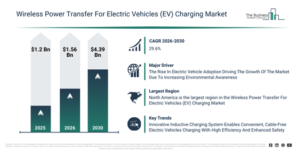
The wireless power transfer for electric vehicles (EV) charging market has experienced substantial expansion in recent years. It is anticipated to increase from $1.2 billion in 2025 to $1.56 billion in 2026, exhibiting a compound annual growth rate (CAGR) of 29.9%. The historical growth of this market can be attributed to factors such as the increasing adoption of electric vehicles, government initiatives promoting clean transportation, the early stages of inductive charging technology development, a restricted public charging infrastructure, and advancements in battery efficiency.
The wireless power transfer for electric vehicles (EV) charging market is projected to experience significant expansion in the upcoming years, with its size expected to reach $4.39 billion in 2030, exhibiting a compound annual growth rate (CAGR) of 29.6%. This anticipated growth during the forecast period is largely attributable to the increasing deployment of dynamic charging lanes, the integration of AI into charging systems, the growing trend of fleet electrification, the expansion of public transport electrification, and the development of multi-coil and hybrid charging solutions. Key trends for this period encompass the broadening of wireless charging infrastructure, the implementation of smart charging management systems, the establishment of standardized charging protocols, the integration with renewable energy sources, and the progression of vehicle-to-grid (V2G) technology.
Download A Free Wireless Power Transfer For Electric Vehicles (EV) Charging Market Sample Report With Size And Forecast Data:
Wireless Power Transfer For Electric Vehicles (EV) Charging Market Growth Driver: The Key Factor Behind Rising Demand
The expanding integration of electric vehicles (EVs) is anticipated to fuel the expansion of the wireless power transfer for electric vehicles (EV) charging market in the future. Electric vehicles are automobiles powered entirely or partially by electricity, offering a more environmentally friendly alternative compared to conventional internal combustion engines. The rising adoption of electric vehicles stems from heightened environmental consciousness, as individuals aim to lessen greenhouse gas emissions and address climate change. Wireless power transfer for electric vehicle (EV) charging improves the ease, effectiveness, and security of EV use through cable-free, automated energy delivery straight to the vehicle. For example, data from February 2024, provided by the U.S. Department of Energy, a federal agency in the US, indicated substantial year-over-year growth in monthly EV sales over the last three years. Monthly sales peaked at around 100,000 in 2023, representing a 25% rise over 2022 figures. Consequently, the growing acceptance of electric vehicles (EVs) is a primary catalyst for the growth of the wireless power transfer for electric vehicles (EV) charging market.
Wireless Power Transfer For Electric Vehicles (EV) Charging Market Segmentation: Key Segments And Subsegments Covered
The wireless power transfer for electric vehicles (EV) charging market covered in this report is segmented –
1) By Technology: Inductive Charging, Resonant Inductive Charging, Capacitive Charging, Other Technologies
2) By Power Supply Range: Low Power, Medium Power, High Power
3) By Application: Private Vehicles, Public Transport, Commercial Vehicles, Other Applications
4) By End-User: Private, Public, Fleet
Subsegments:
1) By Inductive Charging: Static Charging Pads, Dynamic Charging Lanes, Onboard Vehicle Coils
2) By Resonant Inductive Charging: Magnetic Resonance Coupling, Frequency Tuned Systems, Multi Coil Systems
3) By Capacitive Charging: Plate To Plate Systems, Embedded Roadway Systems, Vehicle To Infrastructure Systems
4) By Other Technologies: Radio Frequency Charging, Laser Based Charging, Hybrid Charging Systems
Wireless Power Transfer For Electric Vehicles (EV) Charging Market Trends: Key Developments Shaping 2026 And Beyond
Leading companies in the wireless power transfer for electric vehicles (EV) charging market are dedicated to developing innovative solutions, such as inductive wireless charging systems, to provide convenient, cable-free, and efficient electric vehicle charging experiences. An inductive wireless charging system is a technology that transfers electrical energy from a charging pad to an electric vehicle through magnetic fields, removing the need for physical cables. For example, in September 2025, Dr. Ing. h.c. F. Porsche AG, a Germany-based automobile manufacturer, unveiled the Porsche Cayenne Electric, which includes an 11-kW wireless charging system for convenient, cable-free EV charging. The vehicle features an 11-kW inductive charging floor plate, allowing drivers to charge by simply parking over it, with automatic activation upon engaging the parking brake. This system provides up to 90% energy transfer efficiency, incorporates motion and foreign object detection for heightened safety, integrates with the My Porsche app for monitoring and scheduling, and utilizes ultra-wideband technology and Surround View to ensure precise vehicle alignment.
Leading Companies Operating In The Wireless Power Transfer For Electric Vehicles (EV) Charging Market
Major companies operating in the wireless power transfer for electric vehicles (EV) charging market are Toyota Motor Corporation, Siemens Aktiengesellschaft, Continental Aktiengesellschaft, Dr. Ing. h.c. F. Porsche Aktiengesellschaft, Qualcomm Incorporated, Toshiba Corporation, Zhongxing Telecommunication Equipment Corporation, DAIHEN Corporation, Mahle Gesellschaft mit beschränkter Haftung, Zhejiang VIE Science & Technology Co. Ltd., ChargePoint Inc., GuRu Wireless Inc., Mojo Mobility Inc., HEVO Inc., Momentum Dynamics Corporation, WiTricity Corporation, Powermat Technologies Ltd., Electreon Wireless Ltd., ENRX Group, InductEV Inc.
Access The Full Wireless Power Transfer For Electric Vehicles (EV) Charging Market Research Report:
Wireless Power Transfer For Electric Vehicles (EV) Charging Market Regional Analysis: Largest Region And Key Geographies Covered
North America was the largest region in the wireless power transfer for electric vehicles (EV) charging market in 2025. Asia-Pacific is expected to be the fastest-growing region in the forecast period. The regions covered in the wireless power transfer for electric vehicles (EV) charging market report are Asia-Pacific, South East Asia, Western Europe, Eastern Europe, North America, South America, Middle East, Africa.
Reach Out To Our Team:
The Business Research Company: https://www.thebusinessresearchcompany.com/
Americas: +1 310-496-7795
Asia: +44 7882 955267 & +91 8897263534
Europe: +44 7882 955267
Email us at: marketing@tbrc.info
Follow us on:
LinkedIn: https://in.linkedin.com/company/the-business-research-company
YouTube: https://www.youtube.com/channel/UC24_fI0rV8cR5DxlCpgmyFQ
Global Market Model: https://www.thebusinessresearchcompany.com/global-market-model

Wasay has over a decade of experience in market research, data modelling, and analytics, with prior experience at GlobalData and Decision Tree Consulting Services. At The Business Research Company , he leads research operations across syndicated studies, customized consulting engagements, and the Global Market Model platform. His professional experience includes supporting organizations such as Boston Consulting Group, KPMG, and Ernst & Young. Wasay holds a degree in Electronics and Communications Engineering, postgraduate management qualifications from International Management Institute Belgium and Indian School of Business and Entrepreneurship, and completed the Integrated Program in Business Analytics from Indian Institute of Management Indore.