Delivering more actionable and strategically valuable research, The Business Research Company’s 2026 market reports feature market attractiveness analysis, total addressable market evaluation, company benchmarking matrices, interactive Excel dashboards, expanded supply chain intelligence, emerging startup coverage, and detailed product insights.
Wireless Power Transfer For Electric Vehicles (EV) Charging Market Forecast: What Market Value Is Expected By 2030?
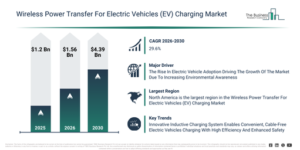
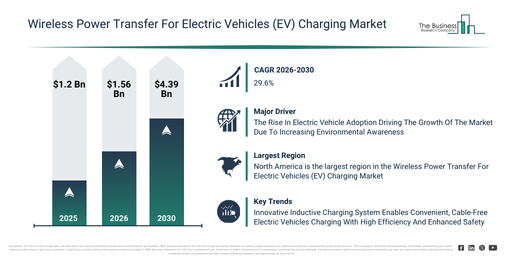
The wireless power transfer for electric vehicles (EV) charging market size has witnessed significant expansion in recent years. This market is expected to increase from $1.2 billion in 2025 to $1.56 billion in 2026, achieving a compound annual growth rate (CAGR) of 29.9%. The market’s historical growth can be linked to factors such as the increasing adoption of electric vehicles, governmental encouragement for clean transportation, the initial advancements in inductive charging technologies, a scarcity of public charging infrastructure, and enhancements in battery efficiency.
The market size for wireless power transfer in electric vehicle (EV) charging is poised for significant expansion in the coming years. It is projected to reach $4.39 billion by 2030, growing at a compound annual growth rate (CAGR) of 29.6%. This anticipated growth can be attributed to several factors during the forecast period, including the increasing implementation of dynamic charging lanes, the integration of AI within charging systems, the rising trend of fleet electrification, the expansion of public transport electrification, and advancements in multi-coil and hybrid charging solutions. Key trends anticipated in the forecast period involve the broadening of wireless charging infrastructure, the development of smart charging management systems, the establishment of standardized charging protocols, greater integration with renewable energy sources, and the adoption of vehicle-to-grid (V2G) technology.
Download A Free Sample Report For Comprehensive Market Insights:
Wireless Power Transfer For Electric Vehicles (EV) Charging Market Growth Drivers: What Factors Are Accelerating Expansion?
The expanding embrace of electric vehicles (EVs) is projected to fuel the expansion of the wireless power transfer for electric vehicles (EV) charging market in the future. EVs are vehicles that run fully or partly on electricity, presenting a more environmentally friendly choice compared to conventional internal combustion engines. The rising popularity of electric vehicles stems from heightened environmental consciousness, as individuals aim to lower greenhouse gas emissions and address climate change. Wireless power transfer for electric vehicle (EV) charging boosts the ease, effectiveness, and security of EV usage by allowing automatic, cable-free energy delivery straight to the vehicle. For example, data from February 2024, released by the U.S. Department of Energy, a US-based federal agency, indicates substantial year-over-year growth in monthly EV sales across the last three years. Monthly sales hit a high of roughly 100,000 in 2023, representing a 25% rise from 2022. Consequently, the expanding uptake of electric vehicles (EVs) is propelling the growth of the wireless power transfer for electric vehicles (EV) charging market.
Wireless Power Transfer For Electric Vehicles (EV) Charging Market Segment Analysis And Revenue Opportunities
The wireless power transfer for electric vehicles (EV) charging market covered in this report is segmented –
1) By Technology: Inductive Charging, Resonant Inductive Charging, Capacitive Charging, Other Technologies
2) By Power Supply Range: Low Power, Medium Power, High Power
3) By Application: Private Vehicles, Public Transport, Commercial Vehicles, Other Applications
4) By End-User: Private, Public, Fleet
Subsegments:
1) By Inductive Charging: Static Charging Pads, Dynamic Charging Lanes, Onboard Vehicle Coils
2) By Resonant Inductive Charging: Magnetic Resonance Coupling, Frequency Tuned Systems, Multi Coil Systems
3) By Capacitive Charging: Plate To Plate Systems, Embedded Roadway Systems, Vehicle To Infrastructure Systems
4) By Other Technologies: Radio Frequency Charging, Laser Based Charging, Hybrid Charging Systems
Wireless Power Transfer For Electric Vehicles (EV) Charging Market Innovation Trends Driving Future Development
Leading companies in the wireless power transfer for electric vehicles (EV) charging market are concentrating on creating innovative solutions, such as inductive wireless charging systems, to offer effortless, cable-free, and efficient electric vehicle charging experiences. An inductive wireless charging system operates by transferring electrical energy from a charging pad to an electric vehicle via magnetic fields, thus removing the need for physical cables. For instance, in September 2025, Dr. Ing. h.c. F. Porsche AG, a Germany-based automobile manufacturer, unveiled the Porsche Cayenne Electric, which features an 11-kW wireless charging system for simple, cord-free EV charging. This vehicle incorporates an 11-kW inductive charging floor plate, allowing drivers to recharge by merely parking above it, with automatic activation occurring upon engaging the parking brake. The system achieves up to 90% energy transfer efficiency, incorporates motion and foreign object detection for enhanced safety, links with the My Porsche app for monitoring and scheduling, and utilizes ultra-wideband technology and Surround View to guarantee accurate vehicle positioning.
Wireless Power Transfer For Electric Vehicles (EV) Charging Market Leading Players Shaping Industry Direction
Major companies operating in the wireless power transfer for electric vehicles (EV) charging market are Toyota Motor Corporation, Siemens Aktiengesellschaft, Continental Aktiengesellschaft, Dr. Ing. h.c. F. Porsche Aktiengesellschaft, Qualcomm Incorporated, Toshiba Corporation, Zhongxing Telecommunication Equipment Corporation, DAIHEN Corporation, Mahle Gesellschaft mit beschränkter Haftung, Zhejiang VIE Science & Technology Co. Ltd., ChargePoint Inc., GuRu Wireless Inc., Mojo Mobility Inc., HEVO Inc., Momentum Dynamics Corporation, WiTricity Corporation, Powermat Technologies Ltd., Electreon Wireless Ltd., ENRX Group, InductEV Inc.
Access The Complete Wireless Power Transfer For Electric Vehicles (EV) Charging Market Report:
Wireless Power Transfer For Electric Vehicles (EV) Charging Market Geographic Analysis: Where Is Demand Growing The Fastest?
North America was the largest region in the wireless power transfer for electric vehicles (EV) charging market in 2025. Asia-Pacific is expected to be the fastest-growing region in the forecast period. The regions covered in the wireless power transfer for electric vehicles (EV) charging market report are Asia-Pacific, South East Asia, Western Europe, Eastern Europe, North America, South America, Middle East, Africa.
Get in touch with us:
The Business Research Company: https://www.thebusinessresearchcompany.com/
Americas: +1 310-496-7795
Asia: +44 7882 955267 & +91 8897263534
Europe: +44 7882 955267
Email us at: marketing@tbrc.info
Follow us on:
LinkedIn: https://in.linkedin.com/company/the-business-research-company
YouTube: https://www.youtube.com/channel/UC24_fI0rV8cR5DxlCpgmyFQ
Global Market Model: https://www.thebusinessresearchcompany.com/global-market-model

Wasay has over a decade of experience in market research, data modelling, and analytics, with prior experience at GlobalData and Decision Tree Consulting Services. At The Business Research Company , he leads research operations across syndicated studies, customized consulting engagements, and the Global Market Model platform. His professional experience includes supporting organizations such as Boston Consulting Group, KPMG, and Ernst & Young. Wasay holds a degree in Electronics and Communications Engineering, postgraduate management qualifications from International Management Institute Belgium and Indian School of Business and Entrepreneurship, and completed the Integrated Program in Business Analytics from Indian Institute of Management Indore.