Market attractiveness scoring, total addressable market sizing, company benchmarking matrices, interactive Excel dashboards, deeper supply chain intelligence, emerging startup tracking, and granular product-level insights are among the key offerings featured in The Business Research Company’s 2026 market reports, designed to deliver more actionable and strategically valuable research.
Sustainable Seafood Market Size Estimate For 2026 And Revenue Forecast Through 2030
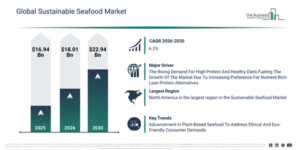
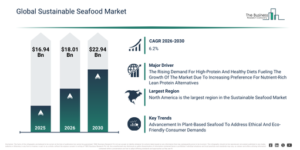
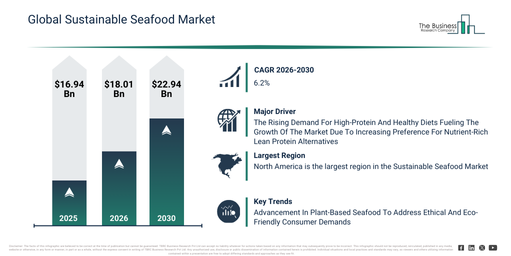
The sustainable seafood market has experienced robust expansion in recent years. This market is projected to expand from $16.94 billion in 2025 to $18.01 billion in 2026, demonstrating a compound annual growth rate (CAGR) of 6.3%. Historically, this growth has been driven by factors such as greater consumer understanding of overfishing issues, the proliferation of certification initiatives, the increase in international seafood commerce, enhanced regulatory supervision of fishing activities, and advancements in aquaculture technologies.
The sustainable seafood market is projected to experience substantial growth in the upcoming years. It is anticipated to expand to $22.94 billion by 2030, achieving a compound annual growth rate (CAGR) of 6.2%. This growth over the forecast period can be attributed to factors such as an increasing demand for ethically sourced protein, the rising adoption of digital traceability platforms, the expansion of sustainable aquaculture investments, a growing preference for certified seafood products, and increasing retailer sustainability commitments. Major trends identified for the forecast period include the wider acceptance of certified sustainable seafood, a heightened demand for traceable fish products, the growing use of eco-labeling and transparency tools, the expansion of responsible aquaculture practices, and an enhanced focus on supply chain accountability.
Free Sustainable Seafood Market Report Sample Available For Download:
Why Is Demand In The Sustainable Seafood Market Expected To Keep Rising?
The increasing consumer preference for high-protein and nutritious eating plans is anticipated to fuel the expansion of the sustainable seafood market in the future. These dietary approaches emphasize foods abundant in protein and essential nutrients, which contribute to improved muscle mass, consistent energy levels, and general well-being. Their popularity is growing because of their efficacy in aiding weight control by fostering satiety and maintaining muscle tissue. Sustainable seafood offers a valuable contribution to such diets, serving as a lean, nutrient-dense protein option that is low in saturated fats and high in beneficial omega-3 fatty acids, presenting an alternative to red meat. For example, data from Jun 2024, released by the International Food Information Council (IFIC), a US‑based non‑profit organization, indicates that 54% of Americans continued to adhere to a particular diet or eating regimen over the preceding year. A significant majority of people intend to boost their protein consumption, with this interest climbing from 59% in 2022 to 67% in 2023, and further to 71% in 2024. Furthermore, approximately half of consumers are looking to incorporate more fresh foods into their diets, given their recognition as the healthiest choices available. Consequently, the expanding demand for high-protein and healthy diets is stimulating the expansion of the sustainable seafood market.
How Is The Sustainable Seafood Market Divided Across Segments And Subsegments?
The sustainable seafood market covered in this report is segmented –
1) By Product Type: Bivalves And Other Molluscs And Aquatic Invertebrates, Cephalopods, Crustaceans, Flatfish, Freshwater Fish, Groundfish, Salmonids, Small Pelagics, Tuna And Tuna-Like Species, Other Product Types
2) By Form: Chilled, Frozen, Canned, Other Forms
3) By Certification Standards: Marine Stewardship Council (MSC), Aquaculture Stewardship Council (Asc), Globalgap, Other Certification Standards
4) By Distribution Channel: Hypermarkets, Supermarkets, Convenience Stores, Specialty Stores, Online, Other Distribution Channels
Subsegments:
1) By Bivalves And Other Molluscs And Aquatic Invertebrates: Mussels, Oysters, Clams, Scallops, Sea Cucumbers, Sea Urchins
2) By Cephalopods: Squid, Cuttlefish, Octopus
3) By Crustaceans: Shrimp, Prawns, Lobster, Crab
4) By Flatfish: Halibut, Flounder, Sole
5) By Freshwater Fish: Tilapia, Carp, Catfish, Trout
6) By Groundfish: Cod, Whiting, Pollock, Haddock
7) By Salmonids: Atlantic Salmon, Trout, Pacific Salmon
8) By Small Pelagics: Sardines, Mackerel, Herring, Anchovies
9) By Tuna And Tuna-Like Species: Bluefin Tuna, Skipjack Tuna, Yellowfin Tuna, Albacore Tuna
10) By Other Product Types: Eels, Jellyfish, Seaweed (For Integrated Aquaculture), Mixed Species Packs
Sustainable Seafood Market Trends Reshaping Customer Demand And Business Strategies
Major companies operating within the sustainable seafood market are concentrating on developing advanced products, such as plant-based seafood, to cater to increasing consumer demand for ethical and eco-conscious alternatives. Plant-based seafood refers to substitute options crafted from plant-based ingredients, designed to replicate the taste, texture, and nutritional value of traditional seafood while also promoting environmental sustainability. As an illustration, in November 2023, Ordinary Seafood, a Germany-based provider of next-generation seafood, launched Ordinary Tuna and Ordinary Smoky Salmon, which are new plant-based salmon and tuna products. These items were initially made available in METRO stores throughout Germany, marking a significant milestone for the company. Ordinary Seafood aims to offer sustainable seafood alternatives that are scientifically grounded, environmentally responsible, and deliver quality taste and texture, thereby reshaping public perception of seafood.
Sustainable Seafood Market Major Players: Companies At The Forefront Of The Industry
Major companies operating in the sustainable seafood market are Maruha Nichiro Corporation, Mowi, Thai Union Group Public Company Limited, Trident Seafoods Corporation, High Liner Foods Incorporated, Pacific Seafood Group, Ocean Beauty Seafoods LLC, Silver Bay Seafoods LLC, Espersen A/S, Blue Circle Foods, Acme Smoked Fish Corporation, Clear Springs Foods Inc., Joseph Robertson (Aberdeen) Limited, Vital Choice Wild Seafood & Organics, American Tuna Inc, Peter Pan Seafood Company LLC, Wild Planet Foods Inc., Regal Springs AG, Sea to Table LLC, Tri Marine Group Inc., Fishpeople Seafood Inc.
Read More About The Sustainable Seafood Market In The Full Report:
Sustainable Seafood Market Regional Share Analysis For 2025
North America was the largest region in the sustainable seafood market in 2025. Europe is expected to be the fastest-growing region in the forecast period. The regions covered in the sustainable seafood market report are Asia-Pacific, South East Asia, Western Europe, Eastern Europe, North America, South America, Middle East and Africa.
Reach Out To Our Team:
The Business Research Company: https://www.thebusinessresearchcompany.com/
Americas: +1 310-496-7795
Asia: +44 7882 955267 & +91 8897263534
Europe: +44 7882 955267
Email us at: marketing@tbrc.info
Follow us on:
LinkedIn: https://in.linkedin.com/company/the-business-research-company
YouTube: https://www.youtube.com/channel/UC24_fI0rV8cR5DxlCpgmyFQ
Global Market Model: https://www.thebusinessresearchcompany.com/global-market-model

Wasay has over a decade of experience in market research, data modelling, and analytics, with prior experience at GlobalData and Decision Tree Consulting Services. At The Business Research Company , he leads research operations across syndicated studies, customized consulting engagements, and the Global Market Model platform. His professional experience includes supporting organizations such as Boston Consulting Group, KPMG, and Ernst & Young. Wasay holds a degree in Electronics and Communications Engineering, postgraduate management qualifications from International Management Institute Belgium and Indian School of Business and Entrepreneurship, and completed the Integrated Program in Business Analytics from Indian Institute of Management Indore.