With a focus on actionable insights and strategic value, The Business Research Company’s 2026 market reports include market attractiveness scoring, total addressable market sizing, company benchmarking matrices, interactive Excel dashboards, deeper supply chain intelligence, emerging startup tracking, and granular product-level insights.
How Large Could The Peer-to-Peer (P2P) Lending Market Become By 2030 At A 30.1% CAGR?
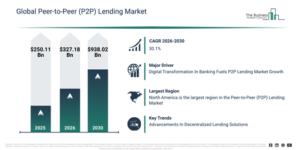
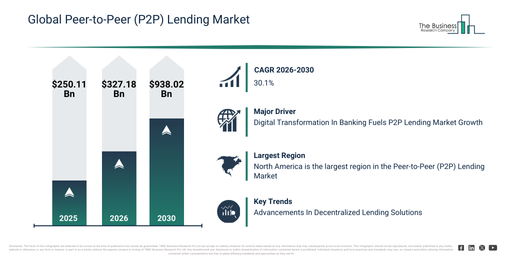
The peer-to-peer (p2p) lending market size has experienced significant expansion in recent years. It is anticipated to grow from $250.11 billion in 2025 to $327.18 billion in 2026, achieving a compound annual growth rate (CAGR) of 30.8%. This historical growth can be attributed to factors such as a heightened demand for unsecured personal loans, limited availability of traditional banking credit, increasing internet penetration, the development of fintech platforms, and greater participation from retail investors.
The peer-to-peer (p2p) lending market is anticipated to see considerable growth in the coming years. It is forecast to expand to $938.02 billion by 2030, achieving a compound annual growth rate (CAGR) of 30.1%. This growth during the projection period can be attributed to several factors, including increasing regulatory oversight for p2p platforms, greater adoption of blockchain for loan transparency, an expanding need for small business financing, an elevated focus on platform risk management, and rising cross-border p2p lending activities. Key trends expected over the forecast period encompass the increasing use of AI-based credit assessment models, a rise in the adoption of alternative lending platforms, a growing emphasis on risk-based pricing mechanisms, the expansion of digital investor-borrower marketplaces, and a strengthened focus on platform transparency.
Get A Free Peer-to-Peer (P2P) Lending Market Sample With 2030 Forecast Insights:
Peer-to-Peer (P2P) Lending Market Outlook: Key Driver Supporting Long-Term Growth
The peer to peer (P2P) lending market is projected to expand due to the escalating digitization within the banking sector. Digital advancements in the banking industry are reshaping financial offerings such as mobile money, along with peer-to-peer (P2P) or marketplace lending. For example, the Bangko Sentral ng Pilipinas, a Philippines-based central banking authority, stated in July 2025 that digital retail payments made up 57.4% of the overall transaction volume in 2024, indicating a year-on-year rise of 4.6 percentage points from 2023. Thus, the increasing digitization within the banking industry is a key driver for the growth of the peer to peer (P2P) lending market.
Segmentation Of The Peer-to-Peer (P2P) Lending Market: Key Categories Explained
The peer-to-peer (p2p) lending market covered in this report is segmented –
1) By Loan Type: Consumer Credit Loans, Small Business Loans
2) By Business Model: Marketplace Lending, Alternative Marketplace Lending
3) By End User: Business, Personal
Subsegments:
1) By Consumer Credit Loans: Personal Loans, Debt Consolidation Loans, Home Improvement Loans, Medical Expense Loans
2) By Small Business Loans: Start-Up Loans, Working Capital Loans, Equipment Financing, Franchise Financing
Peer-to-Peer (P2P) Lending Market Evolving Trends: What Businesses Should Know
Major companies in the peer-to-peer (P2P) lending market are prioritizing the development of innovative platform solutions, such as decentralized finance (DeFi)-based lending platforms, to improve transparency, automation, and cost efficiency in lending processes. Decentralized finance-based lending platforms are digital systems that leverage blockchain technology and smart contracts to directly connect borrowers and investors, thereby eliminating traditional intermediaries and enabling secure, transparent, and automated transactions. For instance, in December 2024, Definder Global, a UK-based blockchain-focused technology company, launched its peer-to-peer lending platform. This DeFi-based solution is designed to facilitate funding for real-world asset projects by linking investors with businesses via blockchain-enabled smart contracts. The platform offers features like automated loan execution, transparent transaction tracking, and reduced intermediary costs. Definder’s peer-to-peer lending platform aims to enhance funding accessibility, boost operational efficiency, and support faster, more transparent lending outcomes.
Who Competes In The Peer-to-Peer (P2P) Lending Market? Major Companies Listed
Major companies operating in the peer-to-peer (p2p) lending market are Upstart, Funding Circle, Peerform, Kiva, Mintos, RateSetter, Zopa, Bondora, Auxmoney, Funding Societies, StreetShares, Crowdstacker, JustUs, MyConstant, Lendable, FairFinance, Patch of Land, LendInvest, LoanNow, SoFi
Read The Complete Peer-to-Peer (P2P) Lending Market Forecast Report Through 2030:
Peer-to-Peer (P2P) Lending Market Regional Ranking: Which Geography Comes First?
North America was the largest region in the peer to peer (P2P) lending market in 2025.Aisa-Pacific is expected to be the fastest-growing region in the forecast period. The regions covered in the peer-to-peer (p2p) lending market report are Asia-Pacific, South East Asia, Western Europe, Eastern Europe, North America, South America, Middle East, Africa.
Reach Out To Our Team:
The Business Research Company: https://www.thebusinessresearchcompany.com/
Americas: +1 310-496-7795
Asia: +44 7882 955267 & +91 8897263534
Europe: +44 7882 955267
Email us at: marketing@tbrc.info
Follow us on:
LinkedIn: https://in.linkedin.com/company/the-business-research-company
YouTube: https://www.youtube.com/channel/UC24_fI0rV8cR5DxlCpgmyFQ
Global Market Model: https://www.thebusinessresearchcompany.com/global-market-model

Wasay has over a decade of experience in market research, data modelling, and analytics, with prior experience at GlobalData and Decision Tree Consulting Services. At The Business Research Company , he leads research operations across syndicated studies, customized consulting engagements, and the Global Market Model platform. His professional experience includes supporting organizations such as Boston Consulting Group, KPMG, and Ernst & Young. Wasay holds a degree in Electronics and Communications Engineering, postgraduate management qualifications from International Management Institute Belgium and Indian School of Business and Entrepreneurship, and completed the Integrated Program in Business Analytics from Indian Institute of Management Indore.