The Business Research Company’s 2026 market reports combine market attractiveness scoring, total addressable market sizing, company benchmarking matrices, interactive Excel dashboards, deeper supply chain intelligence, emerging startup tracking, and granular product-level insights to deliver research that is more actionable and strategically valuable.
Bio Plasticizers Market Size Trajectory: Key Numbers Every Industry Stakeholder Should Know
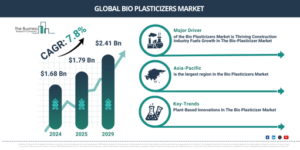
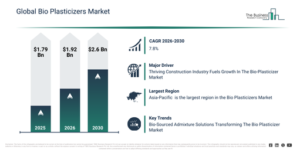
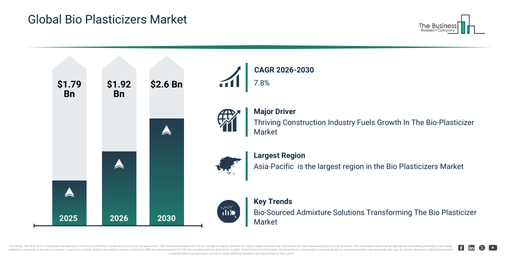
The bio plasticizers market has seen substantial growth in recent years. The market is forecast to increase from $1.79 billion in 2025 to $1.92 billion in 2026, achieving a compound annual growth rate (CAGR) of 7.7%. This past growth is largely due to factors such as regulatory limitations on conventional plasticizers, heightened environmental awareness, the expansion of the packaging and consumer goods industries, the increasing availability of bio-based feedstocks, and a rise in polymer processing activities.
The bio plasticizers market is anticipated to exhibit robust growth in the coming years. Its size is projected to expand to $2.6 billion by 2030, achieving a compound annual growth rate (CAGR) of 7.8%. This expansion over the forecast period is primarily driven by the increasing integration of sustainable polymers, a rising need from medical and healthcare sectors, the proliferation of green building materials, growing investments in bio-refinery technologies, and an enhanced emphasis on circular economy materials. Significant trends during this period encompass the increasing adoption of bio-based plastic additives, a surging demand for non-toxic and phthalate-free plasticizers, the extended use of renewable feedstock, greater application in flexible packaging, and continuous innovation in high-performance bio plasticizers.
Looking For Reliable Bio Plasticizers Market Data? Request A Free Sample:
What Is Behind The Rising Demand In The Bio Plasticizers Market?
The expanding construction sector is anticipated to propel the bioplasticizer market’s expansion in the future. This industry encompasses the commercial production and trade segment responsible for building, maintaining, and renovating infrastructure. Within this sector, bioplasticizers find application in wire insulation and jacketing, contributing to lower water usage and enhancing concrete’s strength and workability. As an example, in July 2024, data from the Committee on Statistics of the Ministry of National Economy of the Republic of Kazakhstan indicated that the value of construction work (services) reached 7,612.8 billion tenge in 2023, marking a 15.1% rise from 2022. Consequently, the thriving construction sector is fueling the bioplasticizer market’s advancement.
Bio Plasticizers Market Segment Coverage And Subsegment Analysis
The bio plasticizers market covered in this report is segmented –
1) By Type: Sebacates, Citrates, Glycerol Esters, Epoxides, Other Types
2) By Application: Flooring And Walls, Film And Sheet Coverings, Coated Fabrics, Consumer Goods, Other Applications
3) By End-Use: Packaging, Textiles, Building And Construction, Medical And Healthcare, Other End Uses
Subsegments:
1) By Sebacates: Di-2-ethylhexyl Sebacate (DEHS), Other Sebacate Variants
2) By Citrates: Triethyl Citrate (TEC), Tributyl Citrate (TBC), Other Citrate Variants
3) By Glycerol Esters: Glycerol Monoesters, Glycerol Diesters
4) By Epoxides: Epoxidized Soybean Oil (ESBO), Other Epoxidized Oils
5) By Other Types: Starch-based Plasticizers, Lactic Acid-based Plasticizers, Other Novel Bio Plasticizers
Bio Plasticizers Market Future Trends: Where Is The Industry Heading?
Key players in the bioplasticizer market are prioritizing the development of new offerings, such as bio-sourced admixture solutions, to sustain their market presence. Bio-sourced admixtures represent a significant and promising innovation within the construction sector, providing a more environmentally friendly alternative to traditional, oil-based admixtures. For instance, in January 2023, CEMEX, a US-based building materials company, launched ISOFLOW BIO. This is an advanced superplasticizer technology crafted from bio-based raw materials, designed to considerably reduce the carbon footprint of concrete production compared to conventional admixtures. ISOFLOW BIO enhances concrete’s workability, simplifying its mixing, pumping, and placement. This leads to faster construction timelines and reduced labor expenditures.
Bio Plasticizers Market Top Players List For 2026
Major companies operating in the bio plasticizers market are Arkema, BASF, Evonik Industries, Emery Oleochemicals, Cargill, Croda International, Jungbunzlauer, Corbion, Polynt, Vertellus, Matrica, Valtris Specialty Chemicals, KLJ Group, Payal Polyplast, BioAmber, Oan Industries, ADEKA Corporation, LANXESS, Mitsubishi Chemical Group, Kao Corporation, Stepan Company
Order Your Copy Of The Bio Plasticizers Market Report 2026:
How Does The Bio Plasticizers Market Vary By Region?
Asia-Pacific was the largest region in the bio plasticizers market in 2025. Europe is expected to be the fastest-growing region in the forecast period. The regions covered in the bio plasticizers market report are Asia-Pacific, South East Asia, Western Europe, Eastern Europe, North America, South America, Middle East, Africa
Reach Out To Our Team:
The Business Research Company: https://www.thebusinessresearchcompany.com/
Americas: +1 310-496-7795
Asia: +44 7882 955267 & +91 8897263534
Europe: +44 7882 955267
Email us at: marketing@tbrc.info
Follow us on:
LinkedIn: https://in.linkedin.com/company/the-business-research-company
YouTube: https://www.youtube.com/channel/UC24_fI0rV8cR5DxlCpgmyFQ
Global Market Model: https://www.thebusinessresearchcompany.com/global-market-model

Wasay has over a decade of experience in market research, data modelling, and analytics, with prior experience at GlobalData and Decision Tree Consulting Services. At The Business Research Company , he leads research operations across syndicated studies, customized consulting engagements, and the Global Market Model platform. His professional experience includes supporting organizations such as Boston Consulting Group, KPMG, and Ernst & Young. Wasay holds a degree in Electronics and Communications Engineering, postgraduate management qualifications from International Management Institute Belgium and Indian School of Business and Entrepreneurship, and completed the Integrated Program in Business Analytics from Indian Institute of Management Indore.