Delivering more actionable and strategically valuable research, The Business Research Company’s 2026 market reports feature market attractiveness analysis, total addressable market evaluation, company benchmarking matrices, interactive Excel dashboards, expanded supply chain intelligence, emerging startup coverage, and detailed product insights.
Bio Plasticizers Market Forecast: What Market Value Is Expected By 2030?
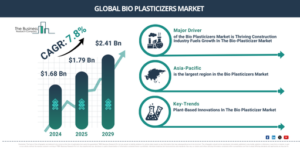
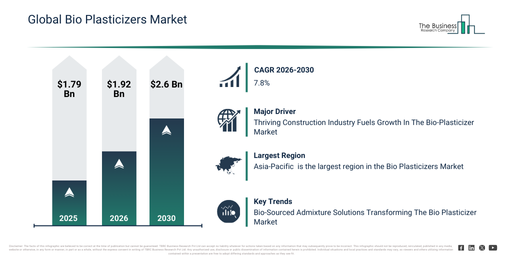
The bio plasticizers market has experienced significant growth in recent times. Projections indicate a rise from $1.79 billion in 2025 to $1.92 billion in 2026, reflecting a compound annual growth rate (CAGR) of 7.7%. This notable expansion stems from factors such as stricter regulations on traditional plasticizers, increasing environmental awareness, the growth of the packaging and consumer goods sectors, a greater availability of bio-based feedstocks, and heightened polymer processing operations.
The bio plasticizers market is anticipated to show considerable expansion in the upcoming years, projected to achieve a value of $2.6 billion by 2030, propelled by a compound annual growth rate (CAGR) of 7.8%. This expected surge over the forecast duration is connected to elements such as the increased acceptance of sustainable polymers, escalating needs from medical and healthcare sectors, the growth of green building solutions, augmented capital investment for bio-refinery enhancements, and a stronger emphasis on materials for a circular economy. Noteworthy developments projected within this period include the expanding integration of bio-based plastic additives, a significant preference for non-toxic and phthalate-free plasticizers, wider adoption of renewable feedstocks, increased utilization in flexible packaging, and advancements in sophisticated bio plasticizers.
Download A Free Sample Report For Comprehensive Market Insights:
Bio Plasticizers Market Opportunity Drivers: What Is Creating New Revenue Potential?
A growing construction sector is anticipated to propel the expansion of the bioplasticizer market in the future. This industry encompasses the commercial production and trade activities focused on creating, maintaining, and restoring infrastructure. Within construction, bioplasticizers find application in wire insulation and jacketing, contributing to reduced water needs and enhanced strength and workability of concrete. An example illustrating this is the data from July 2024, where reports from the Committee on Statistics of the Ministry of National Economy of the Republic of Kazakhstan revealed that in 2023, the total value of construction work (services) reached 7,612.8 billion tenge, marking a 15.1% rise from 2022. Consequently, the thriving construction industry is a key factor in the increasing demand for bioplasticizers.
Bio Plasticizers Market Segmentation Trends And Revenue Drivers
The bio plasticizers market covered in this report is segmented –
1) By Type: Sebacates, Citrates, Glycerol Esters, Epoxides, Other Types
2) By Application: Flooring And Walls, Film And Sheet Coverings, Coated Fabrics, Consumer Goods, Other Applications
3) By End-Use: Packaging, Textiles, Building And Construction, Medical And Healthcare, Other End Uses
Subsegments:
1) By Sebacates: Di-2-ethylhexyl Sebacate (DEHS), Other Sebacate Variants
2) By Citrates: Triethyl Citrate (TEC), Tributyl Citrate (TBC), Other Citrate Variants
3) By Glycerol Esters: Glycerol Monoesters, Glycerol Diesters
4) By Epoxides: Epoxidized Soybean Oil (ESBO), Other Epoxidized Oils
5) By Other Types: Starch-based Plasticizers, Lactic Acid-based Plasticizers, Other Novel Bio Plasticizers
Bio Plasticizers Market Innovation Trends Driving Future Development
Key players in the bioplasticizer market are focusing on developing new products, such as bio-sourced admixture solutions, to sustain their competitive position. These bio-based admixtures present an innovative and promising development for the construction industry, offering a more environmentally sound alternative to traditional, petroleum-derived admixtures. For instance, in January 2023, CEMEX, a US-based building materials firm, launched ISOFLOW BIO. This product is a high-performance superplasticizer technology derived from bio-based raw materials, which significantly reduces the carbon footprint of concrete production when compared to conventional admixtures. ISOFLOW BIO improves concrete’s workability, simplifying its mixing, pumping, and application processes. This enhancement can lead to faster construction timelines and reduced labor costs.
#Bio Plasticizers Market Industry Leaders: Which Organizations Are Driving Competition?
Major companies operating in the bio plasticizers market are Arkema, BASF, Evonik Industries, Emery Oleochemicals, Cargill, Croda International, Jungbunzlauer, Corbion, Polynt, Vertellus, Matrica, Valtris Specialty Chemicals, KLJ Group, Payal Polyplast, BioAmber, Oan Industries, ADEKA Corporation, LANXESS, Mitsubishi Chemical Group, Kao Corporation, Stepan Company
Access The Complete Bio Plasticizers Market Report:
Bio Plasticizers Market Leading Geography: Which Region Generates The Most Revenue?
Asia-Pacific was the largest region in the bio plasticizers market in 2025. Europe is expected to be the fastest-growing region in the forecast period. The regions covered in the bio plasticizers market report are Asia-Pacific, South East Asia, Western Europe, Eastern Europe, North America, South America, Middle East, Africa
Get in touch with us:
The Business Research Company: https://www.thebusinessresearchcompany.com/
Americas: +1 310-496-7795
Asia: +44 7882 955267 & +91 8897263534
Europe: +44 7882 955267
Email us at: marketing@tbrc.info
Follow us on:
LinkedIn: https://in.linkedin.com/company/the-business-research-company
YouTube: https://www.youtube.com/channel/UC24_fI0rV8cR5DxlCpgmyFQ
Global Market Model: https://www.thebusinessresearchcompany.com/global-market-model

Wasay has over a decade of experience in market research, data modelling, and analytics, with prior experience at GlobalData and Decision Tree Consulting Services. At The Business Research Company , he leads research operations across syndicated studies, customized consulting engagements, and the Global Market Model platform. His professional experience includes supporting organizations such as Boston Consulting Group, KPMG, and Ernst & Young. Wasay holds a degree in Electronics and Communications Engineering, postgraduate management qualifications from International Management Institute Belgium and Indian School of Business and Entrepreneurship, and completed the Integrated Program in Business Analytics from Indian Institute of Management Indore.