Designed to make market research more actionable and strategically valuable, The Business Research Company’s 2026 market reports feature market attractiveness scoring, total addressable market sizing, company benchmarking matrices, interactive Excel dashboards, deeper supply chain intelligence, emerging startup tracking, and granular product-level insights.
How Fast Is The All-Flash Array Market Growing? Market Size, CAGR And Forecast Insights
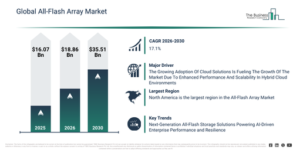
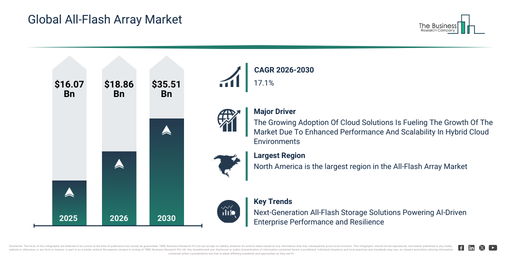
The size of the all-flash array market has experienced significant growth in recent years. It is projected to expand from $16.07 billion in 2025 to $18.86 billion in 2026, demonstrating a compound annual growth rate (CAGR) of 17.4%. Historically, this market’s expansion can be attributed to several factors such as the rise in enterprise data volumes, the increased adoption of virtualization platforms, the growth of cloud computing services, a growing need for low-latency storage, and the decreasing costs of flash memory.
The all-flash array market is projected for substantial expansion in the coming years. This market is anticipated to reach a valuation of $35.51 billion by 2030, exhibiting a compound annual growth rate (CAGR) of 17.1%. This projected growth is driven by factors such as the increasing deployment of AI workloads, the expanding infrastructure of edge computing, the widespread adoption of hybrid cloud storage models, a growing need for real-time analytics storage, and the development of software-defined storage platforms. Key trends anticipated during this period encompass high-performance data storage solutions, NVMe-based flash architectures, the emergence of energy-efficient storage systems, integrated cloud flash solutions, and storage workloads optimized for AI.
Unlock All-Flash Array Market Insights With A Free Sample Report:
All-Flash Array Market Momentum: Key Driver Expected To Boost Growth Through 2030
The increasing embrace of cloud solutions is anticipated to boost the expansion of the all-flash array market. Cloud solutions are adaptable, internet-delivered services that offer remote capabilities for data and application storage, processing, and management as required. Their rising appeal stems from their ability to allow businesses to manage sensitive information securely on private clouds while leveraging the scalable capabilities of public clouds, thus striking a balance between cost-efficiency and security. All-flash arrays enhance cloud solutions by delivering high-speed, low-latency storage, which ensures rapid data access and improved operational efficiency across both private and public cloud infrastructures. They further boost application performance and streamline data management within hybrid settings. For example, in January 2023, Google Cloud, a US-based cloud computing services provider under Google LLC (Alphabet Inc.), reported that hybrid cloud utilization increased in 2022 from 25% to 42.5%. With ongoing rapid innovation and the introduction of new tools and services in the cloud sector, Gartner® projects that worldwide public cloud end-user spending will approach $600 billion in 2023. Consequently, the escalating adoption of cloud solutions is propelling the growth of the all-flash array market.
All-Flash Array Market Segments: A Category-By-Category Overview
The all-flash array market covered in this report is segmented –
1) By Type: Traditional All-Flash Arrays, Hybrid All-Flash Arrays, All-Flash Hyperconverged Infrastructure (HCI), Other Types
2) By Technology: Non-Volatile Memory Express (NVMe), Statistical Analysis System (SAS), Serial Advanced Technology Attachment (SATA)
3) By Flash Media: Custom Flash Modules (CFM), Solid-State Drives (SSD)
4) By End-User: Banking, Financial Services, and Insurance (BFSI), Healthcare, Information Technology And Telecommunications, Government, Media And Entertainment, Retail, Other End-Users
Subsegments:
1) By Traditional All-Flash Arrays: Enterprise-Class All-Flash Arrays, Mid-Range All-Flash Arrays, Entry-Level All-Flash Arrays, Scale-Out All-Flash Arrays
2) By Hybrid All-Flash Arrays: Flash-Optimized Hybrid Arrays, Cache-Accelerated Hybrid Arrays, Tiered Storage Hybrid Arrays
3) By All-Flash Hyperconverged Infrastructure (HCI): Software-Defined Hyperconverged Infrastructure (HCI) With All-Flash Storage, Appliance-Based All-Flash Hyperconverged Infrastructure (HCI), Cloud-Integrated All-Flash Hyperconverged Infrastructure (HCI)
4) By Other Types: Non-Volatile Memory Express (NVMe)-Based All-Flash Arrays, All-Flash Storage For Artificial Intelligence (AI) Or Machine Learning (ML) Workloads, All-Flash Arrays For Edge Computing, All-Flash Arrays With Data Deduplication & Compression Features
Which Emerging Trends Are Gaining Traction In The All-Flash Array Market?
Leading companies operating within the all-flash array market are concentrating on creating advanced solutions, such as traditional all-flash arrays, to boost data storage performance and meet the expanding requirements of enterprise applications. Traditional all-flash arrays represent storage systems exclusively composed of flash memory drives, which provide rapid data access, extremely low latency, and superior reliability compared to conventional disk-based storage solutions. For instance, in September 2024, Huawei Technologies Co., Ltd., a telecommunications equipment firm from China, launched its New-Gen OceanStor Dorado All-Flash Storage with the goal of bringing mission-critical enterprise applications into the AI era by delivering outstanding performance, resilience, and AI-ready capabilities. This new storage solution incorporates a DPU-based SmartNIC, upgraded FLASHLINK algorithms, and a native unified storage architecture, allowing for over 100 million IOPS, ultra-low latency, and robust ransomware protection, alongside support for databases, files, and containers for diverse AI workloads. The primary aim of this launch is to equip enterprises with an efficient, reliable, and intelligent data infrastructure capable of addressing the increasing demands of AI-driven digital transformation and ensuring business continuity for critical applications.
All-Flash Array Market Key Participants: Prominent Companies At A Glance
Major companies operating in the all-flash array market are Dell Technologies, Huawei Technologies Co. Ltd., International Business Machines Corporation, Oracle Corporation, Hewlett Packard Enterprise (HPE), Fujitsu Limited, Western Digital Corporation, Seagate Technology LLC, Hitachi Vantara LLC, NetApp Inc., Super Micro Computer Inc., Pure Storage Inc., Solidigm, Quantum Corporation, DataDirect Networks (DDN), MSys Technologies, VAST Data, Zadara Inc., QSAN Technology Inc., Nimbus Data
Get Detailed All-Flash Array Market Forecasts In The Complete Report:
Top Region In The All-Flash Array Market: A Global Perspective
North America was the largest region in the all-flash array market in 2025. Asia-Pacific is expected to be the fastest-growing region in the forecast period. The regions covered in the all-flash array market report are Asia-Pacific, South East Asia, Western Europe, Eastern Europe, North America, South America, Middle East, Africa.
Reach Out To Our Team:
The Business Research Company: https://www.thebusinessresearchcompany.com/
Americas: +1 310-496-7795
Asia: +44 7882 955267 & +91 8897263534
Europe: +44 7882 955267
Email us at: marketing@tbrc.info
Follow us on:
LinkedIn: https://in.linkedin.com/company/the-business-research-company
YouTube: https://www.youtube.com/channel/UC24_fI0rV8cR5DxlCpgmyFQ
Global Market Model: https://www.thebusinessresearchcompany.com/global-market-model

Wasay has over a decade of experience in market research, data modelling, and analytics, with prior experience at GlobalData and Decision Tree Consulting Services. At The Business Research Company , he leads research operations across syndicated studies, customized consulting engagements, and the Global Market Model platform. His professional experience includes supporting organizations such as Boston Consulting Group, KPMG, and Ernst & Young. Wasay holds a degree in Electronics and Communications Engineering, postgraduate management qualifications from International Management Institute Belgium and Indian School of Business and Entrepreneurship, and completed the Integrated Program in Business Analytics from Indian Institute of Management Indore.