With a focus on actionable insights and strategic value, The Business Research Company’s 2026 market reports include market attractiveness scoring, total addressable market sizing, company benchmarking matrices, interactive Excel dashboards, deeper supply chain intelligence, emerging startup tracking, and granular product-level insights.
Remote Sensing Technology Market Size Snapshot: 2026 Valuation, 2030 Projection And Key Growth Factors
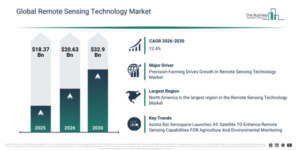
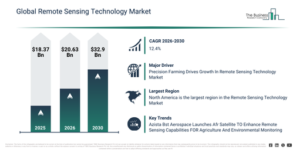
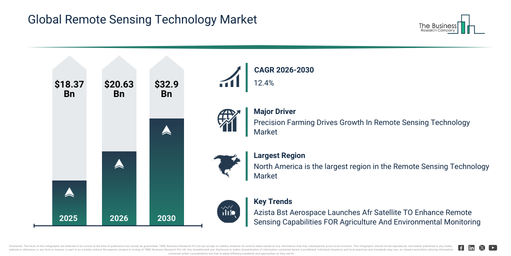
The remote sensing technology market has observed rapid expansion in recent years. This market is expected to increase from $18.37 billion in 2025 to $20.63 billion in 2026, exhibiting a compound annual growth rate (CAGR) of 12.3%. The historical growth of this market can be attributed to advancements in satellite imaging programs, the growing application of aerial survey systems, the integration of remote sensing in defense uses, the enlargement of weather monitoring networks, and the increased usage of geospatial data.
The remote sensing technology market is anticipated to experience substantial expansion over the coming years. It will grow to $32.9 billion in 2030 at a compound annual growth rate (CAGR) of 12.4%. This projected growth is driven by factors such as the increasing need for climate monitoring solutions, wider implementation in smart agriculture, the broadening of disaster management applications, its integration with AI-driven analytics, and the proliferation of commercial satellite constellations. Key developments expected during this forecast period involve the expanding utilization of satellite-based earth observation systems, the growing deployment of lidar and radar technologies, greater incorporation of remote sensing with GIS platforms, the enlargement of environmental monitoring uses, and a heightened emphasis on high-resolution data analytics.
Get A No-Cost Sample Of The Remote Sensing Technology Market Study:
Major Factor Fueling The Remote Sensing Technology Market Through 2030
The expanding implementation of precision farming technology is propelling the growth of the remote sensing technology market. The agricultural sector is experiencing significant changes, putting increased pressure on the food supply chain, primarily due to swift global population expansion and shifting climate patterns. Precision farming involves planning food production using technologies that offer economic advantages like reduced farming costs and higher output, alongside environmental benefits. For instance, in January 2024, according to the United States Government Accountability Office, a US-based government agency reported that, in 2023, 27% of U.S. farms and ranches utilized precision agriculture techniques for managing crops or livestock. Consequently, the increasing adoption of precision farming technology is fostering the expansion of the remote sensing technology market.
Remote Sensing Technology Market Segment Landscape: Main Categories And Subcategories Covered
The remote sensing technology market covered in this report is segmented –
1) By Technology: Active Remote Sensing, Passive Remote Sensing
2) By Platform: Satellite, Aerial Systems
3) By Application: Landscape Assessment, Security, Air Quality, Hydrology, Forestry, Floodplain Mapping And Emergency Management
4) By End User: Military And Intelligence, Weather, Disaster Management, Agriculture And Living Resources, Infrastructure
Subsegments:
1) By Active Remote Sensing: Radar Systems, Lidar
2) By Passive Remote Sensing: Optical Sensors, Infrared Sensors, Multispectral And Hyperspectral Sensors
How Are Emerging Trends Influencing The Remote Sensing Technology Market’s Growth Path?
Major companies operating in the remote sensing technology market are incorporating new technological products, such as Azista BST Aerospace First Runner (AFR), to maintain their market position. The Azista BST Aerospace First Runner (AFR) is a remote sensing satellite launched by the company, constructed on a modular bus platform, and equipped with a wide-swath optical remote sensing payload offering both panchromatic and multispectral imaging capabilities. As an example, in June 2023, Azista BST Aerospace, an Indian-based developer of satellite components and subsystems, introduced Azista BST Aerospace First Runner (AFR). This satellite is engineered to provide round-the-clock remote sensing services for agriculture mapping, disaster monitoring, and environmental observations, performing reliably despite changes in lighting or the presence of clouds that would hinder visible light cameras. Additionally, it can resolve surface features smaller than a yard across when zoomed in on a specific target.
Remote Sensing Technology Market Leading Players And Key Industry Participants In 2026
Major companies operating in the remote sensing technology market are Thales Group; Hexagon AB; Maxar Technologies; Planet Labs PBC; Airbus SE; L3Harris Technologies Inc.; Trimble Inc.; Lockheed Martin Corporation; Raytheon Technologies Corporation; Teledyne Technologies Incorporated; Leidos Inc.; General Dynamics Mission Systems Inc.; Environmental Systems Research Institute Inc.; Orbital Insight Inc.; Cognitive Space Inc.; Sensera Systems Inc.; Resonon Inc.; Muon Space Inc.; Array Labs Inc.; Satyukt Analytics Pvt Ltd.; Chloris Geospatial; LongPath Technologies Inc.
Check Out The Full Remote Sensing Technology Market Report 2026:
Remote Sensing Technology Market By Geography: Revenue Leaders Among Global Regions
North America was the largest region in the remote sensing technology market in 2025. The regions covered in the remote sensing technology market report are Asia-Pacific, South East Asia, Western Europe, Eastern Europe, North America, South America, Middle East, Africa.
Reach Out To Our Team:
The Business Research Company: https://www.thebusinessresearchcompany.com/
Americas: +1 310-496-7795
Asia: +44 7882 955267 & +91 8897263534
Europe: +44 7882 955267
Email us at: marketing@tbrc.info
Follow us on:
LinkedIn: https://in.linkedin.com/company/the-business-research-company
YouTube: https://www.youtube.com/channel/UC24_fI0rV8cR5DxlCpgmyFQ
Global Market Model: https://www.thebusinessresearchcompany.com/global-market-model

Wasay has over a decade of experience in market research, data modelling, and analytics, with prior experience at GlobalData and Decision Tree Consulting Services. At The Business Research Company , he leads research operations across syndicated studies, customized consulting engagements, and the Global Market Model platform. His professional experience includes supporting organizations such as Boston Consulting Group, KPMG, and Ernst & Young. Wasay holds a degree in Electronics and Communications Engineering, postgraduate management qualifications from International Management Institute Belgium and Indian School of Business and Entrepreneurship, and completed the Integrated Program in Business Analytics from Indian Institute of Management Indore.