With a focus on actionable insights and strategic value, The Business Research Company’s 2026 market reports include market attractiveness scoring, total addressable market sizing, company benchmarking matrices, interactive Excel dashboards, deeper supply chain intelligence, emerging startup tracking, and granular product-level insights.
Risk Analytics Market Size Outlook: A $81.53 Billion Market By 2030, Growing At 14.4% Annually
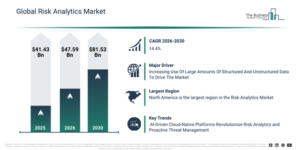
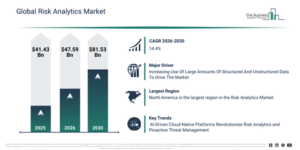
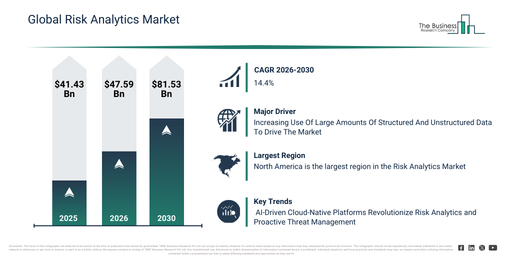
The risk analytics market has seen substantial expansion over recent years. It is anticipated to expand from $41.43 billion in 2025 to $47.59 billion in 2026, achieving a compound annual growth rate (CAGR) of 14.9%. The market’s growth in the past can be linked to factors like increasing financial market volatility, the proliferation of regulatory compliance requirements, the rising complexity of business operations, a surge in operational disruption occurrences, and the wider adoption of data-centric decision-making models.
The risk analytics market is projected for substantial expansion over the upcoming years. Its value is anticipated to reach $81.53 billion by 2030, demonstrating a compound annual growth rate (CAGR) of 14.4%. This growth throughout the forecast timeframe stems from several factors, including the increasing application of AI-powered risk forecasting, a surge in demand for unified risk management platforms, wider adoption of risk analytics by small and medium-sized enterprises (SMEs), an intensified focus on evaluating climate and geopolitical risks, and a greater dependence on cloud-native analytical tools. Key trends expected during this period involve the growing uptake of predictive risk modeling platforms, enhanced integration of enterprise-wide risk dashboards, expanding utilization of scenario-based risk simulation, the broader deployment of cloud-based risk analytics solutions, and an elevated emphasis on achieving real-time risk visibility.
Make Data-Driven Decisions With A Free Risk Analytics Market Sample Report:
Key Demand Driver Expected To Lift Risk Analytics Market Revenue
The risk analytics market is expected to expand due to the growing utilization of significant volumes of both structured and unstructured data. Structured data consists of information typically stored in relational databases, where it can be readily organized into specific fields. Conversely, unstructured data lacks a pre-defined model or schema, making it unsuitable for storage in conventional relational databases. Businesses generate and collect 80 to 90% of their data as unstructured data, and its volume is expanding more rapidly than that of structured data. Companies are increasingly leveraging these vast quantities of structured and unstructured data for various purposes, including predictive analysis, risk analysis, and forecasting. This heightened usage will stimulate demand for risk analytics, as risk analytics tools rely on extensive structured and unstructured data to forecast risks with high precision. For example, a report from the American data storage firm Seagate Technology PLC projects that global data volume will rise by 61%, reaching 175 zettabytes (ZB) by 2025, up from 33 ZB in 2018. By 2025, 90 ZB of data is anticipated to originate from IoT devices. Additionally, nearly 30% of generated data is expected to be consumed in real-time by 2025. This demonstrates the immense amount of data requiring storage, management, and analysis. Consequently, the growing adoption of substantial structured and unstructured data will fuel the expansion of the risk analytics market.
Exploring The Risk Analytics Market Through Its Key Segments
The risk analytics market covered in this report is segmented –
1) By Risk Type Application: Financial Risks, Operational Risks, Compliance Risks, Strategic Risks, Other Risk Type Applications
2) By Component: Solution, Services
3) By Organization Size: Large Enterprises, Small And Medium-Sized Enterprises (SMES)
4) By Deployment Mode: On-Premises, Cloud
5) By Vertical: BFSI, Manufacturing, Transportation, Retail, IT And Telecommunication, Healthcare, Government
Subsegments:
1) By Financial Risks: Credit Risk, Market Risk, Liquidity Risk, Interest Rate Risk
2) By Operational Risks: Process Risks, System Risks, Fraud Risks, External Events
3) By Compliance Risks: Regulatory Risks, Legal Risks, Reporting Risks
4) By Strategic Risks: Competitive Risks, Market Entry Risks, Technology Risks
5) By Other Risk Type Applications: Reputational Risks, Environmental Risks, Geopolitical Risks
New Trends Redefining Competition In The Risk Analytics Market
Leading companies in the risk analytics market are increasingly focusing on utilizing innovative technologies, such as artificial intelligence (AI)-powered safety solutions, to proactively pinpoint and alleviate workplace risks. These AI-powered safety solutions are systems that employ machine learning and data analytics to predict, identify, and manage occupational hazards. They assist organizations by automating hazard detection, evaluating contractor performance, offering real-time risk insights, and enabling forward-thinking safety measures to diminish accidents and compliance issues. For example, in August 2024, Highwire Inc., a US-based technology company, introduced its AI Safety Risk Analytics solution, an innovative service developed to transform contractor risk management. Operating under the Contractor Success brand, this platform integrates advanced artificial intelligence and big-data analytics to provide extensive contextual analysis of safety management systems, categorize safety programs as General, Detailed or Comprehensive, automate document review, and generate proactive risk identification before work commences. Its distinctive features include automated document analysis, which saves hundreds or thousands of hours annually, dynamic contractor profiling using leading safety indicators, and proactive mitigation insights, thereby facilitating its use across construction, energy, and industrial sectors to reduce liability exposure and enhance operational safety.
Risk Analytics Market Competition: Key Players And Industry Participants
Major companies operating in the risk analytics market are International Business Machines Corporation; Oracle Corporation; SAS Institute Inc.; SAP SE; Moody’s Analytics Inc.; Verisk Analytics Inc.; Aon plc; Marsh & McLennan Companies Inc.; Accenture PLC; Capgemini SE; FIS Inc.; Fiserv Inc.; Experian PLC; Deloitte Touche Tohmatsu Limited; Ernst & Young Global Limited; KPMG International Limited; PricewaterhouseCoopers International Limited; MSCI Inc.; S&P Global Inc.; Refinitiv Ltd.; NICE Actimize Ltd.; Riskified Ltd.
Get The Detailed Risk Analytics Market Research Report Here:
Risk Analytics Market Regional Overview: Largest Market And Global Coverage
North America was the largest region in the risk analytics market in 2025.Asia-Pacific is expected to be the fastest-growing region in the forecast period. The regions covered in the risk analytics market report are Asia-Pacific, South East Asia, Western Europe, Eastern Europe, North America, South America, Middle East, Africa.
Reach Out To Our Team:
The Business Research Company: https://www.thebusinessresearchcompany.com/
Americas: +1 310-496-7795
Asia: +44 7882 955267 & +91 8897263534
Europe: +44 7882 955267
Email us at: marketing@tbrc.info
Follow us on:
LinkedIn: https://in.linkedin.com/company/the-business-research-company
YouTube: https://www.youtube.com/channel/UC24_fI0rV8cR5DxlCpgmyFQ
Global Market Model: https://www.thebusinessresearchcompany.com/global-market-model

Wasay has over a decade of experience in market research, data modelling, and analytics, with prior experience at GlobalData and Decision Tree Consulting Services. At The Business Research Company , he leads research operations across syndicated studies, customized consulting engagements, and the Global Market Model platform. His professional experience includes supporting organizations such as Boston Consulting Group, KPMG, and Ernst & Young. Wasay holds a degree in Electronics and Communications Engineering, postgraduate management qualifications from International Management Institute Belgium and Indian School of Business and Entrepreneurship, and completed the Integrated Program in Business Analytics from Indian Institute of Management Indore.