Enhanced with market attractiveness analysis, total addressable market evaluation, company benchmarking matrices, interactive Excel dashboards, expanded supply chain intelligence, emerging startup coverage, and detailed product insights, The Business Research Company’s 2026 market reports deliver more actionable and strategically valuable research.
Risk Analytics Market Value Analysis: What Growth Is Expected Over The Forecast Period?
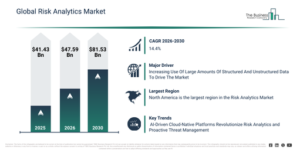
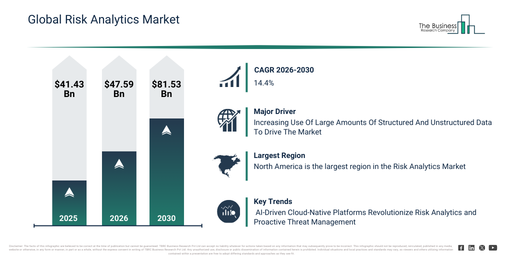
The risk analytics market has experienced significant expansion recently. Projections indicate its expansion from $41.43 billion in 2025 to $47.59 billion by 2026, demonstrating a compound annual growth rate (CAGR) of 14.9%. Historically, this growth stemmed from factors such as heightened financial market volatility, a proliferation of regulatory compliance mandates, the increasing intricate nature of enterprise operations, a rise in operational disruption events, and wider embrace of data-driven decision-making approaches.
The risk analytics market is set for significant expansion in the coming years, with projections indicating it will reach $81.53 billion by 2030, growing at a compound annual growth rate (CAGR) of 14.4%. This anticipated growth is primarily fueled by the increasing application of AI-driven risk forecasting, a rising demand for integrated risk management platforms, broader adoption of risk analytics among SMEs, a heightened focus on assessing climate and geopolitical risks, and an increasing reliance on cloud-native analytics solutions. Noteworthy trends expected during this period include the wider implementation of predictive risk modeling platforms, enhanced integration of enterprise-wide risk dashboards, increased utilization of scenario-based risk simulation, the expansion of cloud-based risk analytics solutions, and an intensified emphasis on real-time risk visibility.
Download A Free Sample Report For Comprehensive Market Insights:
Risk Analytics Market Opportunity Drivers: What Is Creating New Revenue Potential?
The escalating utilization of substantial volumes of structured and unstructured data is set to fuel the expansion of the risk analytics market. Structured data is defined as information typically housed in relational databases, which can be readily organized into specific fields. Conversely, unstructured data comprises information not arranged according to a predefined model or schema, making it unsuitable for standard relational databases. Unstructured data constitutes 80 to 90% of all data produced and collected by businesses, and its volume is growing more rapidly than that of structured databases. Enterprises are progressively leveraging these vast quantities of structured and unstructured data for purposes such as predictive analysis, risk analysis, and forecasting, among others. This growing application generates demand for risk analytics, as risk analytics tools rely on extensive structured and unstructured data to forecast risks with high precision. For instance, Seagate Technology PLC, an American data storage firm, reported that worldwide data is projected to climb by 61% from 33 ZB in 2018 to 175 zettabytes (ZB) by 2025. Furthermore, 90 ZB of data will originate from IoT devices by 2025, with nearly 30% of created data being consumed in real-time by the same year. These figures underscore the massive amount of data requiring storage, management, and analysis. Consequently, the increasing deployment of significant structured and unstructured data volumes will propel the growth of the risk analytics market.
Risk Analytics Market Segment Outlook: Which Categories Are Expanding The Fastest?
The risk analytics market covered in this report is segmented –
1) By Risk Type Application: Financial Risks, Operational Risks, Compliance Risks, Strategic Risks, Other Risk Type Applications
2) By Component: Solution, Services
3) By Organization Size: Large Enterprises, Small And Medium-Sized Enterprises (SMES)
4) By Deployment Mode: On-Premises, Cloud
5) By Vertical: BFSI, Manufacturing, Transportation, Retail, IT And Telecommunication, Healthcare, Government
Subsegments:
1) By Financial Risks: Credit Risk, Market Risk, Liquidity Risk, Interest Rate Risk
2) By Operational Risks: Process Risks, System Risks, Fraud Risks, External Events
3) By Compliance Risks: Regulatory Risks, Legal Risks, Reporting Risks
4) By Strategic Risks: Competitive Risks, Market Entry Risks, Technology Risks
5) By Other Risk Type Applications: Reputational Risks, Environmental Risks, Geopolitical Risks
Risk Analytics Market Industry Trends: What Changes Are Reshaping Demand?
Leading firms within the risk analytics sector are prioritizing the adoption of cutting-edge technologies, particularly artificial intelligence (AI)-powered safety solutions, to preemptively detect and reduce dangers in the workplace. These artificial intelligence (AI)-powered safety solutions function as systems that employ machine learning and data analytics for anticipating, recognizing, and controlling workplace hazards, thereby assisting organizations in automating the identification of dangers, evaluating contractor effectiveness, delivering immediate risk intelligence, and implementing forward-looking safety protocols to decrease mishaps and regulatory problems. As an illustration, in August 2024, Highwire Inc., a technology company situated in the US, introduced its AI Safety Risk Analytics solution, an inventive offering aimed at revolutionizing contractor risk management. Marketed under the Contractor Success brand, this platform combines sophisticated artificial intelligence with big-data analytics to offer in-depth contextual assessments of safety management frameworks, classify safety initiatives into General, Detailed, or Comprehensive categories, streamline document verification, and facilitate the early detection of risks prior to project commencement. Key distinctive functionalities encompass automated document analysis, which yields savings of hundreds or thousands of hours each year, along with dynamic contractor profiling that utilizes prominent safety indicators, and insights for proactive mitigation, thus allowing its use across the construction, energy, and industrial sectors to diminish liability risks and enhance operational safety.
Risk Analytics Market Key Companies And Competitive Benchmarking
Major companies operating in the risk analytics market are International Business Machines Corporation; Oracle Corporation; SAS Institute Inc.; SAP SE; Moody’s Analytics Inc.; Verisk Analytics Inc.; Aon plc; Marsh & McLennan Companies Inc.; Accenture PLC; Capgemini SE; FIS Inc.; Fiserv Inc.; Experian PLC; Deloitte Touche Tohmatsu Limited; Ernst & Young Global Limited; KPMG International Limited; PricewaterhouseCoopers International Limited; MSCI Inc.; S&P Global Inc.; Refinitiv Ltd.; NICE Actimize Ltd.; Riskified Ltd.
Access The Complete Risk Analytics Market Report:
Risk Analytics Market Largest Region By Revenue And Market Share
North America was the largest region in the risk analytics market in 2025.Asia-Pacific is expected to be the fastest-growing region in the forecast period. The regions covered in the risk analytics market report are Asia-Pacific, South East Asia, Western Europe, Eastern Europe, North America, South America, Middle East, Africa.
Get in touch with us:
The Business Research Company: https://www.thebusinessresearchcompany.com/
Americas: +1 310-496-7795
Asia: +44 7882 955267 & +91 8897263534
Europe: +44 7882 955267
Email us at: marketing@tbrc.info
Follow us on:
LinkedIn: https://in.linkedin.com/company/the-business-research-company
YouTube: https://www.youtube.com/channel/UC24_fI0rV8cR5DxlCpgmyFQ
Global Market Model: https://www.thebusinessresearchcompany.com/global-market-model

Wasay has over a decade of experience in market research, data modelling, and analytics, with prior experience at GlobalData and Decision Tree Consulting Services. At The Business Research Company , he leads research operations across syndicated studies, customized consulting engagements, and the Global Market Model platform. His professional experience includes supporting organizations such as Boston Consulting Group, KPMG, and Ernst & Young. Wasay holds a degree in Electronics and Communications Engineering, postgraduate management qualifications from International Management Institute Belgium and Indian School of Business and Entrepreneurship, and completed the Integrated Program in Business Analytics from Indian Institute of Management Indore.