Market attractiveness scoring, total addressable market sizing, company benchmarking matrices, interactive Excel dashboards, deeper supply chain intelligence, emerging startup tracking, and granular product-level insights are among the key offerings featured in The Business Research Company’s 2026 market reports, designed to deliver more actionable and strategically valuable research.
Edge Cloud For Connected Car Market Valued At $3.87 Billion In 2026, Projected To Reach $8.09 Billion By 2030
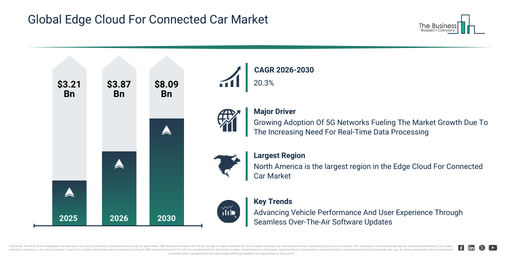
The edge cloud for connected car market size has seen substantial exponential growth over the past few years. This market is projected to expand from $3.21 billion in 2025 to $3.87 billion in 2026, exhibiting a compound annual growth rate (CAGR) of 20.6%. Key drivers for this historical growth include the escalating adoption of connected cars, the development of in-vehicle infotainment systems, the spread of 4G and LTE networks, evolving fleet management demands, and the necessity for current navigation updates.
The edge cloud for connected car market is anticipated to show significant expansion in the coming years, with its size expected to reach $8.09 billion in 2030, exhibiting a compound annual growth rate (CAGR) of 20.3%. This projected growth is largely due to factors such as accelerating 5G network rollout, ongoing autonomous driving development, increasing v2i infrastructure, a heightened demand for edge security, and the wider adoption of software-defined vehicles. Throughout the forecast period, prominent trends are expected to involve the deployment of low-latency vehicle edge computing, the growth of v2x communication infrastructure, the expansion of edge-based ADAS processing, the adoption of real-time telematics analytics, and effective cloud-to-edge workload orchestration.
Request A Complimentary Edge Cloud For Connected Car Market Research Sample:
Key Factor Propelling The Edge Cloud For Connected Car Market Forward
Increased uptake of 5G networks is anticipated to stimulate expansion within the edge cloud for connected car market in the future. These advanced wireless communication systems offer considerably quicker data transmission rates, reduced delay, and improved connection capabilities when compared to earlier network generations. The increasing demand for swift, low-latency connectivity, essential for supporting advanced digital services, connected vehicles, smart city infrastructure, and real-time data processing across numerous sectors, is fueling the rise in 5G adoption. By offering ultra-low latency and high bandwidth, 5G networks facilitate the edge cloud for connected cars, enabling the processing of immense quantities of real-time vehicle data at the network’s periphery. This capability permits immediate communication among vehicles, infrastructure, and cloud services, thereby supporting crucial safety systems, autonomous driving functionalities, and improved in-vehicle experiences that depend on instantaneous choices. As an illustration, in July 2024, 5G Americas, a US-based telecommunication company, reported that global 5G connections neared 2 billion in the first quarter of 2024, with an addition of 185 million new subscriptions, and are forecasted to attain approximately 7.7 billion by 2028. Consequently, the increasing embrace of 5G networks is propelling the expansion of the edge cloud for connected car market.
Edge Cloud For Connected Car Market Segments And Subsegments Explained
The edge cloud for connected car market covered in this report is segmented –
1) By Component: Hardware, Software, Services
2) By Deployment Mode: Public Cloud, Private Cloud, Hybrid Cloud
3) By Connectivity: Fifth Generation (5G), Fourth Generation (4G) Or Long Term Evolution (LTE), Wireless Fidelity (Wi-Fi), Other Connectivities
4) By Vehicle Type: Passenger Cars, Commercial Vehicles
5) By Application: Infotainment, Advanced Driver Assistance Systems (ADAS), Telematics, Fleet Management, Autonomous Driving, Other Applications
Subsegments:
1) By Hardware: Edge Servers, Networking Equipment, Onboard Computing Units, Storage Devices
2) By Software: Edge Computing Software, Data Management Software, Connectivity Management Software, Security And Analytics Software
3) By Services: Deployment Services, Maintenance Services, Consulting Services, Training Services
Emerging Trends Transforming The Edge Cloud For Connected Car Market
Leading companies within the edge cloud for connected car market are prioritizing the implementation of advanced solutions like over-the-air (OTA) software update systems to elevate vehicle performance and enrich the user experience. These over-the-air (OTA) software update systems represent technologies that enable vehicles to remotely acquire and install software updates, eliminating the need for a service center visit, thereby facilitating continuous improvements in vehicle performance, introduction of new functionalities, bug resolutions, and strengthened security. An illustrative example occurred in January 2023, when EPAM Systems Inc., a US-based software firm, unveiled AosEdge. This platform is a complete vehicle-to-cloud (V2C) solution engineered to transform how original equipment manufacturers (OEMs) and service providers administer and deploy applications and services within vehicles. AosEdge facilitates effortless software updates and supports the evolution of software-defined vehicles, relying on two primary constituents: AosCloud, which is EPAM’s cloud-based infrastructure, and AosCore, the in-vehicle runtime component integrated with Renesas’ R-Car System on Chip (SoC). Its contemporary microservices architecture empowers OEMs to implement new features and services with efficiency, concurrently allowing developers, even those with limited automotive background, to create in-vehicle software without dependence on the vehicle’s underlying architecture.
Edge Cloud For Connected Car Market Key Players: Major Companies In The 2026 Report
Major companies operating in the edge cloud for connected car market are Google LLC, Microsoft Corporation, Samsung Electronics Co. Ltd., Ford Motor Company, General Motors Company, HyundAI Motor Company, Amazon.com Inc., Huawei Technologies Co. Ltd., Robert Bosch GmbH, International Business Machines Corporation, NVIDIA Corporation, Cisco Systems Inc., Intel Corporation, Continental AG, Qualcomm Incorporated, Telefonaktiebolaget LM Ericsson, Nokia Corporation, Audi AG, Renesas Electronics Corporation, Equinix Inc.
Explore The Full Edge Cloud For Connected Car Market Report With Forecasts To 2030:
Edge Cloud For Connected Car Market By Region: Where Is Demand Strongest?
North America was the largest region in the edge cloud for connected car market in 2025. Asia-Pacific is expected to be the fastest-growing region in the forecast period. The regions covered in the edge cloud for connected car market report are Asia-Pacific, South East Asia, Western Europe, Eastern Europe, North America, South America, Middle East, Africa.
Reach Out To Our Team:
The Business Research Company: https://www.thebusinessresearchcompany.com/
Americas: +1 310-496-7795
Asia: +44 7882 955267 & +91 8897263534
Europe: +44 7882 955267
Email us at: marketing@tbrc.info
Follow us on:
LinkedIn: https://in.linkedin.com/company/the-business-research-company
YouTube: https://www.youtube.com/channel/UC24_fI0rV8cR5DxlCpgmyFQ
Global Market Model: https://www.thebusinessresearchcompany.com/global-market-model

Wasay has over a decade of experience in market research, data modelling, and analytics, with prior experience at GlobalData and Decision Tree Consulting Services. At The Business Research Company , he leads research operations across syndicated studies, customized consulting engagements, and the Global Market Model platform. His professional experience includes supporting organizations such as Boston Consulting Group, KPMG, and Ernst & Young. Wasay holds a degree in Electronics and Communications Engineering, postgraduate management qualifications from International Management Institute Belgium and Indian School of Business and Entrepreneurship, and completed the Integrated Program in Business Analytics from Indian Institute of Management Indore.