With a focus on actionable insights and strategic value, The Business Research Company’s 2026 market reports include market attractiveness scoring, total addressable market sizing, company benchmarking matrices, interactive Excel dashboards, deeper supply chain intelligence, emerging startup tracking, and granular product-level insights.
How Much Will The Hyperconnectivity Market Be Worth By 2030?
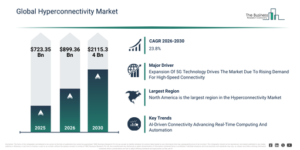
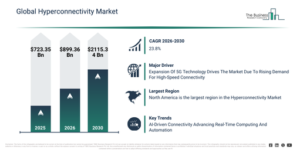
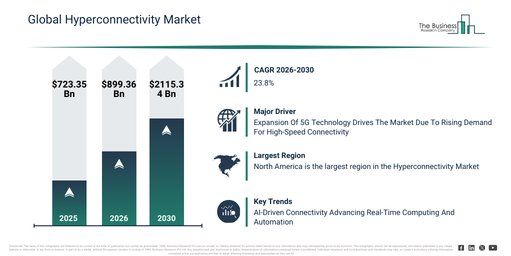
The hyperconnectivity market has seen significant expansion in its size over recent years. It is projected to grow from $723.35 billion in 2025 to $899.36 billion in 2026, demonstrating a compound annual growth rate (CAGR) of 24.3%. The historical increase can be ascribed to factors such as increased internet penetration, the expansion of mobile networks, initial cloud adoption, the proliferation of connected devices, and various digital transformation initiatives.
The hyperconnectivity market is projected to experience substantial expansion in the coming years. Its valuation is anticipated to reach $2115.34 billion by 2030, demonstrating a compound annual growth rate (CAGR) of 23.8%. This projected increase is largely due to the expanding reach of 5G and advanced connectivity, the widespread adoption of smart devices, the rise of AI-powered automation, a greater reliance on data for decision-making, and the need for uninterrupted digital experiences. Key developments expected during this period involve the establishment of continuously connected digital environments, networks facilitating real-time data exchange, integrated cross-platform systems, pervasive device connectivity, and network intelligence driven by automation.
Get Access To A Free Hyperconnectivity Market Report Sample:
The Key Driver Behind The Hyperconnectivity Market’s 23.8% CAGR
The growth of the hyperconnectivity market is anticipated to be driven by the emergence of 5G technology in the coming years. As the fifth-generation wireless network, 5G technology offers ultra-fast speeds, minimal latency, and extensive connectivity, thereby facilitating sophisticated applications. The increasing need for high-speed internet, fueled by the widespread adoption of smartphones, connected devices, and services that consume a lot of data, is speeding up the rollout of 5G networks. Hyperconnectivity supports 5G technology by enabling cutting-edge innovations like self-driving cars, remote healthcare, and industrial automation. For example, in May 2025, Telefonaktiebolaget LM Ericsson, a Sweden-based information and communication technology company, indicated that 5G adoption is expanding quickly, with subscriptions forecast to reach almost 2.9 billion by the close of 2025 and 6.3 billion worldwide by 2030. Thus, the advancement in 5G technology is propelling the expansion of the hyperconnectivity market.
Hyperconnectivity Market Classification: Main Segments And Detailed Subsegments
The hyperconnectivity market covered in this report is segmented –
1) By Product: Enterprise Wearable Devices, Middleware Software, Cloud Platforms, Business Solutions
2) By Component: Services, Software
3) By Connectivity Type: Internet Of Things (IoT), Cloud Computing, Fifth Generation (5G), Artificial Intelligence (AI), Augmented Reality (AR)
4) By Organizational Size: Large Enterprises, Small And Medium-Sized Enterprises
5) By Industry Vertical: Banking, Financial Services, And Insurance (BFSI), Healthcare And Life Sciences, Telecommunications And Information Technology, Government And Public Sector, Manufacturing, Consumer Goods And Retail, Media And Entertainment, Other Industry Verticals
Subsegments:
1) By Enterprise Wearable Devices: Smart Glasses, Smartwatches, Augmented Reality (AR)/Virtual Reality (VR) Headsets, Smart Clothing, Body Sensors
2) By Middleware Software: Application Programming Interface (API) Management Platforms, Internet of Things (IoT) Middleware, Cloud Integration Middleware, Artificial Intelligence (AI) and Analytics Middleware, Enterprise Service Bus (ESB)
3) By Cloud Platforms: Public Cloud, Private Cloud, Hybrid Cloud, Edge Computing Platforms, AI-As-A-Service
4) By Business Solutions: Unified Communication and Collaboration (UCC), Customer Relationship Management (CRM), Enterprise Resource Planning (ERP), Supply Chain Management (SCM), Cybersecurity Solutions
Hyperconnectivity Market Strategic Shifts: What Leading Players Are Prioritizing
Companies operating in the hyperconnectivity market are primarily focused on creating advanced solutions, including artificial intelligence (AI)-driven connectivity, to enhance AI-driven computing and streamline real-time data processing. AI-driven connectivity integrates artificial intelligence (AI) into communication networks and digital infrastructure to boost efficiency, automate various processes, and facilitate real-time decision-making. As an illustration, in January 2025, Advanced Micro Devices Inc., a US-based technology firm, unveiled new Ryzen AI Max, Ryzen AI 300, and Ryzen AI 200 Series processors, expanding its portfolio for consumer and commercial AI PCs. These processors leverage Zen 5 and Zen 4 architectures to deliver high-performance AI-enabled PCs, catering to premium thin-and-light notebooks, everyday productivity needs, and enterprise-grade systems with improved security and manageability through AMD PRO Technologies. AMD emphasized its leading position in AI computing, aspiring to bring workstation-level capabilities to lightweight laptops for both individual consumers and business professionals.
Hyperconnectivity Market Company Analysis: Major Industry Participants
Major companies operating in the hyperconnectivity market are Microsoft Corporation, Samsung Electronics Co. Ltd., Meta Platforms Inc., Siemens AG, International Business Machines Corporation, Oracle Corporation, Telefonica S.A., Broadcom Inc., Fujitsu Limited, Tata Consultancy Services, Nokia Corporation, CommScope Holding Company Inc., Syensqo, Zoom Communications, NTT Docomo, Avaya Holdings Corp., Extreme Networks, CoreSite, Hanwha Systems, Orange Business.
Get Full Access To The Hyperconnectivity Market Report 2026:
Hyperconnectivity Market Global Regional Breakdown: Key Regions Analyzed
North America was the largest region in the hyperconnectivity market in 2025. Asia-Pacific is expected to be the fastest-growing region in the forecast period. The regions covered in the hyperconnectivity market report are Asia-Pacific, South East Asia, Western Europe, Eastern Europe, North America, South America, Middle East, Africa.
Reach Out To Our Team:
The Business Research Company: https://www.thebusinessresearchcompany.com/
Americas: +1 310-496-7795
Asia: +44 7882 955267 & +91 8897263534
Europe: +44 7882 955267
Email us at: marketing@tbrc.info
Follow us on:
LinkedIn: https://in.linkedin.com/company/the-business-research-company
YouTube: https://www.youtube.com/channel/UC24_fI0rV8cR5DxlCpgmyFQ
Global Market Model: https://www.thebusinessresearchcompany.com/global-market-model

Wasay has over a decade of experience in market research, data modelling, and analytics, with prior experience at GlobalData and Decision Tree Consulting Services. At The Business Research Company , he leads research operations across syndicated studies, customized consulting engagements, and the Global Market Model platform. His professional experience includes supporting organizations such as Boston Consulting Group, KPMG, and Ernst & Young. Wasay holds a degree in Electronics and Communications Engineering, postgraduate management qualifications from International Management Institute Belgium and Indian School of Business and Entrepreneurship, and completed the Integrated Program in Business Analytics from Indian Institute of Management Indore.