The Business Research Company’s 2026 market reports are designed to deliver research that is more actionable and strategically valuable. Key offerings include market attractiveness scoring, total addressable market sizing, company benchmarking matrices, interactive Excel dashboards, deeper supply chain intelligence, emerging startup tracking, and granular product-level insights.
Generative Artificial Intelligence (AI) in Logistics Market Revenue Projected To Rise To $3.25 Billion By 2030
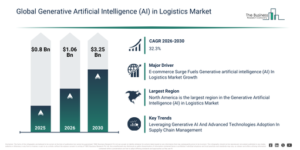
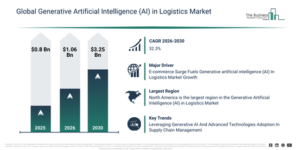
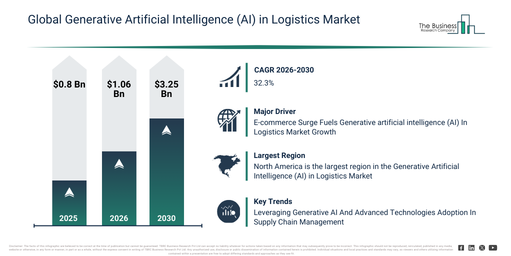
The market size for generative artificial intelligence (AI) in logistics has seen rapid expansion over recent years. It is projected to expand from $0.8 billion in 2025 to $1.06 billion in 2026, at a compound annual growth rate (CAGR) of 32.6%. This historical growth can be attributed to factors such as the expansion of e-commerce and logistics demand, the adoption of warehouse management systems, the early application of predictive analytics in transportation, rising investment in fleet management, and the broadening of supply chain automation.
The generative artificial intelligence (AI) in logistics market is projected for substantial expansion over the coming years, reaching $3.25 billion in 2030 at a compound annual growth rate (CAGR) of 32.3%. This anticipated growth is attributed to several factors, including the integration of generative AI for real-time logistics decision-making, the expansion of AI-enabled predictive maintenance for fleets, the adoption of advanced route simulation tools, the increased use of hybrid and edge AI models, and the growth of AI-powered customer service operations in logistics. Key trends during this period encompass AI-powered route optimization, predictive demand forecasting, inventory management automation, sophisticated supply chain analytics solutions, and last-mile delivery optimization.
Want Deeper Generative Artificial Intelligence (AI) in Logistics Market Insights? Get A Free Sample Report:
Primary Growth Driver Shaping The Generative Artificial Intelligence (AI) in Logistics Market Outlook
The future expansion of the generative artificial intelligence (AI) in logistics market is anticipated to be fueled by increasing e-commerce sales. E-commerce continues to gain traction, largely attributable to its convenience, diverse product offerings, and the expanding adoption of digital tools. Within e-commerce logistics, generative AI improves inventory control, refines route optimization, and accurately forecasts demand, leading to greater operational efficiency and reduced costs. As an illustration, a report released in May 2024 by the US-based Census Bureau of the Department of Commerce indicated that e-commerce sales hit approximately $1,118.7 billion in 2023. Moreover, total retail sales for the first quarter of 2024 were estimated to be $1,820.0 billion. During this specific quarter, e-commerce sales experienced an 8.5% increase (±1.1%) compared to the corresponding quarter in 2023, whereas overall retail sales expanded by 2.8% (±0.5%). Consequently, the surge in e-commerce sales is a key factor propelling the expansion of the generative artificial intelligence (AI) in logistics market.
Generative Artificial Intelligence (AI) in Logistics Market Structure: A Detailed Look At Segments And Subsegments
The generative artificial intelligence (AI) in logistics market covered in this report is segmented –
1) By Type: Variational Autoencoder (VAE), Generative Adversarial Networks (GANs), Recurrent Neural Networks (RNNs), Long Short-Term Memory (LSTM) Networks, Other Types
2) By Component: Software, Solution
3) By Deployment Mode: On-Premises, Cloud-Based
4) By Application: Warehouse Management, Route Optimization, Inventory Management, Supply Chain Analytics, Last-Mile Delivery Optimization, Customer Service Operations, Other Applications
5) By End-User: Retail, Healthcare, Aerospace, Telecommunication, Technology, Other End-Users
Subsegments:
1) By Variational Autoencoder (VAE): Demand Forecasting Models, Anomaly Detection In Logistics Operations, Predictive Maintenance For Fleet Management, Data Imputation For Incomplete Records, Supply Chain Optimization Solutions
2) By Generative Adversarial Networks (GANs): Synthetic Data Generation For Training Models, Route Optimization And Simulation, Image Generation For Inventory And Asset Management, Fraud Detection In Shipment And Delivery, Product Demand Forecasting Through Scenario Simulation
3) By Recurrent Neural Networks (RNNs): Time Series Analysis For Demand Prediction, Shipment Tracking And Forecasting, Customer Behavior Prediction For Delivery Services, Inventory Management Forecasting, Delivery Time Estimation Models
4) By Long Short-Term Memory (LSTM) Networks: Advanced Time Series Forecasting, Predictive Analytics For Supply Chain Performance, Transportation Optimization Models, Order Fulfillment Prediction, Capacity Planning And Resource Allocation
5) By Other Types: Reinforcement Learning For Route Optimization, Hybrid Models Combining Multiple AI Approaches, Flow-Based Models For Real-Time Data Analysis, Self-Supervised Learning Techniques, Edge AI For On-Site Decision Making
Generative Artificial Intelligence (AI) in Logistics Market Innovation And Strategy Trends Among Leading Companies
Leading companies in the generative artificial intelligence (AI) in logistics market are concentrating on adopting advanced technologies, such as natural language interfaces, to improve operational efficiency and enhance accuracy in supply chain management. A natural language interface is defined as a system that enables users to interact with supply chain management software or tools using everyday language, making it simpler to query data, generate reports, and manage operations without needing specialized technical knowledge. For instance, in September 2023, FourKites, Inc., a US-based supply chain visibility and logistics technology company, launched FinAI, a generative AI tool designed to enhance supply chain management. FinAI utilizes a natural language interface to uncover insights, automate tasks, and optimize operations by analyzing extensive data, including 3 million shipments daily, 18 million estimated times of arrival (ETAs), and 62 billion miles tracked annually.
Top Companies Competing In The Generative Artificial Intelligence (AI) in Logistics Market
Major companies operating in the generative artificial intelligence (AI) in logistics market are Microsoft Corporation, Amazon Web Services Inc., Intel Corporation, Accenture plc, International Business Machines Corporation, Oracle Corporation, Honeywell International Inc., SAP SE, NVIDIA Corporation, Cognizant Technology Solutions Corporation, Epicor Software Corporation, Blue Yonder Group Inc., Coupa Software Incorporated, Kinaxis Inc., ShipBob Inc., Project44 Inc., Vorto Inc., Logility Inc., FourKites Inc., Shippeo SAS, Freightos Ltd., Slync.io Inc., Locus.sh, ClearMetal Inc.
View The Complete Generative Artificial Intelligence (AI) in Logistics Market Study With Segment And Regional Data:
Generative Artificial Intelligence (AI) in Logistics Market Regional Outlook Across Major Geographies
North America was the largest region in the generative artificial intelligence (AI) in logistics market in 2025. Asia-Pacific is expected to be the fastest-growing region in the forecast period. The regions covered in the generative artificial intelligence (AI) in logistics market report are Asia-Pacific, South East Asia, Western Europe, Eastern Europe, North America, South America, Middle East, Africa.
Reach Out To Our Team:
The Business Research Company: https://www.thebusinessresearchcompany.com/
Americas: +1 310-496-7795
Asia: +44 7882 955267 & +91 8897263534
Europe: +44 7882 955267
Email us at: marketing@tbrc.info
Follow us on:
LinkedIn: https://in.linkedin.com/company/the-business-research-company
YouTube: https://www.youtube.com/channel/UC24_fI0rV8cR5DxlCpgmyFQ
Global Market Model: https://www.thebusinessresearchcompany.com/global-market-model

Wasay has over a decade of experience in market research, data modelling, and analytics, with prior experience at GlobalData and Decision Tree Consulting Services. At The Business Research Company , he leads research operations across syndicated studies, customized consulting engagements, and the Global Market Model platform. His professional experience includes supporting organizations such as Boston Consulting Group, KPMG, and Ernst & Young. Wasay holds a degree in Electronics and Communications Engineering, postgraduate management qualifications from International Management Institute Belgium and Indian School of Business and Entrepreneurship, and completed the Integrated Program in Business Analytics from Indian Institute of Management Indore.