Designed to make market research more actionable and strategically valuable, The Business Research Company’s 2026 market reports feature market attractiveness scoring, total addressable market sizing, company benchmarking matrices, interactive Excel dashboards, deeper supply chain intelligence, emerging startup tracking, and granular product-level insights.
What Is The Projected CAGR Of The Generative Artificial Intelligence (AI) In Material Science Market Through 2030?
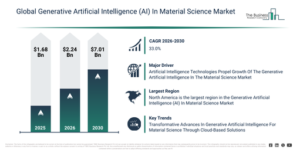
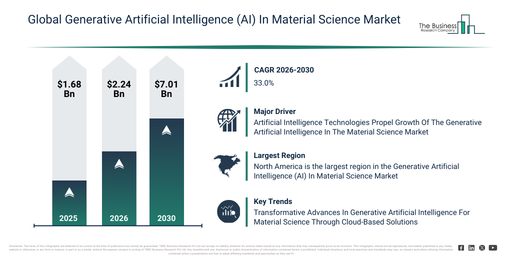
The market for generative artificial intelligence (AI) in material science has experienced substantial exponential growth in recent years. This sector is projected to expand from $1.68 billion in 2025 to $2.24 billion in 2026, demonstrating a compound annual growth rate (CAGR) of 33.6%. Historically, this growth has been driven by several factors, including the imperative for faster material development, the high cost of traditional experimentation, the advancement of computational chemistry, increasing demand for high-performance materials, and significant industrial research and development investments.
The generative artificial intelligence (AI) in material science market is projected to experience substantial expansion over the upcoming years, with its size expected to reach $7.01 billion in 2030, demonstrating a compound annual growth rate (CAGR) of 33.0%. This anticipated expansion throughout the forecast period stems from factors such as the accelerated pace of AI-driven discovery, increasing demand for sustainable materials, the integration of digital twin technology, the broader adoption of advanced manufacturing techniques, and the proliferation of cloud-based simulation platforms. Key trends identified for this period encompass AI-driven materials discovery, predictive modeling of material properties, simulation-based material design, AI-enhanced process optimization, and the advancement of sustainable material innovation.
Claim Your Free Generative Artificial Intelligence (AI) In Material Science Market Sample Report With Key Data And Trends:
Generative Artificial Intelligence (AI) In Material Science Market Demand Analysis: The Driving Force Behind Expansion
The generative artificial intelligence in material science market is expected to expand going forward, driven by increasing investment in artificial intelligence technologies. This surge in AI investment is attributed to several factors, including growing demand for automation, enhanced data analytics, the emergence of innovative applications, and strong support from both government and private sectors. Generative AI within material science plays a crucial role in accelerating discovery and innovation by optimizing material properties and processes, which in turn stimulates significant investment in artificial intelligence technologies. For example, in September 2025, the Department for Science, Innovation & Technology, a UK-based government department, indicated that AI-related inward investment into the UK saw growth in 2024, with 51 projects attracting over £15 billion in capital and anticipated to generate more than 6,500 jobs. Thus, the escalating investment in artificial intelligence technologies is a key driver for the growth of the generative artificial intelligence in material science market.
Breaking Down The Generative Artificial Intelligence (AI) In Material Science Market By Segment
The generative artificial intelligence (AI) in material science market covered in this report is segmented –
1) By Type: Materials Discovery And Design, Predictive Modeling And Simulation, Process Optimization
2) By Deployment: Cloud-Based, On-Premises, Hybrid
3) By Application: Pharmaceuticals And Chemicals, Electronics And Semiconductors, Energy Storage And Conversion, Automotive And Aerospace, Construction And Infrastructure, Consumer Goods, Other Applications
Subsegments:
1) By Materials Discovery And Design: AI-Driven Materials Screening, AI-Based Computational Chemistry, Quantum Materials Design, Material Property Prediction
2) By Predictive Modeling And Simulation: AI-Based Simulation For Material Behavior, Predictive Analytics For Material Performance, Failure Prediction And Reliability Analysis, Thermal And Mechanical Property Simulation
3) By Process Optimization: AI For Manufacturing Process Optimization, Energy Efficiency In Material Processing, AI-Driven Quality Control In Material Production, Supply Chain Optimization For Materials
Top Trend Influencing The Generative Artificial Intelligence (AI) In Material Science Market Outlook
Major companies operating in the generative artificial intelligence in material science market are actively pursuing advanced solutions, such as accelerated generative artificial intelligence (AI) models for drug discovery, to enhance the pace of drug discovery and life sciences research through sophisticated generative AI tools. These accelerated generative AI models for drug discovery are cutting-edge computational frameworks that leverage machine learning algorithms to rapidly and effectively formulate and forecast potential new pharmaceutical compounds. For instance, in March 2023, Nvidia Corporation, a US-based computer hardware manufacturing company, introduced its BioNeMo Cloud Service. This service incorporates pre-trained and customizable generative AI models for drug discovery, including AlphaFold2 and MoFlow, which expedite molecular design and optimization processes. The significance of these innovations is evident in their capacity to substantially diminish the duration and expenses associated with research and development in drug discovery and life sciences, thereby facilitating quicker identification and development of novel therapeutic candidates and materials.
Generative Artificial Intelligence (AI) In Material Science Market Competitive Landscape And Major Players
Major companies operating in the generative artificial intelligence (AI) in material science market are Microsoft Corporation, Siemens AG, International Business Machines Corporation IBM, NVIDIA Corporation, Hexagon AB, ANSYS Inc., DeepMind Technologies Limited, Altair Engineering Inc., OpenAI, Schrödinger Inc., XtalPi, Alchemy Insights Inc., Citrine Informatics Inc., QuesTek Innovations LLC, Materials Zone, Kebotix Inc., Nanotronics Imaging Inc., AION Labs, Exabyte io, DeepMatter Group Plc, Orbital Materials, PostEra, Polymerize, Quantum Motion, NNAISENSE, Dassault Systèmes BIOVIA, Turbine ai, NobleAI, Newfound Materials Inc, Osium AI, KoBold Metals, Albert Invent
Read The Full Generative Artificial Intelligence (AI) In Material Science Market Report By The Business Research Company:
Where Is The Generative Artificial Intelligence (AI) In Material Science Market Largest? Key Regional Insights
North America was the largest region in the generative artificial intelligence in material science market in 2025. Asia-Pacific is expected to be the fastest-growing region in the forecast period. The regions covered in the generative artificial intelligence (AI) in material science market report are Asia-Pacific, South East Asia, Western Europe, Eastern Europe, North America, South America, Middle East, Africa.
Reach Out To Our Team:
The Business Research Company: https://www.thebusinessresearchcompany.com/
Americas: +1 310-496-7795
Asia: +44 7882 955267 & +91 8897263534
Europe: +44 7882 955267
Email us at: marketing@tbrc.info
Follow us on:
LinkedIn: https://in.linkedin.com/company/the-business-research-company
YouTube: https://www.youtube.com/channel/UC24_fI0rV8cR5DxlCpgmyFQ
Global Market Model: https://www.thebusinessresearchcompany.com/global-market-model

Wasay has over a decade of experience in market research, data modelling, and analytics, with prior experience at GlobalData and Decision Tree Consulting Services. At The Business Research Company , he leads research operations across syndicated studies, customized consulting engagements, and the Global Market Model platform. His professional experience includes supporting organizations such as Boston Consulting Group, KPMG, and Ernst & Young. Wasay holds a degree in Electronics and Communications Engineering, postgraduate management qualifications from International Management Institute Belgium and Indian School of Business and Entrepreneurship, and completed the Integrated Program in Business Analytics from Indian Institute of Management Indore.