Backed by market attractiveness analysis, total addressable market sizing, company benchmarking matrices, interactive Excel dashboards, wider supply chain intelligence, emerging startup coverage, and detailed product-level insights, The Business Research Company’s 2026 market reports are designed to offer research that is more actionable and strategically valuable than ever.
Non-Lethal Biochemical Weapons Market Size Forecast: How Big Could The Market Get By 2030?
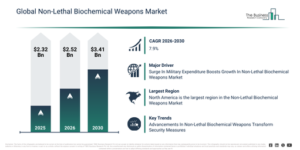
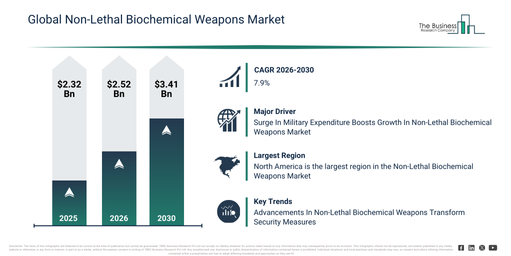
The non-lethal biochemical weapons market has experienced robust expansion over recent years. Projections indicate its size will increase from $2.32 billion in 2025 to $2.52 billion in 2026, demonstrating a compound annual growth rate (CAGR) of 8.9%. Historically, this growth is linked to factors such as a heightened demand for incapacitating systems aiding crowd control and peacekeeping missions, the initial creation of scent-based agents intended to neutralize hostile individuals without inflicting harm, the uptake of acoustic deterrent technologies by military and law enforcement bodies, an escalating requirement for non-lethal alternatives to reduce incidental damage in metropolitan areas, and an increase in research concerning biochemical processes that facilitate temporary incapacitation.
The non-lethal biochemical weapons market size is anticipated to undergo significant expansion over the next few years. It is projected to reach $3.41 billion by 2030, demonstrating a compound annual growth rate (CAGR) of 7.9%. This forecasted growth can be attributed to increased investment in advanced non-lethal technologies that enhance precision and controllability, the growing adoption of directed acoustic systems for perimeter security and area denial, a rising need for scalable non-lethal solutions in asymmetric and humanitarian missions, the development of next-generation biochemical formulations offering improved safety and effectiveness, and the expanding integration of non-lethal capabilities into military and law enforcement modernization programs. Significant trends during this period include the growth in scent-based (olfactory) crowd-management technologies, an increase in the deployment of acoustic and directed-energy deterrent systems for perimeter security, the integration of sensors and telemetry for remote monitoring and effect control, a demand for modular, non-lethal payloads for unmanned platforms (UAV/UGV integration), and an emphasis on legal compliance, humane-use features, and traceability in product design.
Get A Free Sample Report With In-Depth Market Insights:
Non-Lethal Biochemical Weapons Market Growth Momentum: What Factors Are Shaping Demand?
The non-lethal biochemical weapons market is anticipated to expand due to rising military expenditure. This expenditure encompasses funds allocated for weaponry, weapon systems, operational activities, upkeep, personnel, and other specialized military equipment. Government investment in the military is vital for fostering advancements across various segments of the defense market, including non-lethal biochemical weapons. For example, in October 2025, the UK Parliament’s House of Commons Library, a UK government administration, reported that the defense spending detailed in the 2025 Spending Review is projected to be USD 83.3 billion (£62.2 billion) in 2025/26. This figure is expected to climb to USD 98.2 billion (£73.5 billion) by 2028/29, indicating an annual average real-terms growth rate of 3.8% throughout this period. Consequently, heightened military spending is a key factor propelling the non-lethal biochemical weapons market.
Non-Lethal Biochemical Weapons Market Segment Analysis And Revenue Potential
The non-lethal biochemical weapons market covered in this report is segmented –
1) By Product Type: Directed Energy, Direct Contact
2) By Operation Type: Defensive, Offensive
3) By End User: Military Forces, Law Enforcement Agencies
Subsegments:
1) By Directed Energy: Laser Weapons, Microwave Weapons, Acoustic Weapons
2) By Direct Contact: Chemical Agents, Riot Control Agents
Non-Lethal Biochemical Weapons Market Trends Redefining Industry Growth
Leading companies within the non-lethal biochemical weapons market are emphasizing the launch of non-lethal pepper bullet guns to improve crowd control measures and provide law enforcement with more secure methods for subduing individuals. A non-lethal pepper bullet gun is a type of firearm or launcher engineered to deploy projectiles filled with a pepper-based irritant, such as oleoresin capsicum (OC), which is derived from hot peppers. As an illustration, in March 2023, Guard Dog Security, a US-based Company, introduced a non-lethal pepper bullet gun. This system can accurately deliver projectiles up to 150 feet, allowing users to maintain a safe distance from potential threats. The non-lethal gun is designed to fire multiple rounds without frequent reloading, thereby enhancing its effectiveness in dynamic situations. It is equipped with a quick puncture CO2 system, enabling rapid firing and easy reloading, which ensures users can respond promptly to incidents.
Non-Lethal Biochemical Weapons Market Key Players Shaping Industry Direction
Major companies operating in the non-lethal biochemical weapons market are Lamperd Less Lethal Inc., BAE Systems Inc., QinetiqGroup Inc., General Dynamics Corporation, Raytheon Company, Chemring Group plc, Textron Systems Corp., ALS Less-Lethal Systems Inc., ASP Inc., Combined Systems Inc., Condor Non-Lethal Technologies, ISPRA by Ei Ltd., Rheinmentall AG, Safariland LLC, Zarc International Inc., Genasys Inc., Axon Enterprise Inc., Bruzer Less Lethal, PACEM Solutions International, Mace Security International Inc., Fabrique Nationale Herstal, Mission Less Lethal Technologies, NonLethal Technologies Inc., Herstal SA, PepperBall Technologies Inc., AMTEC Less-Lethal Systems Inc., Byrna Technologies Inc., UTS United Tactical Systems LLC, Fiocchi Munizioni S.p.A., RUAG International Holding Ltd.
View The Full Non-Lethal Biochemical Weapons Market Report:
Non-Lethal Biochemical Weapons Market Largest Region: Which Geography Holds The Highest Market Share?
North America was the largest region in the non-lethal biochemical weapons market in 2025. The regions covered in the non-lethal biochemical weapons market report are Asia-Pacific, South East Asia, Western Europe, Eastern Europe, North America, South America, Middle East, Africa.
Reach Out To Our Team:
The Business Research Company: https://www.thebusinessresearchcompany.com/
Americas: +1 310-496-7795
Asia: +44 7882 955267 & +91 8897263534
Europe: +44 7882 955267
Email us at: marketing@tbrc.info
Follow us on:
LinkedIn: https://in.linkedin.com/company/the-business-research-company
YouTube: https://www.youtube.com/channel/UC24_fI0rV8cR5DxlCpgmyFQ
Global Market Model: https://www.thebusinessresearchcompany.com/global-market-model

Wasay has over a decade of experience in market research, data modelling, and analytics, with prior experience at GlobalData and Decision Tree Consulting Services. At The Business Research Company , he leads research operations across syndicated studies, customized consulting engagements, and the Global Market Model platform. His professional experience includes supporting organizations such as Boston Consulting Group, KPMG, and Ernst & Young. Wasay holds a degree in Electronics and Communications Engineering, postgraduate management qualifications from International Management Institute Belgium and Indian School of Business and Entrepreneurship, and completed the Integrated Program in Business Analytics from Indian Institute of Management Indore.