
Featuring market attractiveness scoring, total addressable market sizing, company benchmarking matrices, interactive Excel dashboards, deeper supply chain intelligence, emerging startup tracking, and granular product-level insights, The Business Research Company’s 2026 market reports are built to deliver research that is both more actionable and more strategically valuable.
Non-Ferrous Metal Recycling Market Revenue Outlook: What CAGR Lies Ahead Through 2030?
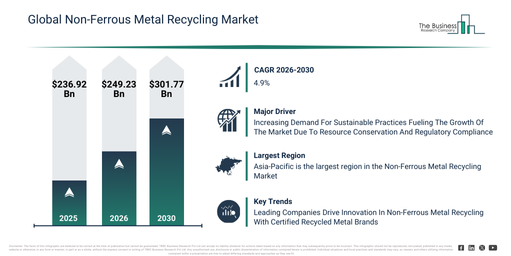
The non-ferrous metal recycling market size has exhibited substantial growth over the past few years. This market is projected to expand from $236.92 billion in 2025 to $249.23 billion in 2026, demonstrating a compound annual growth rate (CAGR) of 5.2%. The historic expansion of this market can be linked to several factors, including the rising industrial need for recycled non-ferrous metals like aluminum and copper, enhanced scrap collection and processing capacities that boost recycling output, the increasing embrace of recycling as a method to lower energy consumption compared to producing metals from virgin materials, the expansion of the automotive and construction industries which fuels the demand for recycled metal products, and improvements in sorting and separation technologies that enhance recovery efficiency.
The non-ferrous metal recycling market is projected to experience consistent expansion over the upcoming years. By 2030, its value is anticipated to reach $301.77 billion, growing at a compound annual growth rate (CAGR) of 4.9%. This projected growth can be linked to several factors during the forecast timeframe, including an increased focus on circular economy principles promoting greater recycling, an escalating need for high-purity recycled metals within the electronics and renewable energy industries, the broadening of urban mining efforts to retrieve valuable non-ferrous components from waste, enhanced investment in automated and AI-powered recycling technologies, and intensified regulatory demands to lower carbon emissions, which in turn drives the uptake of recycled non-ferrous metals. Key developments expected during this period involve an increase in scrap retrieval from discarded vehicles and consumer electronics, the proliferation of specialized non-ferrous sorting and pre-processing sites, a move towards higher-purity recycled metal grades to satisfy more stringent quality standards, expanding vertical integration among scrap collectors, recyclers, and metal manufacturers, and the diversification of regional scrap sourcing to mitigate fluctuations in supply and pricing.
Get A Free Sample Report With In-Depth Market Insights:
Non-Ferrous Metal Recycling Market Expansion Drivers: What’s Shaping Future Growth?
The rising requirement for sustainable methods is anticipated to drive expansion in the non-ferrous metal recycling market moving forward. Sustainable practices refer to strategies that achieve equilibrium between economic development, environmental preservation, and societal welfare, ensuring the responsible utilization and future conservation of resources. This surge in demand for sustainable approaches stems from more stringent government regulations and policies, which mandate adherence and foster responsible management of resources. Non-ferrous metal recycling improves sustainable practices by preserving natural resources and lowering energy usage, rendering it vital for environmentally conscious manufacturing and waste management. Furthermore, it reduces environmental harm through decreased emissions and less waste sent to landfills, thereby supporting a circular economy. As an illustration, a survey conducted in April 2024 by PDI Technologies, a US-based software solutions firm, involving more than 1,200 US consumers, revealed that 80% expressed interest in purchasing sustainable products. This marks a notable rise from 66% in 2022 and 68% in 2023. Consequently, the expanding demand for sustainable practices is a key factor propelling the growth of the non-ferrous metal recycling market.
Non-Ferrous Metal Recycling Market Segmentation And Category Overview
The non-ferrous metal recycling market covered in this report is segmented –
1) By Recycling Process Type: Mechanical Recycling, Pyrometallurgical Recycling, Hydrometallurgical Recycling, Biotechnology-Based Recycling
2) By Type Of Non-Ferrous Metal: Copper, Aluminum, Lead, Zinc, Nickel, Graphite, Precious Metals
3) By Source Of Scrap Material: Industrial Scrap, End-Of-Life Vehicles, Construction And Demolition Debris, Consumer Electronics, Household Appliances
4) By End-Use Industry: Automotive, Building And Construction, Electrical And Electronics, Industrial Machinery, Other End Users
Subsegments:
1) By Mechanical Recycling, Shredding, Sorting, Baling, Dismantling
2) By Pyrometallurgical Recycling, Smelting, Refining, Incineration, Thermal Treatment
3) By Hydrometallurgical Recycling, Leaching, Solvent Extraction, Precipitation, Electro-Winning
4) By Biotechnology-Based Recycling, Bioleaching, Biosorption, Bioprecipitation, Enzymatic Treatment
Non-Ferrous Metal Recycling Market Strategic Trends: What Defines The Next Growth Phase?
Leading companies operating in the non-ferrous metal recycling market are focusing on developing innovative products, such as recycled metal, to enhance product trustworthiness, fulfill regulatory requirements, and appeal to environmentally conscious consumers. Recycled metal refers to material recovered from used products, scrap, or industrial waste, which is then reprocessed for manufacturing reuse. This category encompasses both ferrous metals (like steel and iron) and non-ferrous metals (such as aluminum, copper, and brass). For instance, in January 2024, Mitsubishi Materials Corporation, a Japan-based cement manufacturing company, launched REMINE. This recycled metal brand specifies and certifies the recycled content in non-ferrous metal products, including refined tin and lead. This initiative bolsters transparency, traceability, and sustainability by adhering to certified environmental labeling and employing advanced recycling technologies.
Non-Ferrous Metal Recycling Market Competitive Analysis Of Leading Industry Participants
Major companies operating in the non-ferrous metal recycling market are Aurubis Aktiengesellschaft, Gerdau North America Corporation, Novelis Inc., Dowa Holdings Co. Ltd., Sims Limited, Chiho Environmental Group Limited, OmniSource Corporation, Alter Trading Corporation, SA Recycling Limited Liability Company, Triple M Metal LP, Harmony Enterprises Inc., MS Enterprises, STEINERT GmbH, Quest Resource Management Group LLC, Jansen Recycling Group B.V., Jain Metal Group, ASM Recycling Inc., Aruhya Enterprises, Stena Metall Aktiebolag, GLE Scrap Metal Inc.
View The Full Non-Ferrous Metal Recycling Market Report:
Non-Ferrous Metal Recycling Market Regional Analysis: Which Region Leads By Revenue?
Asia-Pacific was the largest region in the non-ferrous metal recycling market in 2025. North America is expected to be the fastest-growing region in the forecast period. The regions covered in the non-ferrous metal recycling market report are Asia-Pacific, South East Asia, Western Europe, Eastern Europe, North America, South America, Middle East, Africa.
Reach Out To Our Team:
The Business Research Company: https://www.thebusinessresearchcompany.com/
Americas: +1 310-496-7795
Asia: +44 7882 955267 & +91 8897263534
Europe: +44 7882 955267
Email us at: marketing@tbrc.info
Follow us on:
LinkedIn: https://in.linkedin.com/company/the-business-research-company
YouTube: https://www.youtube.com/channel/UC24_fI0rV8cR5DxlCpgmyFQ
Global Market Model: https://www.thebusinessresearchcompany.com/global-market-model

Wasay has over a decade of experience in market research, data modelling, and analytics, with prior experience at GlobalData and Decision Tree Consulting Services. At The Business Research Company , he leads research operations across syndicated studies, customized consulting engagements, and the Global Market Model platform. His professional experience includes supporting organizations such as Boston Consulting Group, KPMG, and Ernst & Young. Wasay holds a degree in Electronics and Communications Engineering, postgraduate management qualifications from International Management Institute Belgium and Indian School of Business and Entrepreneurship, and completed the Integrated Program in Business Analytics from Indian Institute of Management Indore.

